Sales Plan: How to Build, Calculate and Hit It — an Example and a Free Template
Sales13 min read
How to build a sales plan: types, calculation methods from revenue to requests, an example by manager, tracking progress, 7 mistakes and a free Excel template.

A sales plan is a concrete target for revenue or number of deals over a set period, broken down by manager, product and week.
It's built by calculating backwards: from the desired revenue through the average bill to the number of deals, and through conversion to the number of requests you need to receive.
For a plan to work, the numbers are checked against past results and seasonality, and progress is tracked every week.
What a sales plan is
A sales plan is a document or spreadsheet that records how much the company must sell over a period, through which channels and with which people.
A sales plan answers four questions: how much (revenue, deals), when (month, week), who (managers, branches) and from what (requests, repeat sales, average bill).
It's important not to confuse a plan with a forecast.
A sales forecast shows how much the company will sell if everything stays as it is. A plan is a target the company deliberately moves towards and allocates resources to: advertising, people, time.
Why you need a sales plan
While the company has one seller — the owner — you can do without a formal target. As soon as a second and third manager appear, without a shared number you lose sight of who drives revenue and who is just busy chatting. A plan solves four practical tasks:
- Financial stability. If the target is below the cost of salaries, rent and advertising, you see it in advance, not at the end of the quarter.
- Marketing. Knowing conversion, it's easy to see how many requests you need and whether the current budget for advertising and platforms like Avito is enough.
- Team management. One employee falling behind in week two can still be fixed; in week four it can't.
- Motivation. A clear number and a transparent calculation turn the abstract "we need to sell more" into a concrete task.
Types of sales plan
| Type | What it measures | Who it suits |
|---|---|---|
| By revenue | Total payments for the period, ₽ | Almost everyone |
| By number of deals | Number of closed sales | Services with similar bills |
| By manager | Each employee's personal target | Teams of two or more |
| By product and line of business | Revenue by service or category | Companies with several lines |
| By channel | Sales from the website, Avito, messengers, repeat clients | Those investing in several sources |
| By activity | Calls, meetings, viewings, measurements | New employees on probation |
By timeframe, plans are annual (strategy and budget), quarterly (seasonality and big projects), monthly (the team's main working target) and weekly (checkpoints). For most companies the best combination is an annual benchmark for the owner and a monthly target broken down by week for the team.
Which metrics to include in the plan
- Revenue — the main bottom-line metric.
- Number of requests — how many enquiries will come from all channels: messengers, website, marketplaces, calls.
- Conversion — the share of requests that turn into payment. More on calculating it by stage in our article on the sales funnel.
- Average bill — revenue divided by the number of deals.
- Share of repeat sales — how much revenue regular clients bring in.
- Margin — so hitting the plan doesn't mean selling at a loss because of discounts.
4 methods for building a sales plan
1. Top-down
The owner sets the overall target based on the company's financial goals: covering costs, reaching the required profit, funding growth. The number is then distributed across departments and managers.
Pro — the plan is linked to strategy. Con — without checking against real data, the target often turns out to be unachievable.
2. Bottom-up
Each manager estimates how much they can sell based on their base and pipeline. The numbers add up to the overall plan.
Pro — the team believes in the target. Con — employees tend to lowball estimates to make sure they hit the plan.
3. By funnel (calculating backwards)
The most accurate method. Go from money to requests:
- The revenue we want — for example, 1,200,000 ₽.
- Average bill — 40,000 ₽. So you need 1,200,000 / 40,000 = 30 deals.
- Request-to-deal conversion — 15%. So you need 30 / 0.15 = 200 requests.
If 140 enquiries came in last month, it's immediately clear: without extra advertising, work with the old base or higher conversion, the target won't be met. The calculation shows the bottleneck before the month even starts.
4. From past periods
Take the results of the same month last year and the last 3–6 months, then adjust for seasonality and planned changes: new advertising, a new employee, a price increase. This method is good as a check on the first three.
In practice, a combination works best: a top-down target, checked against the funnel and past data, discussed with the team.
How to build a sales plan: 7 steps
Step 1. Gather data
Revenue, number of deals and requests for at least 6–12 months. If records were kept in a notebook or messengers, reconstruct at least the last three months — without this base, any number is pulled out of thin air. How to put your base in order is covered in our article on client tracking.
Step 2. Account for seasonality
Most niches have peaks and troughs: renovation in summer, travel before holidays, education in September. Compare the same months in previous years. The "+10% every month" mistake means the team is guaranteed to miss the target in the low season and lose motivation.
Step 3. Calculate the target by funnel
Revenue → average bill → deals → conversion → requests. Check where resources fall short.
Step 4. Identify the sources
How many requests will come from advertising, Avito, the website and referrals, and how much revenue from repeat clients. Repeat sales are almost never included, even though they're the cheapest source of money.
Step 5. Distribute the target among managers
Don't split the total equally. Take experience, workload and past months' results into account. A newcomer's first-month target is 50–70% of an experienced colleague's.
Step 6. Break the month into weeks
If less than 40% is done by the middle of the period, that's a signal — not a reason to wait for a "final push".
Step 7. Discuss the numbers with the team
A plan a manager considers unrealistic doesn't work. Show the calculation: how many requests will come in, what the conversion is, what the average bill is. When the logic is clear, people argue about specific numbers, not about "why bother".
Example sales plan by manager
An apartment renovation company with three managers: the October target is 1,200,000 ₽, the average bill 40,000 ₽ and conversion 15%.
| Manager | Target, ₽ | Deals | Requests needed | Week 1 | Week 2 | Week 3 | Week 4 |
|---|---|---|---|---|---|---|---|
| Anna (experienced) | 520,000 | 13 | 87 | 130,000 | 130,000 | 130,000 | 130,000 |
| Igor | 440,000 | 11 | 73 | 110,000 | 110,000 | 110,000 | 110,000 |
| Olga (newcomer) | 240,000 | 6 | 40 | 60,000 | 60,000 | 60,000 | 60,000 |
| Total | 1,200,000 | 30 | 200 | 300,000 | 300,000 | 300,000 | 300,000 |
You'll find the same table with formulas in the template: change the revenue, average bill and conversion, and the rest calculates itself; on the second sheet you can track actuals by week.

Download the sales plan template (Excel)
Plan specifics for different types of business
Services: salons, clinics, renovation
The main unit is a booking or a measurement. Calculate how many bookings you need at average specialist or crew utilisation, and include repeat visits: in salons and clinics they bring up to half of revenue. Plan evening and weekend enquiries as a separate line — services get a lot of them.
Retail and online stores
Targets are easier to set by revenue and number of orders, with the average bill split by product category. Account for marketplace promotions and holiday peaks: in retail, December and March often bring 15–20% of annual revenue each.
B2B sales
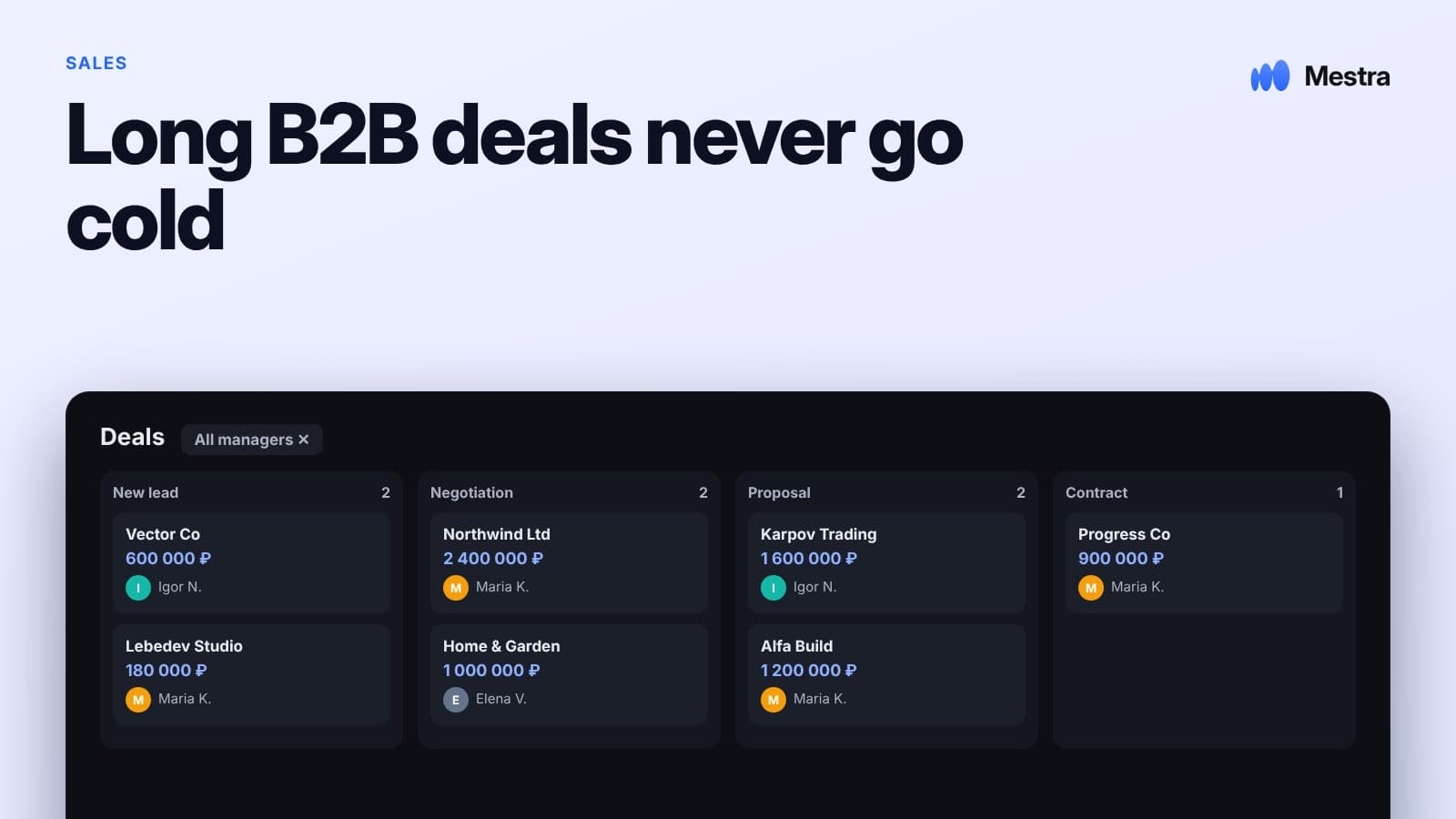
The deal cycle is longer, so besides revenue you plan intermediate stages: meetings, proposals sent, approvals. The monthly plan here relies on past months' pipeline: deals closing in October started back in August.
Real estate
Agencies plan the number of viewings and deals for each agent, and calculate commission by property type. The key factor is how quickly requests from Avito and CIAN are answered: a client writes to several agencies at once.
Calculation formulas
| Metric | Formula |
|---|---|
| Number of deals | Revenue target / Average bill |
| Requests needed | Number of deals / Conversion |
| Percentage achieved | Actual / Target × 100% |
| End-of-month forecast | Actual to date / Working days elapsed × All working days |
| Average bill | Revenue / Number of deals |
| Conversion | Deals / Requests × 100% |
The forecast formula is especially useful: by the tenth working day you can see where the month is heading, and there's still time to change something.
Annual, quarterly and monthly plans: how to break them down
- Year. Start from the financial goal and last year's results, and distribute revenue across months in proportion to seasonality, not in equal shares.
- Quarter. Refine the annual plan based on actual results and new inputs: a new branch, a new service, a price change.
- Month. The team's working target, calculated by funnel and distributed by manager.
- Week. A checkpoint: 25% of the target by the end of week one, 50% by week two. If you're more than 10–15% behind, action is needed.
How to track plan progress
A plan doesn't work if it's only remembered on the last day of the month. The minimum tracking rhythm:
- Daily — new requests and unanswered conversations.
- Weekly — plan vs actual by manager, the end-of-month forecast, a review of 3–5 lost deals.
- Monthly — results, reasons for deviations, adjusting next month's plan.
How to run reviews without total surveillance is covered in our article how to manage sales managers.
Why a sales plan isn't met: 7 reasons
Revenue follows the formula requests × conversion × average bill. If the plan isn't met, at least one multiplier is falling short.
- Too few requests. Advertising and platforms deliver fewer enquiries than the calculation requires.
- Slow replies. A client writes to three companies, and your manager replies two hours later.
- Evening and weekend requests go unanswered. A large share of enquiries arrives when nobody is around.
- Conversations on different phones. MAX on one employee's phone, WhatsApp* on another's, Avito checked once a day — some messages simply go unseen.
- No next step. The manager answered the question but didn't suggest a meeting or a quote, and the conversation fizzled out.
- Weak objection handling and discounts instead of value. Conversion and the average bill fall. The method is in our article handling objections.
- A number without a calculation. "+20% this month" without accounting for requests, conversion, seasonality and newcomers' experience.
What to do if the month is already under way
- Calculate the forecast and the real gap.
- Find the stage that's falling short: requests, handling, conversion or average bill.
- Check all unanswered conversations — some "lost" clients are still waiting.
- Write to your old base: those who were interested but didn't buy, and those due a repeat purchase. Ready texts are in our article how to win back a client.
- Cover evenings and weekends with a staff member on duty or an AI assistant.
- Revise next month's plan based on real numbers.
How Mestra helps hit the plan
In Mestra, everything that makes up the result is visible in one window:
- All enquiries in one feed. MAX, Telegram, WhatsApp*, VKontakte, Avito, CIAN — no request gets lost between apps.
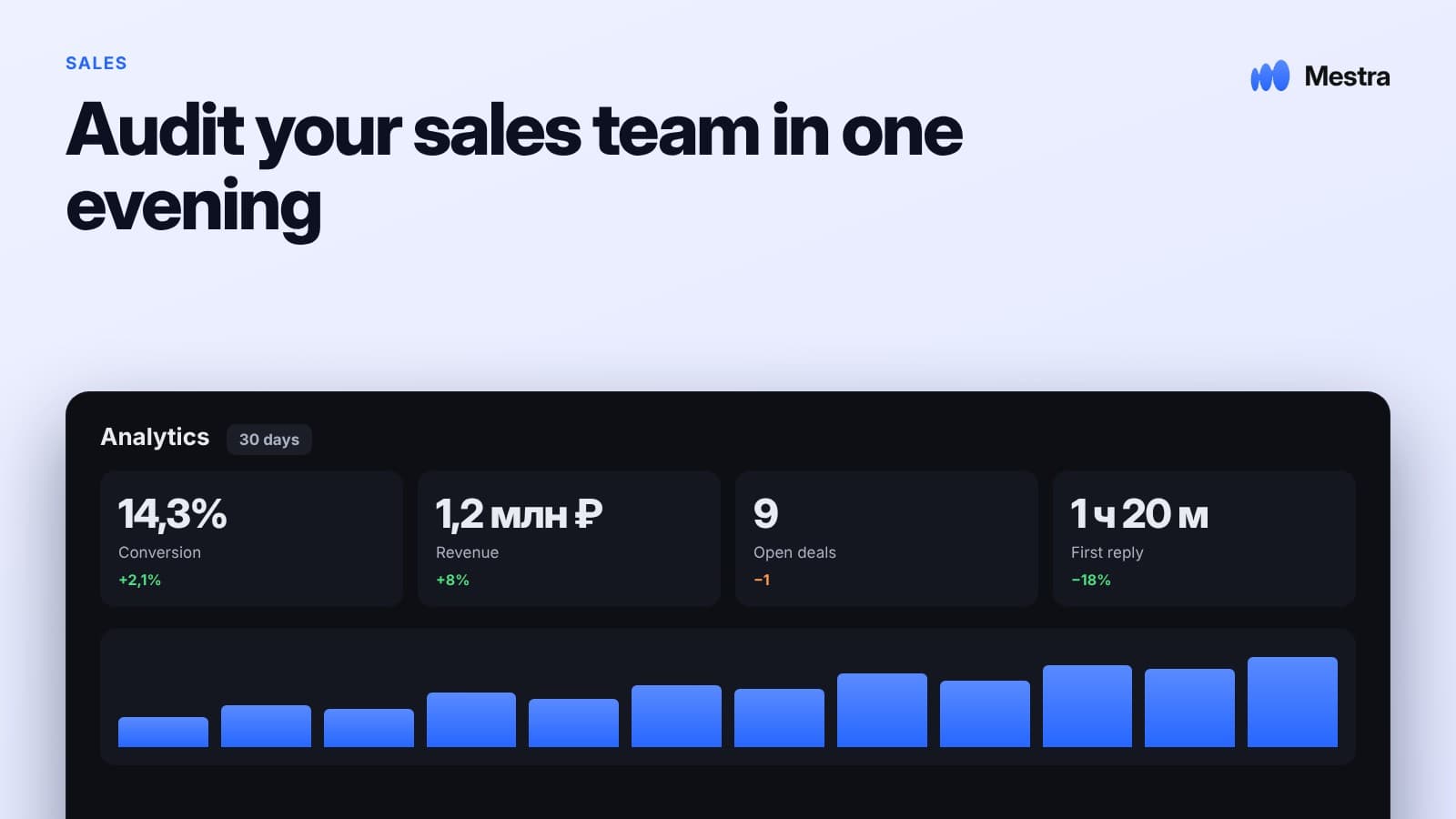
- Analytics without manual reports. New leads, conversion, revenue, request sources and each employee's conversion.
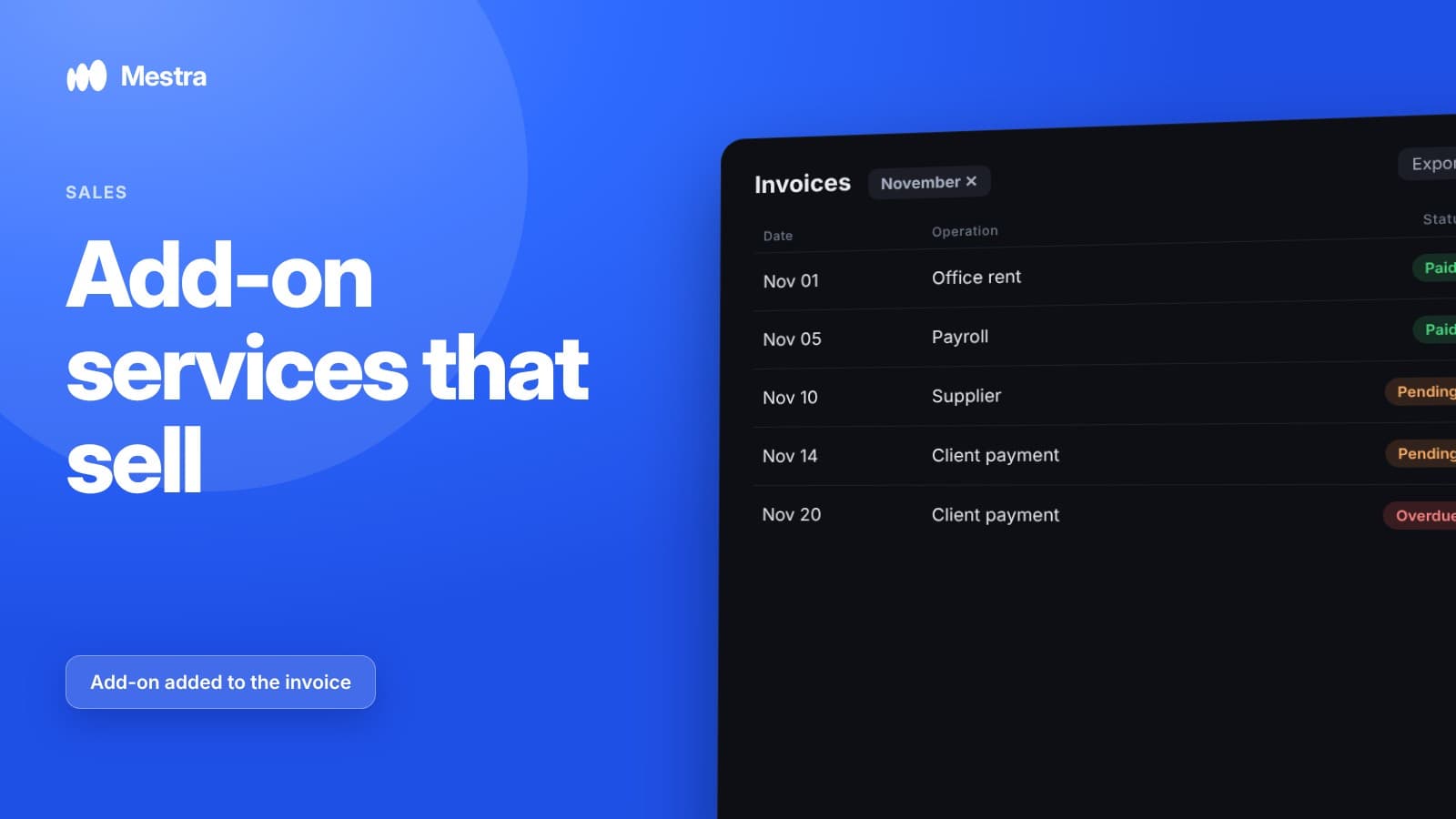
- Finance next to clients. Invoices and payments are linked to the card, so actual revenue matches the money in the account.
- An AI assistant on the front line. Answers clients at night and at weekends, books meetings and creates a task for the manager itself.
- Repeat sales reminders and mailings to your base.

Plans start from 390 ₽ per user per month (CRM and all messengers). The AI assistant and marketplaces are included in Standard for 1,090 ₽. The first 15 days are free, no bank card needed.
Related reading: department goals and OKRs, revenue forecast.
FAQ
How do you build a sales plan if the business has only just opened?
Use the break-even point as the basis: how much you need to sell to cover costs. After two or three months you'll have real data — then move to calculating by funnel.
What period should a sales plan cover?
For the team — a month broken down by week. The year and quarter are benchmarks for the owner and the budget.
How is a sales plan different from a forecast?
A forecast shows how much you'll sell under current conditions. A plan is a target for which you change the conditions: add advertising, people or work with the old base.
How do you distribute the plan among managers?
By experience, past months' results and workload. Splitting it equally is a common mistake.
What if the plan hasn't been met for several months in a row?
Recalculate it from real data: requests, conversion and average bill. The number may have been unachievable from the start, or the company may be losing requests at the reply stage.
Should you fine people for missing the plan?
Fines usually make things worse: managers start hiding problems. It's more effective to review deals and remove obstacles.
Do you need a CRM for sales planning?
A spreadsheet is enough for one or two employees. When there are more managers and clients write in several messengers, it's easier to collect actuals automatically — otherwise reconciliation takes hours.
Bottom line
A good sales plan is built from data, not wishes: revenue → average bill → deals → requests.
Combine calculation methods, account for seasonality, distribute the target by experience and track weeks, not months. And for the plan to be met, make sure requests don't get lost along the way. The Excel template will help you start today, and Mestra will collect actuals automatically.
*WhatsApp is owned by Meta, which is recognised as extremist and banned in Russia.