Handling Objections in Sales: A 5-Step Algorithm, 7 Techniques and 20 Sample Answers
Sales12 min read
How to handle client objections: genuine vs false objections, a 5-step algorithm, 7 techniques and 20 ready answers to "too expensive" and "I'll think".

Handling objections is the stage of a sale where the manager finds out the real reason for the client's doubts and removes it with facts, not pressure.
The classic algorithm has five steps: listen, empathise, clarify, answer with an argument and suggest the next step.
An objection isn't a refusal — it's a signal that the buyer lacks information or confidence.
What handling objections means
An objection is any doubt that stops the client buying right now: "too expensive", "I'll think about it", "it's cheaper elsewhere", "I'll ask my husband".
Handling objections is a set of techniques that help you understand the reason for the doubt and give the person what they need to decide.
An objection means interest. Someone who doesn't need the product usually just stops replying. Someone who argues about price or timing is already picturing themselves buying.
Why clients object
Every objection comes down to one of five reasons:
- They don't see the value. The client doesn't understand what they're paying for or how you differ from others.
- They don't trust you. They fear they won't get what was promised: deadlines will slip, quality will disappoint.
- There's no urgency. The need exists but isn't pressing.
- There's no money, or the budget is already allocated.
- They're not the decision-maker. They need to agree it with a partner, manager or family.
The manager's job is to work out which reason is the real one. The answer to "too expensive" is different for a client who doesn't see the value and for one who really doesn't have the money.
Genuine and false objections
A genuine objection is a real reason that can be discussed: the price is above budget, the timing doesn't work, a needed feature is missing.
A false objection is a polite way to end the conversation or hide the real reason. "I'll think about it" often means "I'm not sure about you", and "too expensive" means "I don't understand what the money is for".
A clarifying question helps tell them apart:
— What exactly would you like to think over: the price, the timing or something about the service itself?
To a genuine objection, the client answers specifically. To a false one, they dodge or name a new reason. Then it's worth gently testing trust: offer reviews, a guarantee, a trial period.
Types of objections
| Type | What it sounds like | What's behind it |
|---|---|---|
| Price | "Too expensive", "it's cheaper elsewhere" | The value or the difference from a competitor isn't visible |
| Time | "Not now", "let's do it later" | No urgency, or fear of change |
| Trust | "What if it doesn't work?", "nobody knows you" | No proof or guarantees |
| Need | "We don't need it", "we manage on our own" | The client doesn't see the problem |
| Authority | "I'll check with my manager" | Someone else makes the decision |
| Competitor | "We already work with someone else" | Habit and reluctance to change supplier |
The objection-handling algorithm: 5 steps
1. Listen
Don't interrupt. A person who's cut off hears not arguments but an attempt to "push". Let them finish and, if needed, ask again.
2. Empathise
Show that having doubts is normal: "I understand, it's a significant amount", "You're right to compare". You're not agreeing that it's expensive — you're showing you hear the person; otherwise any argument feels like an attempt to win a debate.
3. Clarify
Ask a question to find the real reason: "What are you comparing it with?", "What concerns you most — the price or the timing?". Often after clarifying it turns out the issue isn't the price at all.
4. Make your case
Answer exactly the reason you found: with a number, an example, a guarantee. One precise argument works better than five general phrases, especially if it's about the client's benefit rather than how good your company is.
5. Check and suggest the next step
"Have I answered your question?", "Shall I book you in for Thursday?". Without a next step, the conversation stalls and the deal slips away. What to do if the client still goes quiet — in our article how to close a client.
7 objection-handling techniques
"Yes, and…"
"Yes, but" cancels out the agreement, so replace it with "yes, and": "Yes, it's a noticeable sum, and it already includes materials and a two-year guarantee."
Isolating the objection
Find out whether anything else stands in the way besides the stated reason: "If we sort out the price, are you ready to start next week?". That way you don't waste effort on false objections.
Reframing
Show the purchase from another angle: "You're not paying for a bathroom renovation — you're paying not to have to redo it ten years from now."
Answering with a question
"Expensive compared with what?" — the question brings the conversation back to facts and shows what exactly the client is comparing.
Comparison
Break down your offer and the competitor's point by point. Often it's only cheaper elsewhere because delivery, installation or the guarantee isn't included in the price.
Social proof
Show how you've already solved the same problem for a similar client: a review, a photo, a short case study. "Here's an example of an apartment in the building next door — same task, here's the result."
Reducing risk
A trial period, staged payment, a money-back guarantee. Reviews and case studies are especially good at removing trust objections.
20 objections and ready answers
| Objection | Answer |
|---|---|
| Too expensive | I understand, it's a significant amount. What are you comparing it with? Let me check what's included in both prices. |
| It's cheaper elsewhere | Possibly. What's included in their price? Ours includes materials, delivery and a 2-year guarantee. |
| I'll think about it | Of course. What would you like to think over — the price, timing or details? Maybe I can answer right away. |
| No time | It'll take three minutes: I'll send a short quote, have a look whenever suits you. |
| I'll ask my husband | Good idea. I'll prepare a comparison of options to make it easier to discuss. When would suit you for a three-way call? |
| I need to agree it with my manager | Let me prepare a short proposal with a calculation of the benefit — that'll make it easier for your manager to decide. |
| We already work with someone else | Great that you have a trusted supplier. If you ever need a second option for comparison, I'll be glad to help. |
| It's not relevant right now | Understood. When will it become important? I'll get in touch closer to then. |
| Send me a proposal | I will. Let me clarify two things so the proposal is accurate: budget and timing? |
| I don't have the money | There's an instalment option or a simpler package — shall we see what fits? |
| I'm not sure it'll work | Here's an example of a similar client and the result after a month. We can start with a trial period. |
| I'll do it myself | You can. I'll tell you what to watch out for. If you decide to trust us with it, we guarantee the deadlines. |
| Nobody knows you | Fair point. Here are reviews and examples of our work, and payment is in stages, based on results. |
| It takes too long | We can speed up the first stage and start this week. What deadline is critical for you? |
| I had a bad experience with companies like yours | Tell me what went wrong? I want to understand so it doesn't happen again. |
| I need more options | Of course. I'll prepare two or three options at different budgets. |
| I don't see a difference from others | The main difference is the guarantee and the deadlines in the contract. Shall I show you an example? |
| Call me later | Sure, what time suits you? I'll set a reminder. |
| Can you give me a discount? | I can offer a bonus: free delivery or an extra service. |
| I don't need it | I understand. May I ask how you currently handle this? |
More templates for the first reply and for reviving a client who went quiet — in our collection of sales scripts for messengers.
Objections in messaging: how it differs from a call
Today most clients write in MAX, Telegram, WhatsApp* and on Avito rather than calling. Messaging has its own rules:
- Speed decides. While a manager spends an hour thinking about a reply, the client gets a competitor's offer.
- Don't write essays. One paragraph with a question at the end works better than a long monologue.
- Voice messages only by agreement. Many people prefer to read.
- Add proof. Photos of work, a review, a quote — in messaging they're easy to attach straight away.
- Silence is an objection too. If the person didn't reply, it's not a refusal but a reason to come back in a day or two with a useful clarification.
Objections in B2B and B2C
In B2C, decisions are made quickly and emotionally: trust, convenience and price matter. The main techniques are reviews, guarantees and a clear next step.
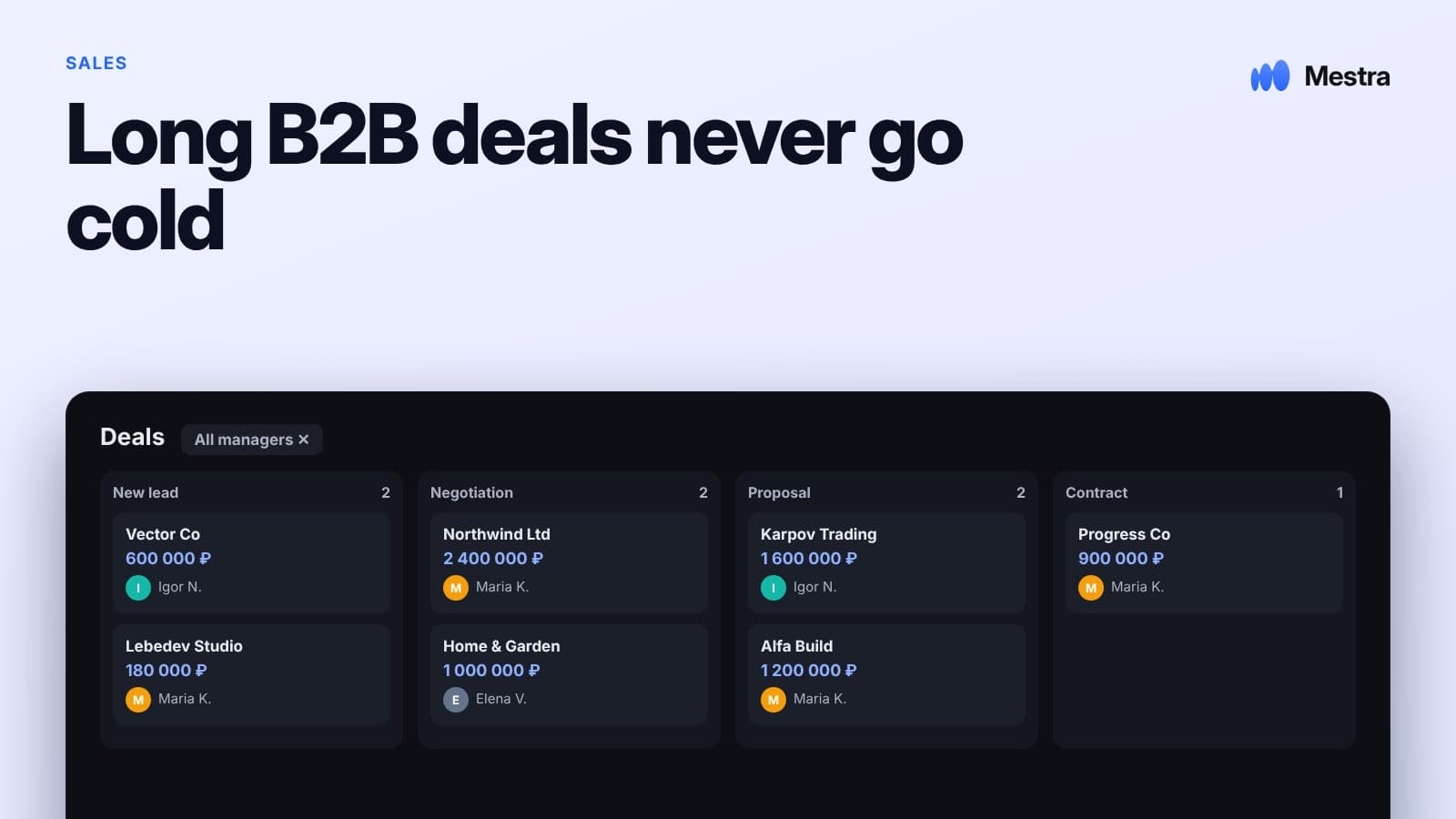
In B2B, several people make the decision, the cycle is longer, and objections are more often about risks and approvals. What helps is a calculation of the benefit in numbers, case studies of similar companies, and materials the contact person can forward to their manager.
Common manager mistakes
- Arguing with the client. Even if you win the argument, you'll lose the deal.
- Offering a discount straight away. This teaches the client to object and lowers the average bill.
- Answering a false objection. Without clarifying, you spend effort on the wrong problem.
- Speaking in templates. A memorised script is noticeable immediately.
- Not suggesting a next step. The conversation ends and the deal stalls.
How to train your team to handle objections
- Collect real client phrases. Scroll through a month of conversations and write down what most often blocks a deal.
- Write answers together with the team. The best phrasing usually already exists among your strongest managers.
- Review conversations once a week. 30 minutes on 3–5 lost deals gives more than any training. How to do it without total surveillance — in our article how to manage sales managers.
- Record reasons for refusal. After a month, you'll see which objections come up most often.
- Update your answer base. The market changes, and so do objections.
How Mestra helps answer objections
In Mestra, conversations from all messengers and marketplaces are gathered in one window, and the AI assistant works in suggestions mode:
- A ready draft reply appears right in the input field — the manager can send it, edit it or generate a new one.
- The reply takes your catalogue, prices and terms into account, rather than generic phrases from the internet.
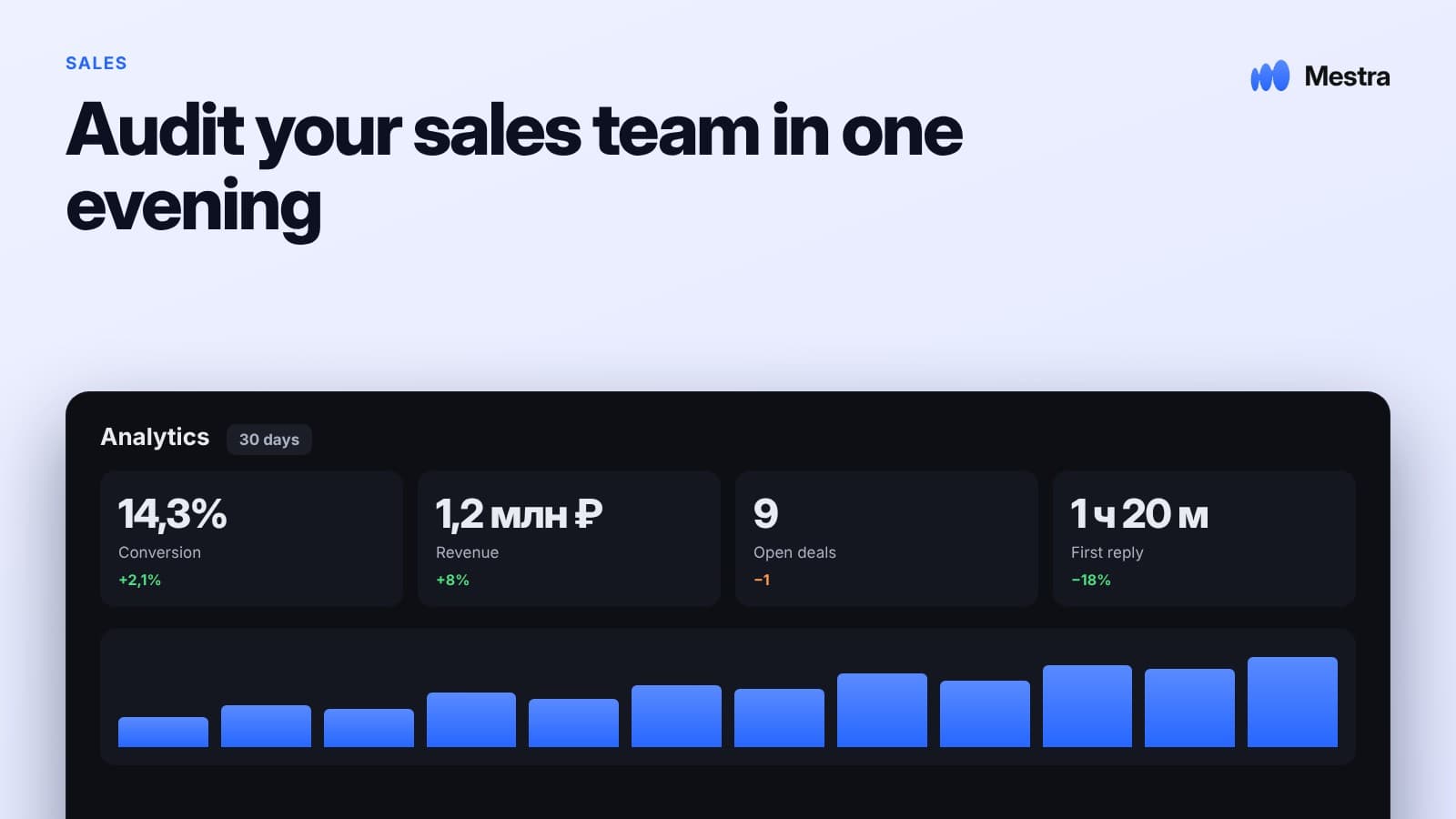
- The manager sees all the team's conversations and reviews lost deals using real examples.
- The reason for refusal is recorded in the client card — over time you see which objections come up most.
- AI replies at night and at weekends, so a client with a price question doesn't go to a competitor before morning.

The AI assistant is included in the Standard plan for 1,090 ₽ per user per month. You can try it free for 15 days, no bank card needed.
FAQ
How is an objection different from an excuse?
An objection is a real reason that can be discussed. An excuse is a polite way to end the conversation. A clarifying question helps tell them apart: with an excuse, the client can't give specifics.
Should you answer every objection?
Yes, but without arguing. The goal is to understand the doubt and provide information, not to win a debate.
How do you respond to "too expensive"?
Empathise, clarify what the client is comparing with, and show what's included in the price. Offer a discount last.
Can you use ready-made scripts?
As a basis, yes. But clients spot a word-for-word memorised script immediately, so adapt the wording.
What if the client keeps objecting again and again?
Most likely you haven't found the real reason yet. Go back to clarifying questions or test trust.
How do you handle objections in messaging?
Reply quickly and briefly, end with a question, and attach proof — photos, reviews, a quote.
Bottom line
Handling objections rests on a simple algorithm: listen, empathise, clarify, make your case and suggest the next step.
Tell genuine objections from false ones, use proven techniques, collect real client phrases and review lost deals with the team. And in messaging, whoever replies fast and to the point wins — an AI suggestion right in the chat window helps with that.
*WhatsApp is owned by Meta, which is recognised as extremist and banned in Russia.