How to Oversee Sales Managers' Work: 6 Metrics and 6 Methods Without Total Surveillance
Sales5 min read
How to oversee sales managers without surveillance: 6 metrics, reading conversations without micromanaging, and a 30-minute weekly pipeline review.

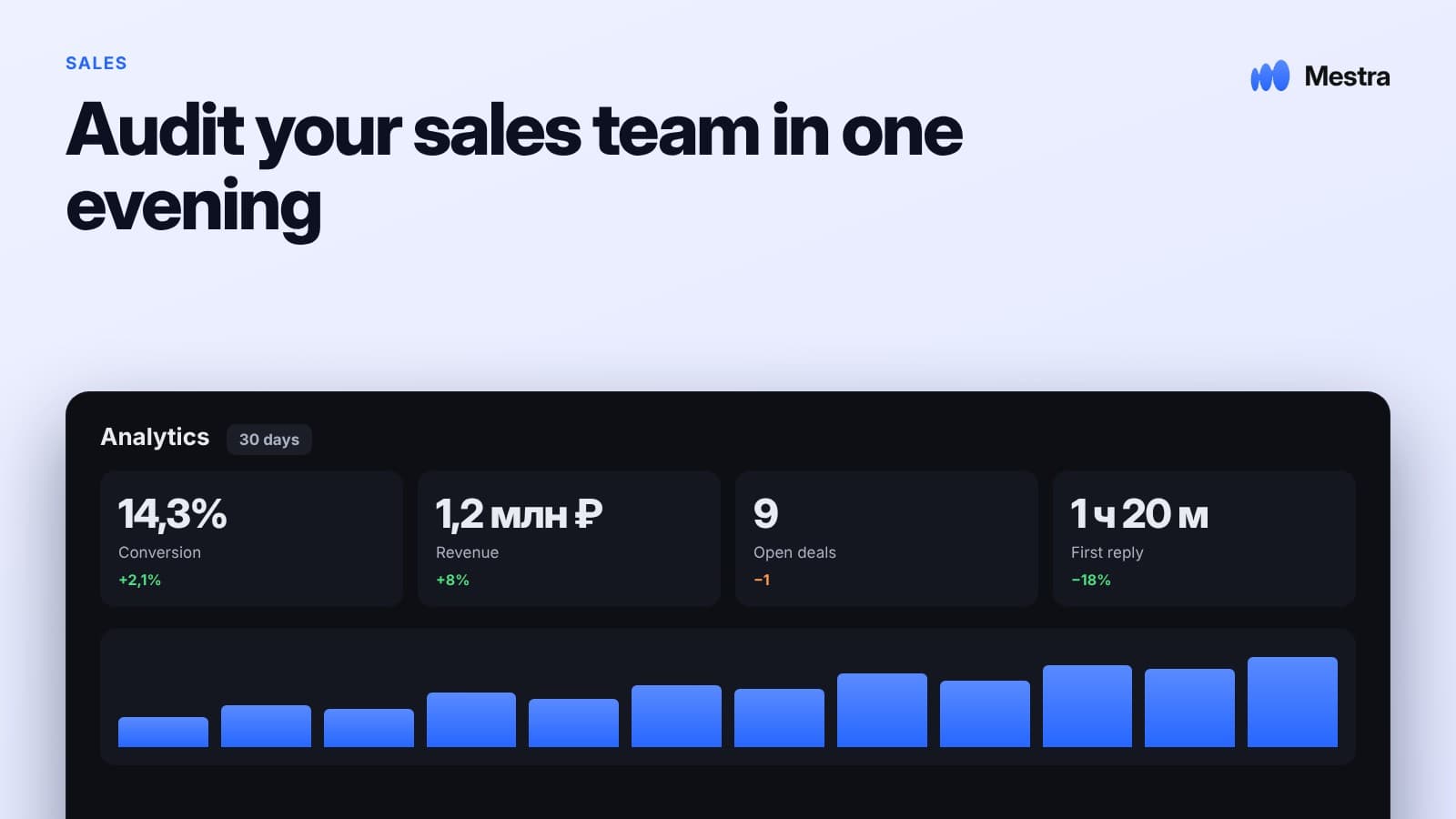
Overseeing sales managers means seeing not how many hours they spent at work but their results and quality: response speed, conversion at each stage, why deals fell through and how they talk to customers. It's easiest to do in a CRM where all messenger conversations and all deals are stored in one place, and metrics are calculated automatically.
Why "oversight by gut feeling" doesn't work
One manager has lots of calls and is always busy; another is quiet. It seems the first works better. Then it turns out the second closed twice as many deals — they simply don't waste time on people who aren't ready to buy.
Without numbers, the head assesses activity, not results. And the main losses stay invisible: a curt reply in a messenger, a forgotten promise to call back, a buyer who "cooled off" after the first message.
6 metrics worth watching
| Metric | What it shows |
|---|---|
| First response speed | How long someone who wrote has to wait |
| Manager conversion | What share of their deals reached payment |
| Conversion by stage | At which step the employee loses people |
| Time at each stage | Where deals "hang" for weeks |
| Reasons for refusal | Why deals fall through: price, timing, no reply |
| Workload | How many open chats, leads and tasks each person has |
Compare metrics in combination, not one at a time. High workload and low conversion usually mean the person can't keep up. How to link metrics to a bonus — in our article sales manager KPIs.
6 methods of oversight without total surveillance
1. A single base instead of personal phones. While conversations live in a messenger on an employee's phone, there's nothing to oversee.
2. Selective reading of conversations. Once a week, open 10–20 conversations for each manager. Look for the moment the person stopped replying: most often it's a message with no question and no next step.
3. A mandatory reason for refusal. After a month, you can see what needs fixing: the script, the price or the response speed.
4. Tasks with deadlines. Every promise to a client is a task. Overdue ones are visible immediately, and the conversation is about facts.
5. A weekly pipeline review. 30 minutes with the team: how many came in, how many reached a meeting, where deals got stuck. More on the pipeline in our article the sales funnel.
6. Comparing managers with each other. If one has twice the conversion, review their conversations with the team — it's the best training there is.
A template for a 30-minute weekly review
| Time | What we discuss |
|---|---|
| 5 minutes | The week's numbers: enquiries, replies, meetings, deals |
| 10 minutes | 3–5 deals that fell through: where and why |
| 10 minutes | The best conversation of the week: what worked |
| 5 minutes | One change for next week |
How not to turn oversight into surveillance
- Explain why. The goal is to find where customers are lost, not to punish.
- Discuss numbers, not people. "Half are lost at the Proposal stage" sounds different from "you're bad at selling".
- Praise in public, review mistakes in private.
- Don't demand extra reports. Anything visible in the system doesn't need to be asked for separately.
On gentle ways to keep motivation up — in our article motivating managers.
How it works in Mestra
Mestra is our product. Oversight is built on data that's collected by itself as people work:
- All managers' conversations with buyers — in MAX, Telegram, WhatsApp*, VKontakte, Instagram*, on Avito and CIAN.
- Each employee's conversion — deals won relative to deals assigned.
- Workload distribution: open chats, leads, deals and tasks for each person.
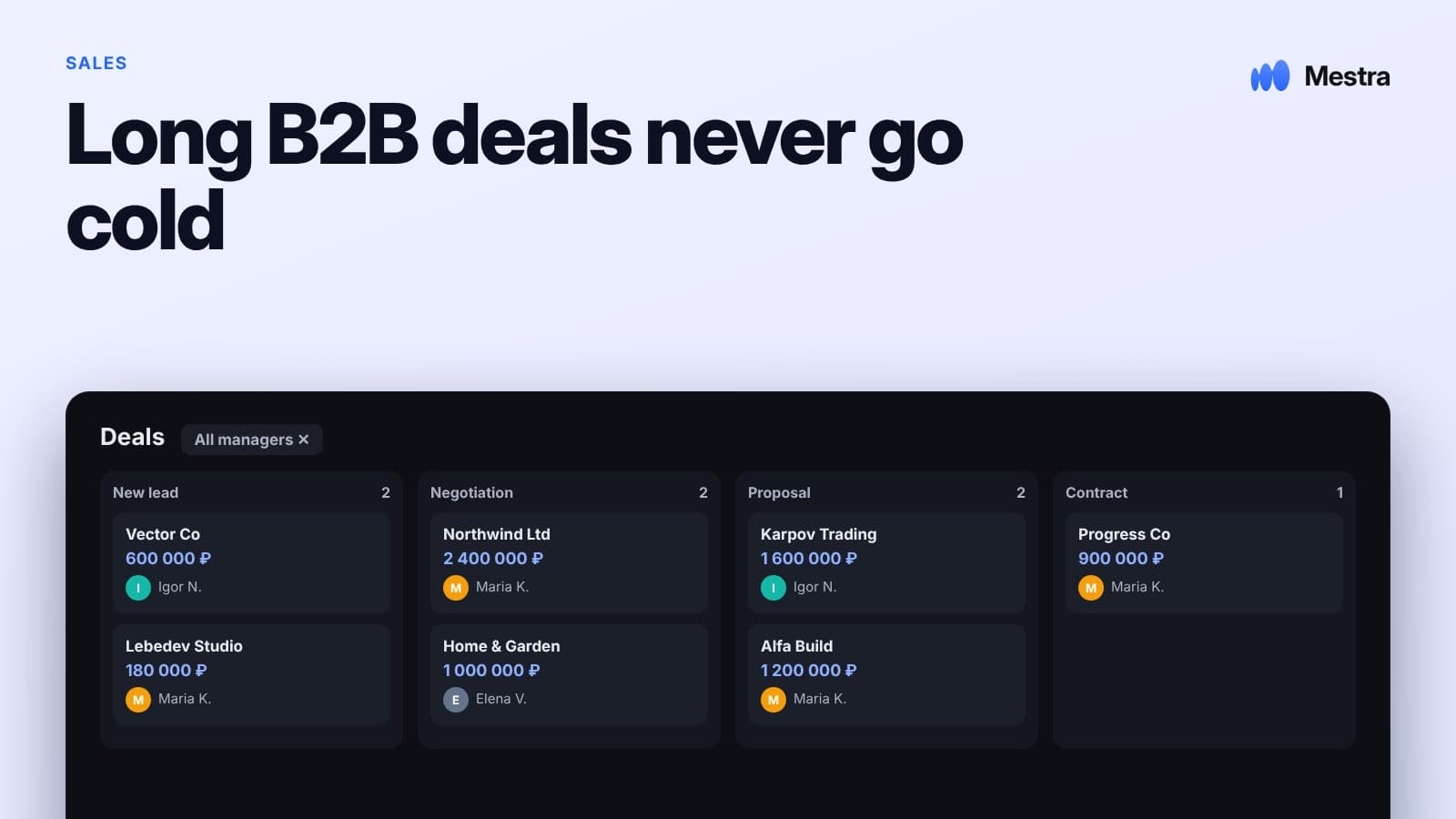
- The stage pipeline with average waiting time.
- A mandatory reason for refusal when a deal is moved to "lost".
- Roles and detailed permissions: a manager sees their own deals and can't export the whole base; team leads see their team.
- Scale: from three managers to a department of hundreds — unlimited users.

Related reading: how to hire a sales manager.
FAQ
How do you check that a manager isn't losing requests?
Compare the number of enquiries across all channels with the number of cards in the CRM, and look at first response speed.
Do you need to read all managers' conversations?
No. 10–20 conversations a week and a review of deals that fell through are enough.
What KPIs should a manager have?
Usually conversion to payment, first response speed and tasks completed on time.
How do you oversee remote managers?
The same way as in the office: through a shared system where conversations, tasks and the pipeline are visible.
How do you oversee a large sales department?
Through team-lead roles, analytics for each employee and automatic request routing. More in our article CRM for a large sales department.
Bottom line
Good oversight means transparency, not surveillance: all conversations, deals and reasons for refusal in one place.
Then conversations with the team are about numbers, and the head sees where money is being lost before the month ends. Try Mestra free for 15 days.
*WhatsApp and Instagram are owned by Meta, which is recognised as extremist and banned in Russia.