Department OKRs: how to set quarterly goals and not forget them a week later
Management8 min read
OKRs in plain words: objectives and key results, how to set department goals for the quarter, OKR examples for sales, service and finance, and tracking.

OKR (Objectives and Key Results) is a way of setting goals in which every objective has 2-4 measurable results that show whether it has been achieved. The method helps a team focus on what matters most for the coming quarter and see whether it is moving toward the goal.
OKRs in a minute
| Element | What it is | Example |
|---|---|---|
| Objective | Where we want to get to, qualitatively | Clients get a reply faster than anywhere else in the market |
| Key Result | A measurable sign of achievement | Average first response time — under 5 minutes |
| Initiatives | What we do to achieve the result | Bring all channels into one window, set up distribution |
| Period | For how long | A quarter |
| Review | How often we check progress | Once a week |
How OKRs differ from KPIs and a plan
| KPI | Plan | OKR | |
|---|---|---|---|
| What it is | Ongoing performance indicators | A specific volume for a period | Goals for change over a quarter |
| Example | Conversion, average order value | 5 million in revenue in November | Raise conversion from 22% to 30% |
| Link to bonuses | Often direct | Direct | Usually not linked |
| Ambition | Realistic | Realistic | Ambitious: 70% completion is a good result |
KPIs show how the work is going. OKRs show what the team wants to change this quarter.
How to set department OKRs: 6 steps
1. Look at the company's goals
A department's goals should support the company's goals. If the company wants to grow in a new segment, the sales department sets goals tied to that segment.
2. Choose 1-3 objectives
More than three is no longer a focus. An objective should be clear and motivating.
3. For each objective, 2-4 key results
A key result is measurable and has a current value and a target value: "from 22% to 30%."
4. Check that these are results, not tasks
| Task (bad) | Result (good) |
|---|---|
| Run training for managers | Request-to-payment conversion — from 22% to 30% |
| Implement a new system | First response time — from 40 to 5 minutes |
| Launch a loyalty program | Share of repeat purchases — from 18% to 25% |
5. Define the data source
For each key result, decide where the number comes from and who is responsible for it. If the number can't be obtained quickly, OKRs turn into guesswork.
6. Agree on them with the team
OKRs that the team hasn't discussed don't work. It is better if some of the objectives are proposed by the employees themselves.
OKR examples
Sales department
Objective: No request is lost, and clients choose us for our speed.
| Key result | Now | Target |
|---|---|---|
| Average first response time | 40 minutes | 5 minutes |
| Share of requests unanswered for more than an hour | 15% | 2% |
| Request-to-payment conversion | 22% | 30% |
Service and support
Objective: Clients are happy and come back.
| Key result | Now | Target |
|---|---|---|
| Share of unhappy clients in conversations | 8% | 3% |
| Share of repeat purchases | 18% | 25% |
| Complaint resolution time | 3 days | 1 day |
Finance
Objective: The company sees its money and avoids cash gaps.
| Key result | Now | Target |
|---|---|---|
| Profit and loss statement ready | By the 15th | By the 3rd |
| Share of invoices paid on time | 70% | 90% |
| Cash reserve in accounts | 2 weeks of expenses | 1.5 months of expenses |
Management and team
Objective: New hires reach results quickly.
| Key result | Now | Target |
|---|---|---|
| Time for a new hire to meet plan | 3 months | 6 weeks |
| Share of new hires who pass probation | 60% | 80% |
How to track OKRs
- Weekly — a quick look at the key result numbers at the team meeting.
- Monthly — a review: what is moving, what isn't, whether the initiatives need to change.
- At the end of the quarter — a final assessment and conclusions for the next quarter.
It is convenient to score on a scale from 0 to 1: 0.7 and above is a good result for an ambitious objective. If all OKRs are always 100% achieved, the objectives are too easy.
It is important that the numbers are collected automatically. If someone spends half a day consolidating spreadsheets to check OKRs, the checks soon stop. For more, see the article on analytics in a CRM.
How to connect OKRs to daily work
The main reason OKRs don't work is that they live in a presentation, not in the work. To keep goals from being forgotten:
- Every key result is in plain sight. The number updates itself and is visible at the team meeting.
- Initiatives live in tasks. Each initiative has an owner, a deadline and a checklist.
- The week starts with OKRs. The first 5 minutes of the team meeting go to progress on key results.
- Decisions are checked against OKRs. A new idea? Ask which key result it moves.
An example quarterly cycle
| Week | What we do |
|---|---|
| 2 weeks before the quarter | Results of the previous quarter, draft of new objectives |
| 1 week before | Discussion with the team, final OKRs |
| 1 | Initiatives broken down into tasks with owners |
| 2-12 | Weekly check of the numbers, monthly review |
| 13 | Final 0-1 assessment, conclusions, carrying over unfinished items |
How to assess OKRs at the end of the quarter
| Score | What it means | What to do |
|---|---|---|
| 0-0.3 | Objective not achieved | Look into the causes: the objective, the initiatives or the resources |
| 0.4-0.6 | Partial progress | Decide whether to continue in the next quarter |
| 0.7-1.0 | Good result | Consolidate and set the next objective |
| Always 1.0 | Objectives are too easy | Set more ambitious ones |
Common mistakes
- Too many objectives. Five objectives with five results each is not a focus but a to-do list.
- Tasks instead of results. "Run training" is done, but conversion hasn't changed.
- No current value. It's unclear what we are growing from.
- No data. The key result can't be measured without manual counting.
- OKRs forgotten after a week. There is no regular review.
- Tied to bonuses. The team starts setting easy goals to guarantee the bonus.
OKRs for a company of 10-30 people
You don't need to roll out OKRs across the whole company with a cascade of goals for every employee. To start, it is enough to have:
- 1-2 objectives per quarter for the whole company or a key department;
- 2-3 key results with numbers that can be taken from the system;
- 10 minutes at the weekly team meeting to look at progress.
For how to organize the weekly meeting, see the article on the team meeting.

How it works in Mestra
Mestra does not have a separate OKR module, but it provides the numbers that let you track key results without manual spreadsheets:
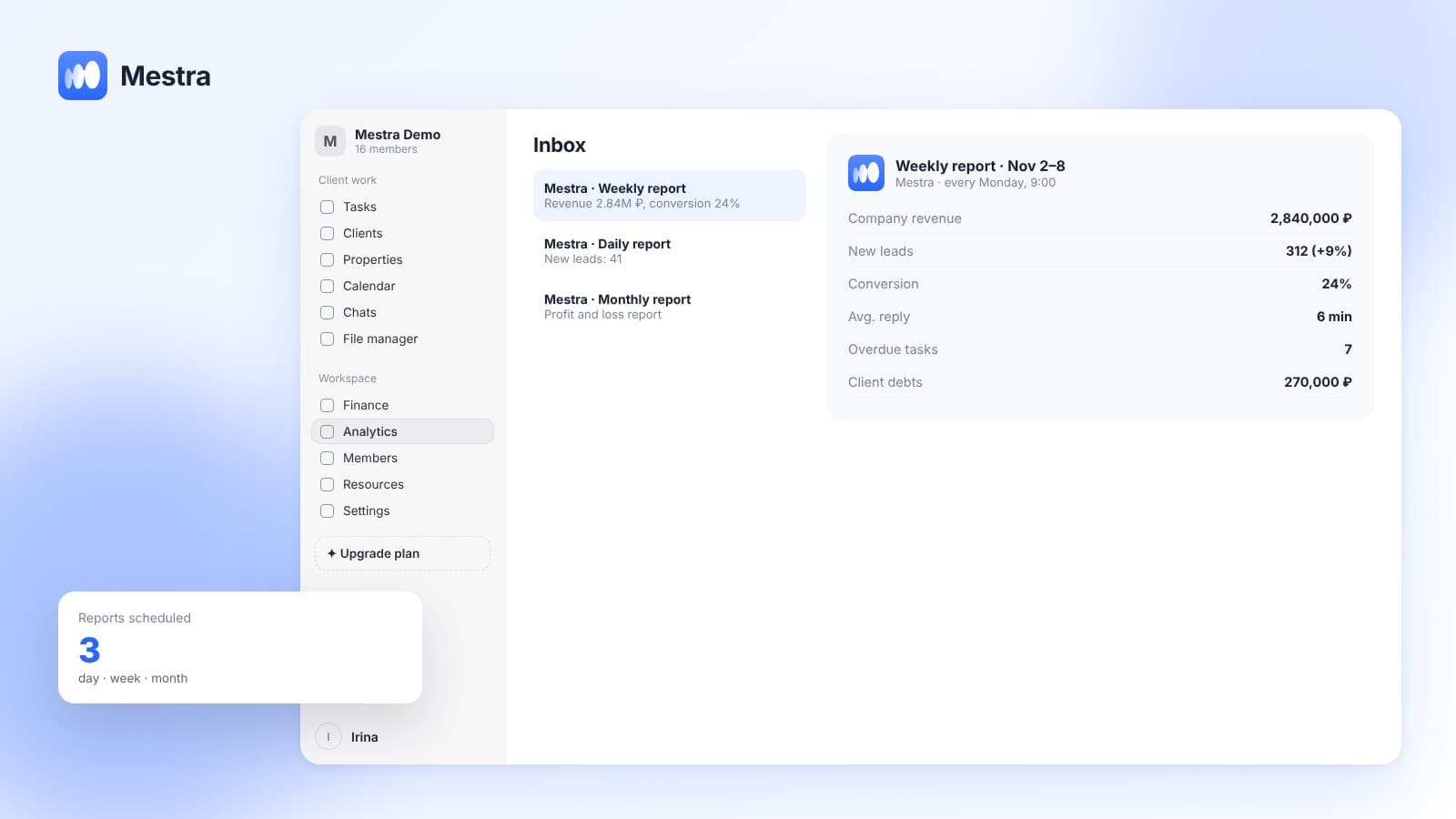
- Sales analytics. A funnel of stages, conversion, loss reasons, client sources.
- Analytics by employee. Response speed, workload, task completion.
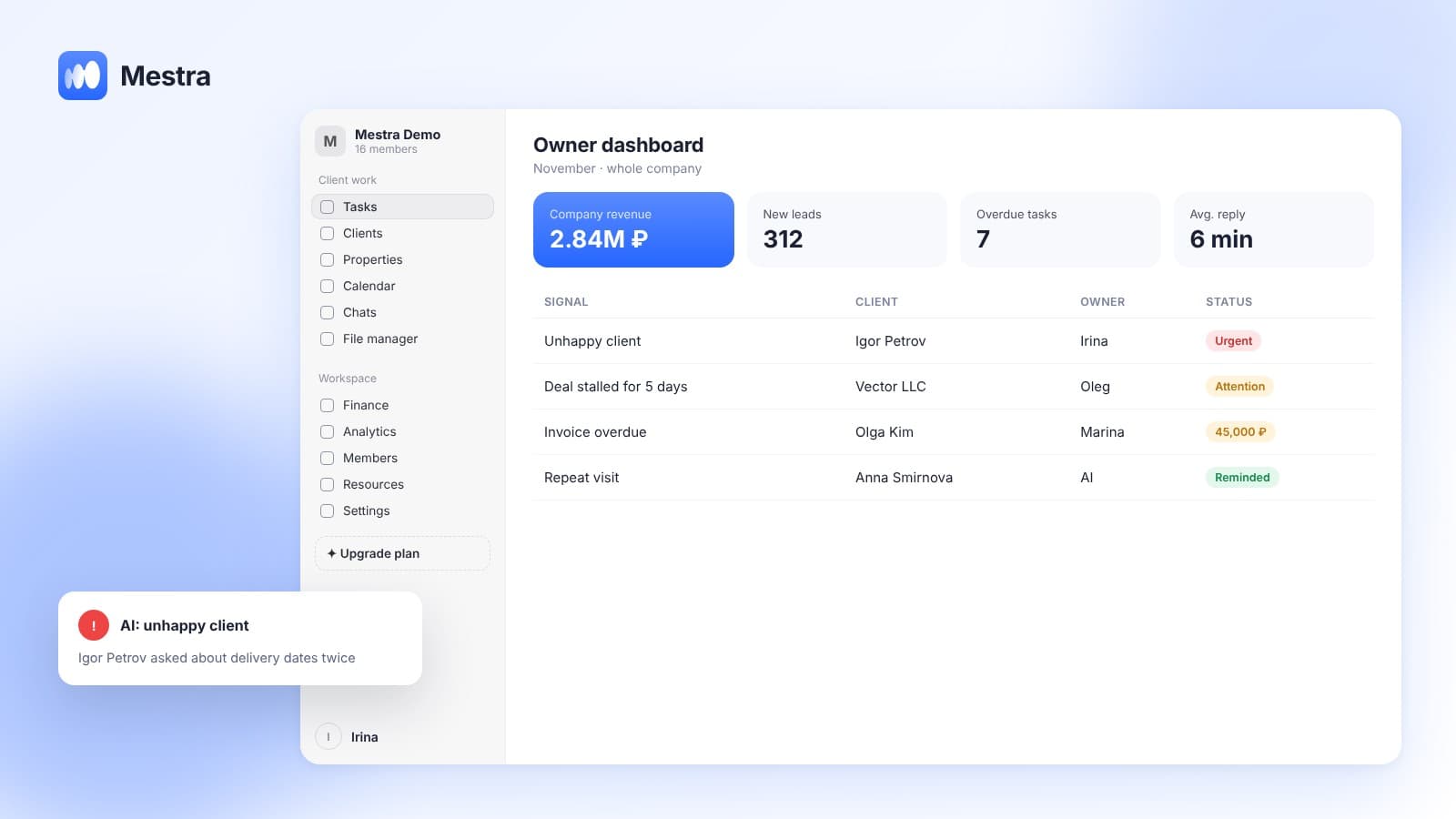
- Service quality. AI flags unhappy clients and weak operator replies — you can see the share of problem conversations.
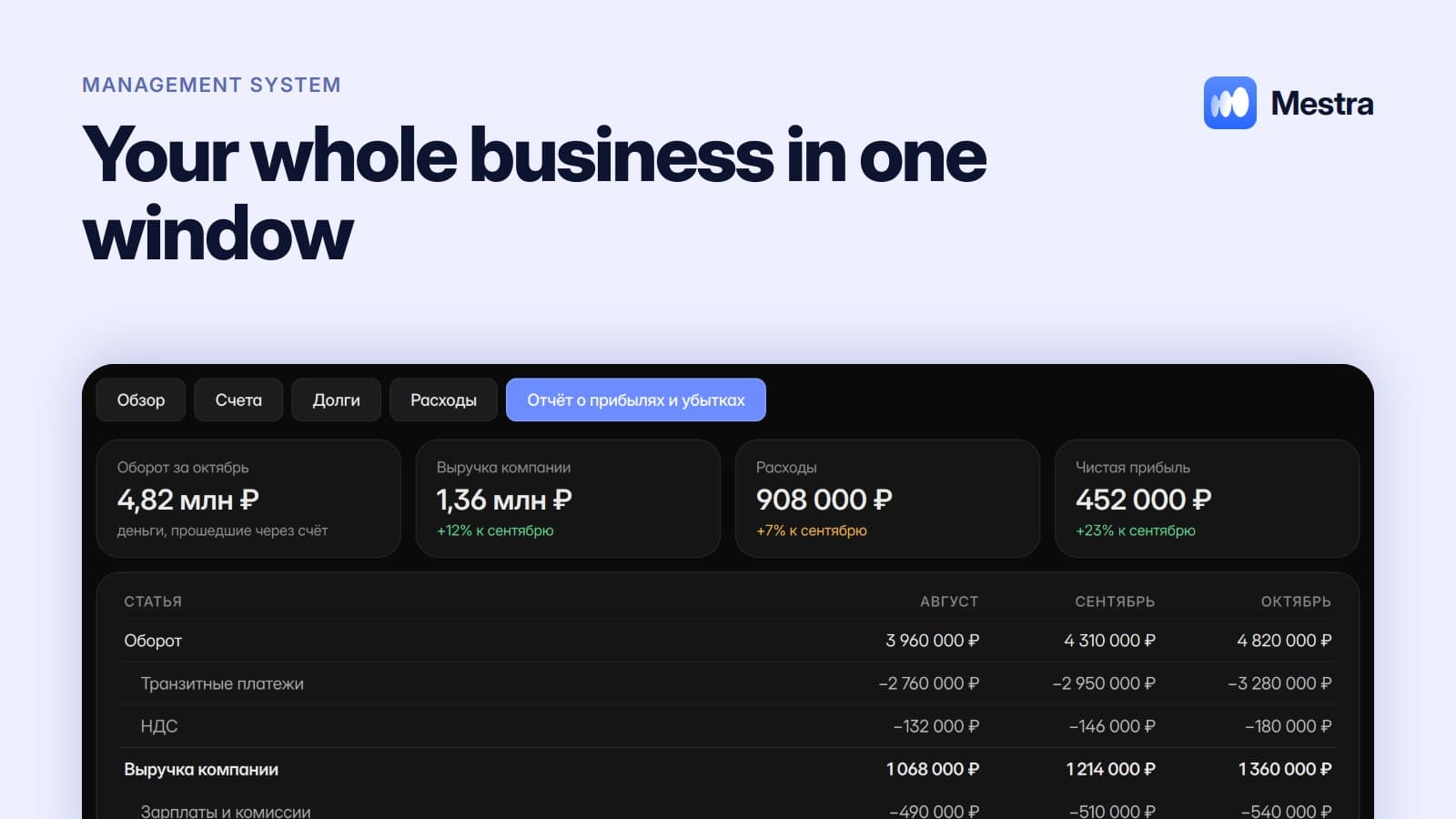
- Finance. The profit and loss statement builds itself; you can see invoices, payments and balances across the company's accounts.
- Initiatives as tasks. Actions for each objective are set up as tasks with an assignee and a deadline, visible as a list, on a kanban board and on a timeline.
Frequently asked questions
What are OKRs in plain words?
It is a way of setting goals: a qualitative objective plus 2-4 measurable key results that show whether the objective has been achieved.
How many OKRs should a department set?
Usually 1-3 objectives per quarter, with 2-4 key results each.
How do OKRs differ from KPIs?
KPIs are ongoing performance indicators. OKRs are ambitious goals for change over a specific period.
How often should OKRs be checked?
Weekly — briefly at the team meeting, monthly — a detailed review, and at the end of the quarter — a final assessment.
Should OKRs be linked to bonuses?
Usually not: otherwise the team starts setting easy goals. It is better to tie bonuses to KPIs and the plan.
Summary
OKRs help a department focus on 1-3 main changes over a quarter and see whether it is moving toward the goal. They work only with measurable key results, data that doesn't depend on manual spreadsheets and a weekly check.
In Mestra, conversion, response speed, service quality and finance are visible in analytics, while initiatives for each objective are managed as tasks with assignees and deadlines. Try Mestra free for 15 days at mestra.chat.