The Sales Funnel in Simple Terms: Stages, Examples for Different Industries, Calculating Conversion and How to Set It Up
Sales6 min read
What a sales funnel is in simple terms: the stages, how to calculate conversion and time at each stage, examples by niche, common mistakes and running it in a CRM.

A sales funnel is a person's path from first enquiry to purchase, broken into stages: enquiry, qualification, meeting, proposal, payment and repeat sale. At each stage some potential buyers drop out, so the diagram narrows like a funnel.
Knowing how many people pass each step and how long they spend on it, the owner sees where the business is losing money and can fix a specific point rather than "sales in general".
The sales funnel in simple terms
In a month, 200 people wrote to you. 120 got a reply and had an initial conversation. 60 reached a meeting or viewing. 36 received a proposal. 18 paid.
That's the funnel: 200 → 120 → 60 → 36 → 18. Of 200 enquiries, 18 ended in purchases — 9%.
More important than the overall figure is where the most people drop out. If only 120 of 200 reach a conversation, the problem isn't the price or the product but the speed and quality of the first reply. More in our article why a business has too few clients.
The main stages of a sales funnel
| Stage | What happens | What to measure |
|---|---|---|
| Enquiry | The person wrote, called or left a request | Number, source |
| Qualification | The task, timing and budget are clarified | First response speed |
| Meeting, viewing, consultation | Getting to know the product | Share who got this far |
| Proposal | A quote, contract or invoice | Time to decision |
| Payment | The deal is closed | Revenue, average bill |
| Repeat sale | A return or a referral | Share of repeat purchases |
The last step is often forgotten, even though winning back a past customer is usually easier and cheaper than finding a new one.
How to calculate funnel conversion
Conversion = the number at the next step ÷ the number at the current step × 100%.
| Transition | Calculation | Conversion |
|---|---|---|
| Enquiry → qualification | 120 ÷ 200 | 60% |
| Qualification → meeting | 60 ÷ 120 | 50% |
| Meeting → proposal | 36 ÷ 60 | 60% |
| Proposal → payment | 18 ÷ 36 | 50% |
| Overall | 18 ÷ 200 | 9% |
It's also useful to look at waiting time: if deals sit at "Proposal" for weeks, managers aren't following up. More on the calculation in our article sales conversion.
Funnel examples for different industries
| Industry | Stages |
|---|---|
| Real estate agency | New lead → viewing scheduled → viewing done → contract → paid |
| Clinic | Request → booking → appointment → repeat visit |
| Recruitment agency | Vacancy → search → interview → offer → start date |
| Renovation | Request → survey → estimate → contract → work stages → handover |
| Online school | Request → trial lesson → payment → learning → next level |
The more precisely the steps reflect the real process, the clearer it is where money is lost.
How the funnel relates to the sales plan
The funnel helps you calculate the plan backwards: from the revenue you need, through the average bill, to the number of deals, and through conversion to the number of enquiries. More in our article the sales plan.
Common mistakes
- Too many steps. If there are 12, managers stop moving deals between stages. 5–7 are usually enough.
- Tracking in a spreadsheet. Excel goes out of date quickly: it gets filled in once a week.
- No reasons for refusal. Without them, you can't tell what to fix.
- Combined figures for all managers. One employee's conversion can be three times lower than their colleagues'.
- A forgotten last stage. The base of past customers just sits there unused.
How to run the funnel in a CRM
Here's an example using Mestra — our product.
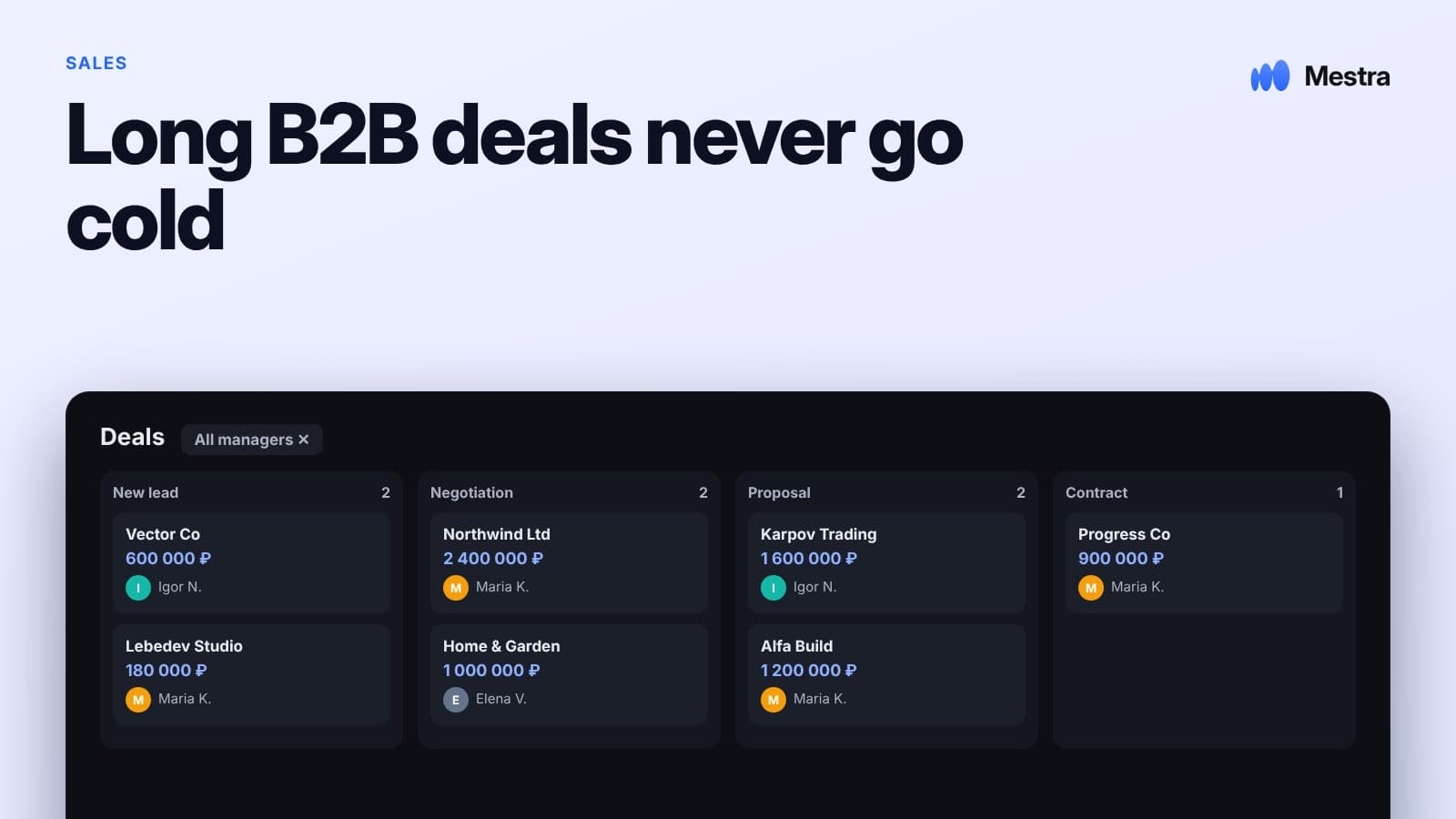
- A ready solution for your industry. At sign-up, you choose one of 23 industries — the deal stages are already built for a typical process and can be adjusted for your team.
- Deals move by themselves. Enquiries from MAX, Telegram, WhatsApp*, VKontakte, Instagram*, CIAN and Avito enter the funnel automatically. The AI assistant can move a deal forward itself by booking the person for a meeting.
- A reason for every refusal. When a deal is moved to "lost", the system requires a reason.
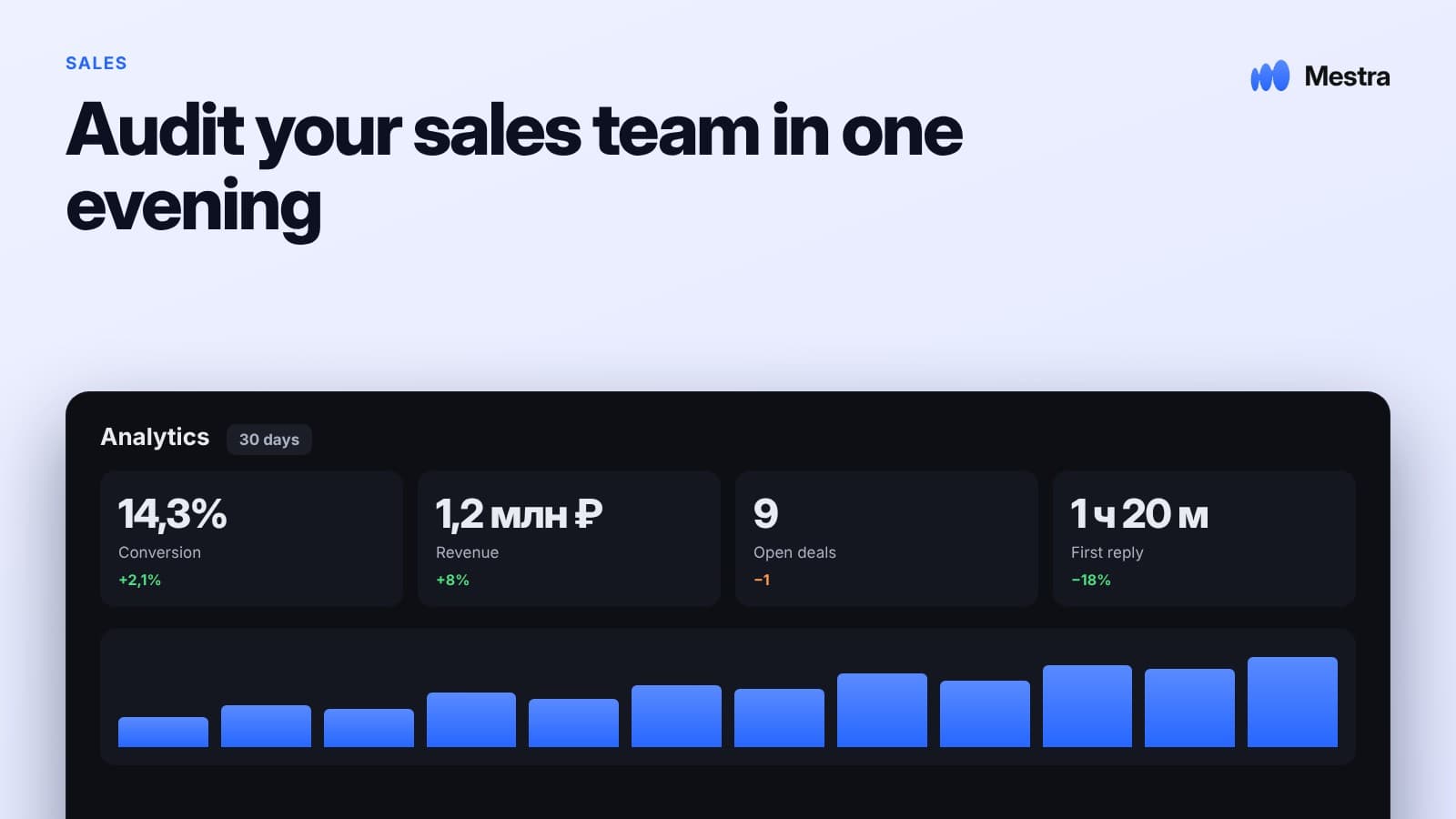
- Analytics without manual reports. Each manager's conversion, leads by source and the average time at each stage — for 7, 30, 90 or 365 days.
- Repeat sales. The whole history stays in the card, so you can return to past customers with a new offer.

FAQ
What is a sales funnel in simple terms?
The buyer's path from first enquiry to payment, broken into steps. The funnel shows how many people reached each step and where the most are lost.
How many stages should a funnel have?
Usually 5–7.
What funnel conversion is considered normal?
There's no single norm: it depends on the industry, the bill size and the enquiry source. Compare your conversion month by month and between managers.
Can you run a funnel in Excel?
You can, but the spreadsheet quickly goes out of date and doesn't show waiting time. In a CRM, the data updates itself.
Bottom line
A sales funnel shows not "how much you sold" but where the business is losing buyers.
Choose 5–7 steps, measure conversion and time at each one, look at the data by manager — and it becomes clear what to fix first. Try Mestra free for 15 days.
*WhatsApp and Instagram are owned by Meta, which is recognised as extremist and banned in Russia.