Sales department audit: how to find where your company loses clients and money
Sales9 min read
How to audit your sales department yourself: what to check in requests, conversations, the funnel, team and numbers, with a 30-point checklist and plan.

A sales department audit is a check of every stage of sales, from the incoming request to payment, to find where the company loses clients and money and to draw up a plan of fixes. You can run it yourself in 1-2 weeks if you have access to conversations, tasks and basic analytics.
The audit in a minute
| Area | Key question | Where to look |
|---|---|---|
| Requests | Does every request get a reply, and how fast? | All channels, response time |
| Conversations and calls | How do managers talk to clients? | 20-30 real conversations |
| Funnel | Where do clients drop off? | Conversion by stage, loss reasons |
| Team | Are there enough people and skills? | Workload, results by employee |
| Numbers | How much does a client cost and how much do they bring in? | Sources, average order value, repeat purchases |
When you need an audit
- revenue is flat even though the number of requests hasn't dropped;
- advertising is getting more expensive but sales aren't growing;
- the head of sales doesn't understand why one manager sells twice as much as another;
- clients complain about slow replies;
- the company is preparing to scale or hire new managers.
Step 1. Requests: are clients lost at the door
The most expensive losses are requests that got no reply or a reply that came too late. The advertising money has already been spent, and the client is gone.
What to check:
- Whether someone reads every channel where clients write (messengers, social networks, listing platforms, the website).
- The average first response time during and outside working hours.
- The share of requests unanswered for more than an hour.
- Whether there are requests that were never answered at all.
- Whether each chat is assigned to a specific manager.
- What happens to requests in the evening and on weekends.
A simple test: write to each of the company's channels as a client and time the reply.
Step 2. Conversations and calls: how managers sell
Take 20-30 real conversations from the last month: both successful and unsuccessful.
| Criterion | What to check |
|---|---|
| Greeting and tone | Polite, uses the client's name, no bureaucratic language |
| Needs discovery | Did the manager ask questions before giving the price |
| Offer | Did they propose options that fit the client's request |
| Handling objections | Did they answer "too expensive" or go silent |
| Next step | Did they suggest a specific action |
| Follow-up | Did they return to a client who didn't reply |
- Whether managers ask questions before naming a price.
- Whether they offer several options or just one.
- How they respond to the "too expensive" objection.
- Whether they suggest a next step at the end of every message.
- Whether they go back to clients who went quiet.
- Whether there are rude or careless replies.
For more on how to check the quality of replies, see the article on monitoring managers.
Step 3. The funnel: where clients drop off
| Stage | Conversion to the next one | What low conversion means |
|---|---|---|
| Request → conversation | The client replied to the first message | Slow or weak first reply |
| Conversation → offer | The client was sent options | Weak needs discovery |
| Offer → invoice | The client agreed | Price, weak objection handling |
| Invoice → payment | The client paid | Inconvenient payment, no invoice follow-up |
- Whether the deal stages and the criteria for moving between them are defined.
- Whether the conversion at each stage is known.
- Whether loss reasons are recorded.
- Which loss reasons are the most common.
- How many days a deal stays at each stage on average.
- How many issued invoices are unpaid.
Step 4. The team
- Whether the workload is distributed evenly.
- Which managers bring in the most revenue and why.
- Whether there are communication standards and reply templates.
- How onboarding of new hires works.
- How motivation is set up — whether people are paid for revenue, margin or volume.
- How much time managers spend on manual work: filling in records, reports, invoices.
Step 5. The numbers
- Which sources the paying clients come from.
- How much it costs to acquire a client in each channel.
- What the average order value is and how it changes.
- What the share of repeat purchases is.
- How many clients left over the past six months and why.
- Whether the owner sees these numbers without collecting them by hand.
If you can't answer half of the questions in this block, start with basic analytics — see the article on analytics in a CRM. And if it turns out that clients leave after the first purchase, the article on customer retention will help.
How to turn findings into a plan
An audit usually finds 15-20 problems. You don't need to fix everything at once. Pick 3-5 changes with the biggest effect:
| Problem | Impact | Difficulty | Priority |
|---|---|---|---|
| 15% of requests unanswered for more than an hour | High | Low | 1 |
| No loss reasons recorded | Medium | Low | 2 |
| Managers don't ask questions before the price | High | Medium | 3 |
| Invoices with no payment follow-up | Medium | Low | 4 |
| No onboarding standard | Medium | Medium | 5 |
For each change, set an owner, a deadline and a metric that will show in a month whether it worked.
A two-week audit plan
| Day | What we do |
|---|---|
| 1 | Test requests to all channels, measure response time |
| 2-3 | Pull the numbers: requests, conversion, loss reasons, sources |
| 4-6 | Review 20-30 conversations against the criteria |
| 7 | Analyze workload and results by manager |
| 8 | Short interviews with managers: what gets in the way of selling |
| 9 | Consolidate findings, list the problems |
| 10 | Prioritize, draw up a plan of 3-5 changes |
Interviews with managers: 7 questions
Managers often know best where clients are lost. Ask:
- What takes up the most time besides talking to clients?
- What do clients who decline most often say?
- What materials or answers are missing when working with clients?
- Where does information get lost between you and other departments?
- What would you change first in the sales process?
- Which requests are the hardest and why?
- What stops you from replying to clients faster?
Compare the answers with the numbers: if everyone says "too expensive" but the loss reasons don't confirm it, the problem may be in how managers present the price.
Common mistakes
- An audit based on gut feeling. Without real conversations and numbers, conclusions are subjective.
- Looking for someone to blame. An audit looks for problems in the process, not bad managers.
- A plan that is too big. Nobody will implement 20 changes at once.
- No follow-up check. A month later nobody looks at what has changed.
- Ignoring the first reply. The cheapest fixes are often right there.

How it works in Mestra
Mestra collects most of the audit data on its own:
- All channels in one window. Messengers, social networks and listing platforms — you can see which requests went unanswered and how fast people reply.
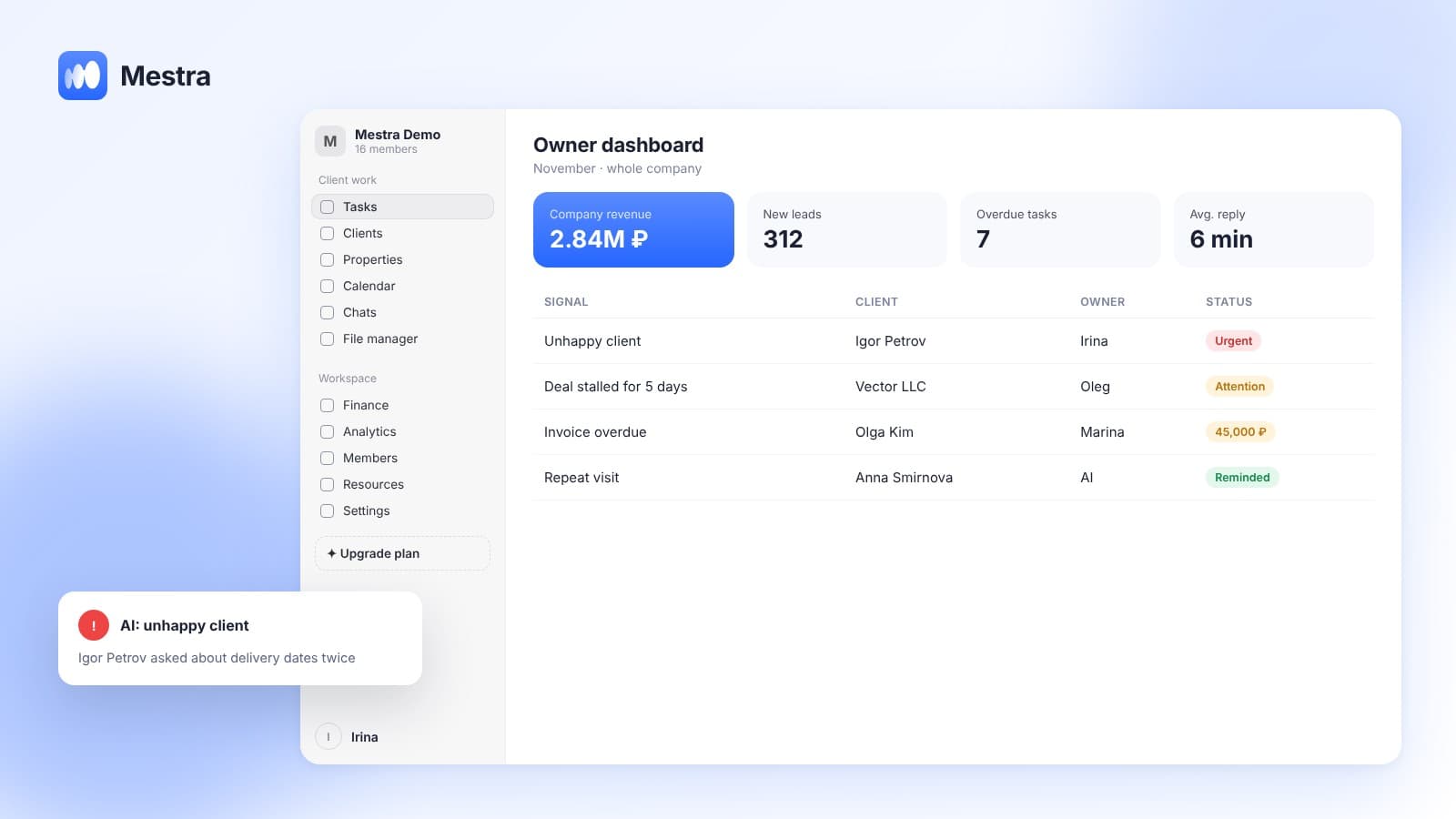
- AI conversation review. AI flags weak spots in operators' replies and unhappy clients — no need to read hundreds of chats by hand.
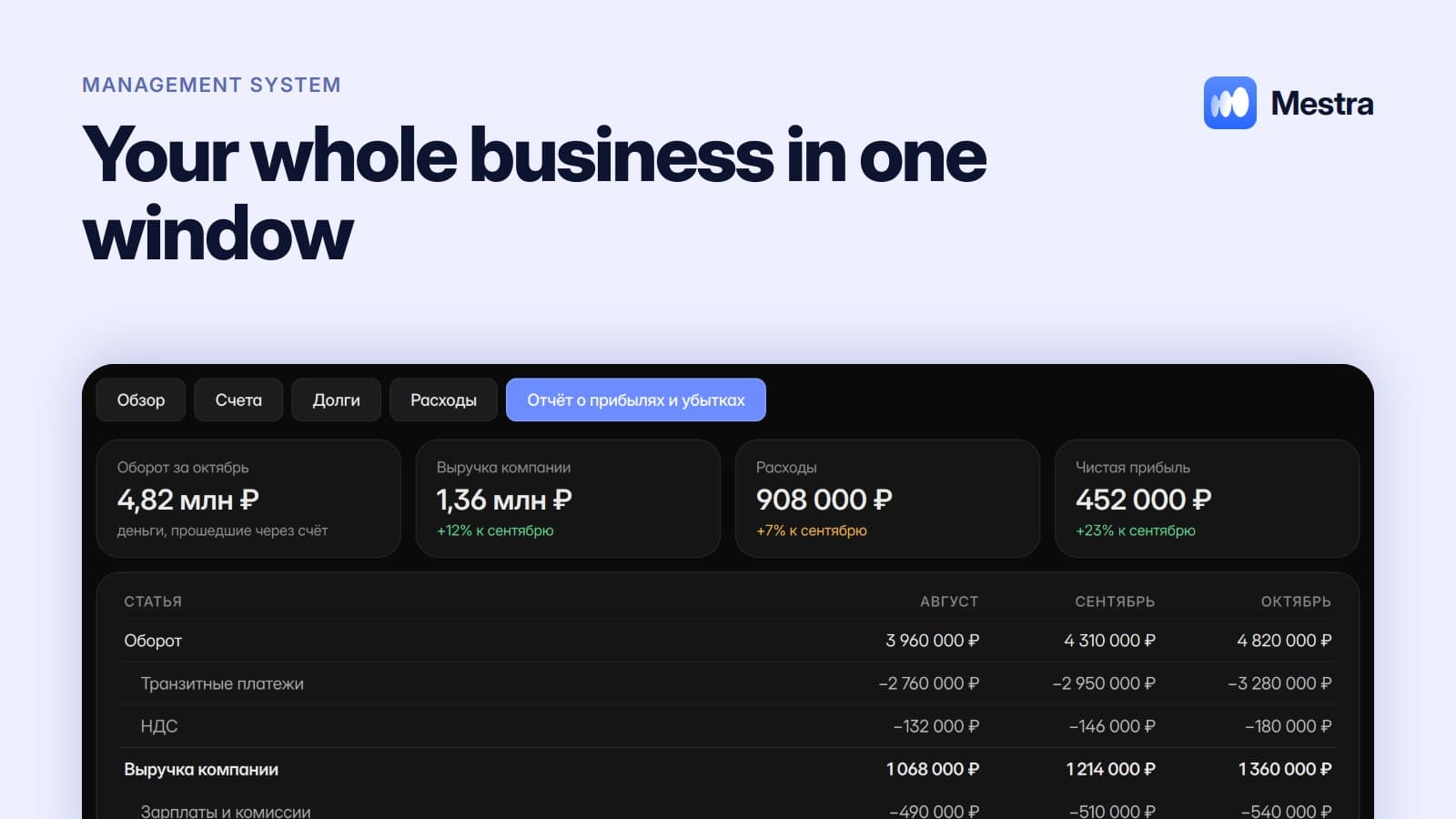
- Funnel analytics. A funnel of stages, conversion, loss reasons, client sources.
- Analytics by employee. Workload, response speed and conversion for each manager.
- Invoices and payments. You can see which invoices have been issued and not paid.
- Less manual work. AI fills in records, creates tasks and prepares invoices — managers get time back for selling.
Frequently asked questions
What is a sales department audit?
It is a check of every stage of sales — requests, conversations, the funnel, the team and the numbers — to find where clients and money are lost and to draw up a plan of fixes.
Can I run a sales department audit myself?
Yes, if you have access to conversations, tasks and basic analytics. It usually takes 1-2 weeks.
Where should a sales audit start?
With requests: whether every channel is being read, how fast people reply and how many requests are left unanswered. These are the most expensive losses and the easiest to fix.
How many conversations should I review?
Usually 20-30 conversations from the last month for each manager, including both successful and unsuccessful ones.
How often should I audit the sales department?
A full audit every six months or once a year, and a short check of key metrics every month.
Summary
A sales department audit covers five areas: requests, conversations, the funnel, the team and the numbers. The quickest results usually come from fixes at the entry point — the speed and completeness of replies. The result of an audit is a short plan of 3-5 changes with owners, deadlines and metrics.
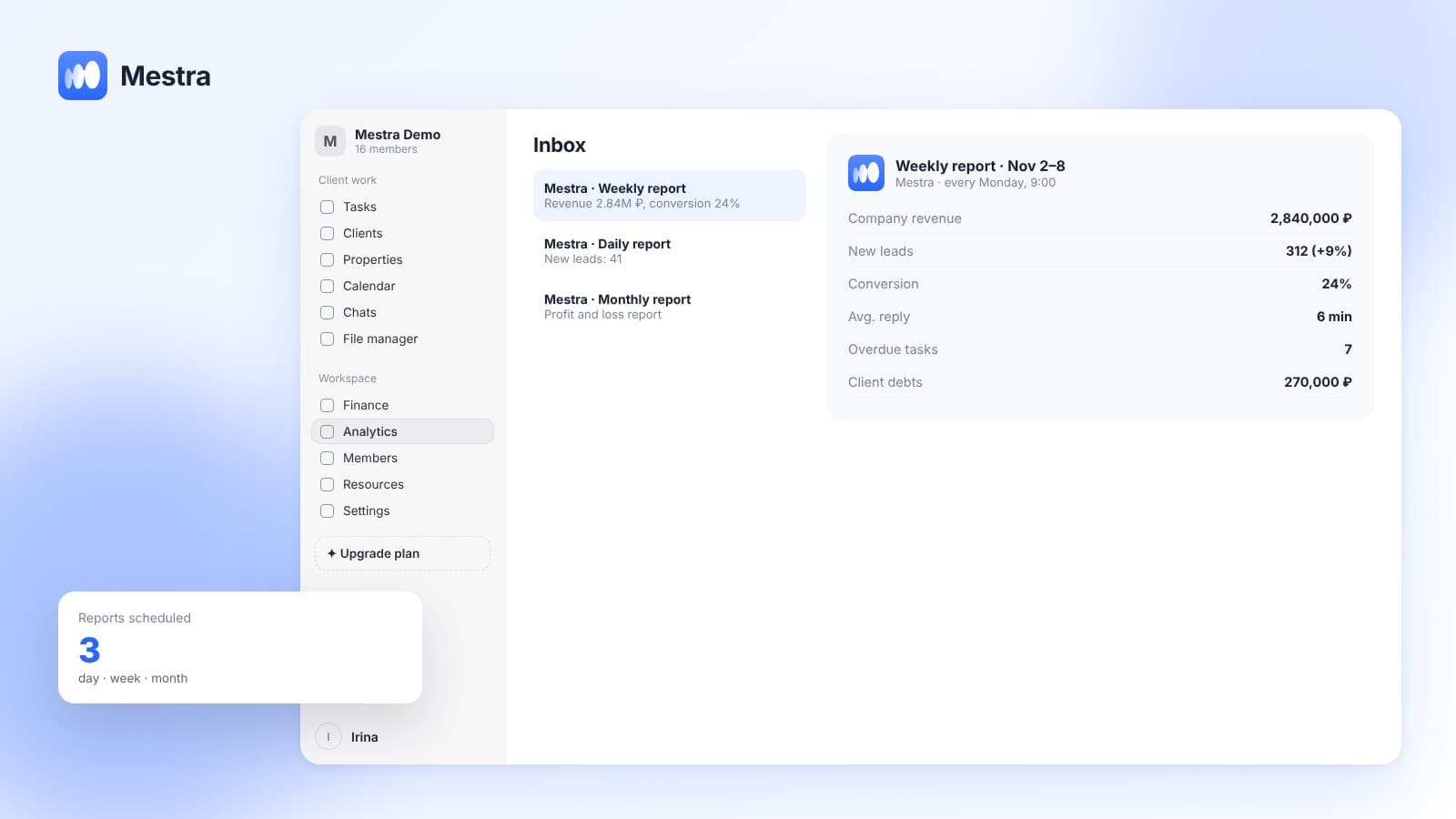
In Mestra, the data for an audit — response time, conversation quality, the funnel, loss reasons and workload — is collected automatically. Try Mestra free for 15 days at mestra.chat.