Client Tracking: How to Keep a Base, What to Record and Which Software to Use in 2026
Guides5 min read
How to keep track of clients: which fields to record, methods from a notebook and Excel to a CRM, when a spreadsheet stops being enough and how to switch.

Client tracking is a single base that stores, for each customer, their contacts, enquiry source, conversation history, purchases, payments and next step. You can keep it in a notebook, Excel or a CRM system.
The main rule is one base for the whole company, not a separate one for each manager. When enquiries come from several messengers and a team handles them, a CRM is more convenient: the base updates itself rather than once a week by hand.
Why a business needs client tracking
- Requests disappear. Someone wrote on Telegram, nobody replied, and a week later nobody remembers they got in touch.
- The base leaves with the employee. If contacts are on a manager's personal phone, the company is left with nothing when they leave.
- Repeat sales don't happen. Nobody goes back to past customers, even though it's easier and cheaper to sell to them.
- It's unclear where people come from. Without tracking sources, advertising is paid for blindly.
What to record about each client
| Field | Why |
|---|---|
| Name and phone | To get in touch |
| Messengers | Where the person prefers to talk: MAX, Telegram, WhatsApp* |
| Source | Avito, website, referral, advertising |
| Type | Buyer, tenant, seller, partner |
| Interest | What they want to buy or which problem to solve |
| Conversation history | What was agreed and promised |
| Next step | What to do next and when |
| Purchases and payments | What they bought and for how much |
| Date of first enquiry | How long the deal takes |
| Owner | Who handles the client |
The most important field is the next step. A card without it is a contact, not work with a customer.
3 ways to keep track of clients
| Method | Pros | Cons | Who it suits |
|---|---|---|---|
| A notebook or notes | Simple | No search, reminders or shared access | A handful of clients |
| Excel or Google Sheets | Free, familiar, shared access | No reminders, messages by hand, goes out of date fast | A start, one or two people |
| A CRM system | The base updates itself, tasks, analytics | Needs choosing and setting up | A team and several channels |
How to keep a base in a spreadsheet — in our article CRM in a spreadsheet; what a CRM is — in our article what a CRM is in simple terms.
When a spreadsheet is no longer enough
It's time to move to software if at least two of these apply:
- enquiries come from several channels;
- there are more than a few dozen clients a month;
- more than one person works with them;
- you can't say within a minute how many deals are in progress;
- promises to "call back on Thursday" are regularly forgotten.
How to move from a spreadsheet to software without losses
- Clean the spreadsheet. Remove duplicates and bring phone numbers into one format.
- Decide on the fields. Keep only what you actually use.
- Upload the base to the CRM. Most systems accept an Excel file.
- Connect the channels — the messengers and classified sites enquiries come from.
- Set up roles and permissions so an employee can't export the whole base.
- Agree the rules. Every enquiry is a card, every agreement is a task.
How it works in Mestra
Mestra is our product. Client tracking in Mestra is designed so the base fills itself as you work:
- One base for the whole company with filters and export to Excel.
- A client card with the key data: type, source (UTM), messengers, date of first enquiry, manager notes.
- All history in one place: conversations, tasks, invoices and payments, files.
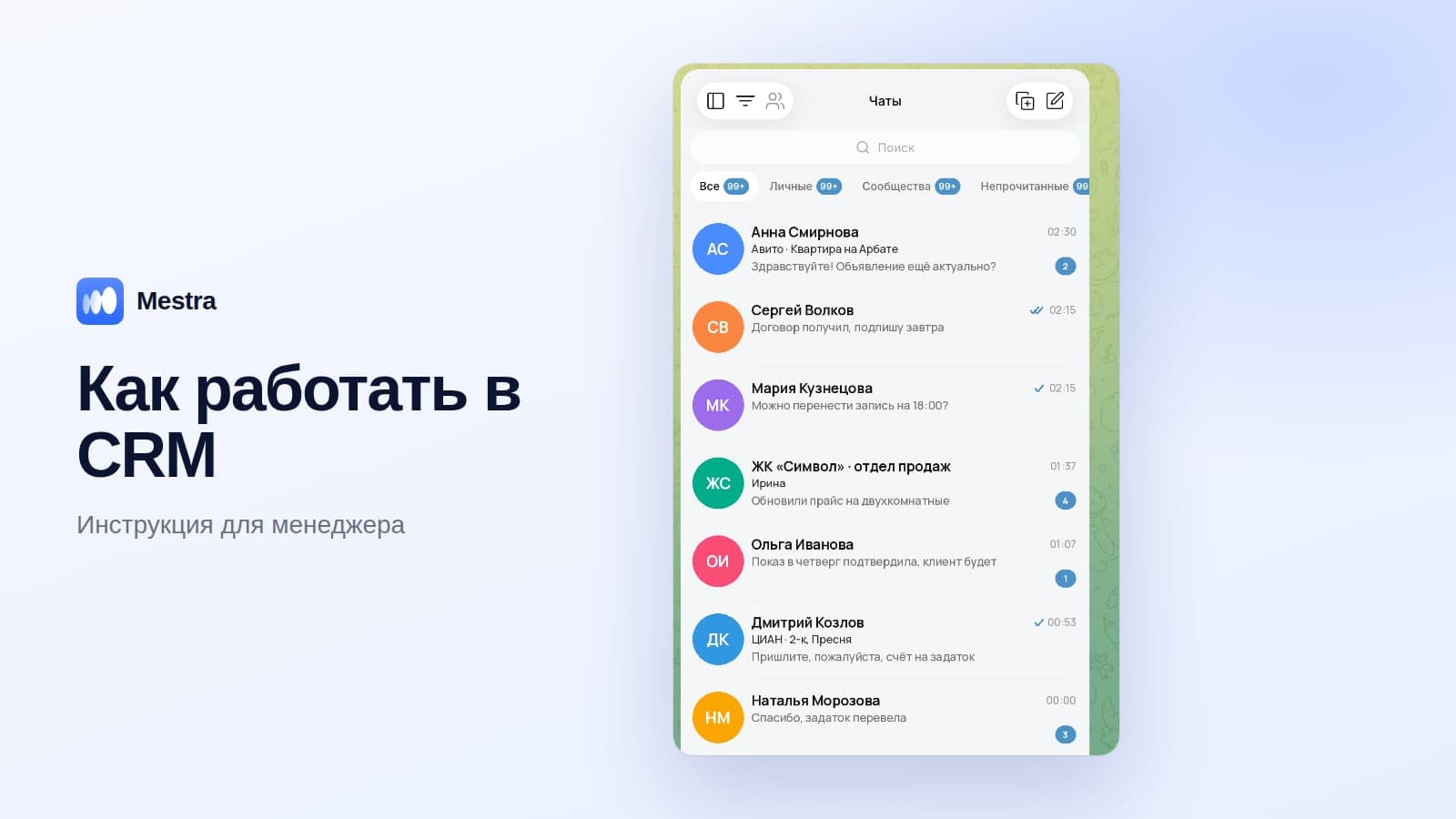
- Enquiries from messengers and classified sites — MAX, Telegram, WhatsApp*, VKontakte, Instagram*, Avito, CIAN — go straight into cards.
- Roles and detailed permissions, unlimited users — from one manager to hundreds.
- Import from Excel or an old CRM at launch.

FAQ
Which software should you use to track clients?
If you have few clients and work alone, Google Sheets is enough. If enquiries come from messengers and a team handles them, a CRM where the base updates itself is more convenient.
Can you track clients for free?
Yes: in a spreadsheet or on some CRMs' free plans. Most systems have a trial; Mestra offers 15 days with no bank card.
How do you avoid losing the base when a manager leaves?
Keep contacts and conversations in a shared system rather than on personal phones, and set up permissions.
Is it legal to store client data?
Yes, provided you comply with Federal Law No. 152-FZ: you need consent to process personal data, and the data of Russian citizens must be stored in line with the law's requirements.
Bottom line
Client tracking starts not with software but with a rule: one base for everyone and a next step in every card.
A spreadsheet suits a start, but when there are many enquiries and several channels, the base needs to update itself. Try Mestra free for 15 days: move your base from Excel and connect your messengers in 10 minutes.
*WhatsApp and Instagram are owned by Meta, which is recognised as extremist and banned in Russia.