CRM With AI: Why You Need a CRM If All You Do Is Record Clients in It
CRM8 min read
Why pay for a CRM that stores records like a spreadsheet? What a CRM with AI does by itself: matches listings to clients, sets tasks from chats, wins clients back.

A CRM where managers only record clients is the same spreadsheet, just more expensive. The real reason to have a CRM is for the system to suggest the right option to the client, set a task after a conversation and remind you about a person you would otherwise forget.
That's why many owners are disappointed after implementation. They bought a system and moved the base over, and three months later managers are back to running clients in messengers and notebooks. The problem isn't the people. The problem is that the system only demands things from them and gives nothing back.
One-minute check: does your CRM work or just store?
Answer "yes" or "no" to five questions:
- When a new request comes in, does the system suggest suitable listings, products or services by itself?
- If a client writes "call me back on Friday", does a Friday task appear without the manager doing anything?
- Do you find out about an unhappy client before they go to a competitor?
- Does the system remind you about clients who bought six months ago and disappeared?
- Does the manager avoid copying data from the chat into the card by hand?
Three or more "no" answers mean you have an archive, not a working tool. You could replace it with a spreadsheet and lose nothing.
Why a CRM turns into an address book
A classic CRM is built like a card index: fields, statuses, a pipeline. A person fills all of it in. If a manager forgets to log a call, the system never learns about it. If a client hasn't replied for a week, nobody notices.
Let's compare the two approaches in specific situations:
| Situation | Archive CRM | CRM that works by itself |
|---|---|---|
| A new request to buy a flat | The agent searches the base by hand | The system shows matching listings in the client card |
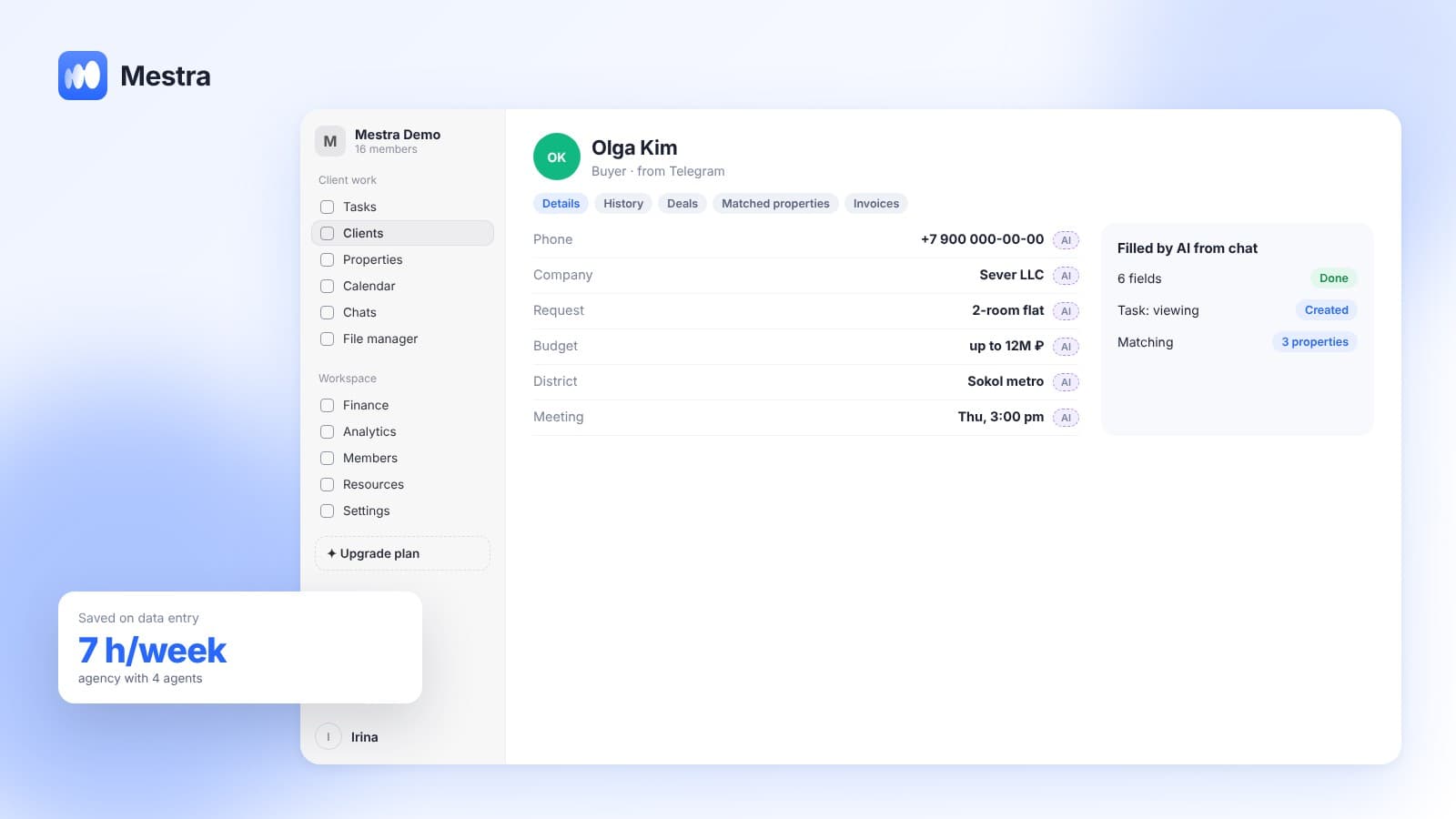
| The client mentioned budget and area in chat | The agent copies the data into fields | AI fills in the card from the conversation |
| You agreed to talk on Friday | It lives in the manager's head | AI creates a task with a deadline |
| A deal hasn't moved for two weeks | Nobody sees it | The owner gets a signal |
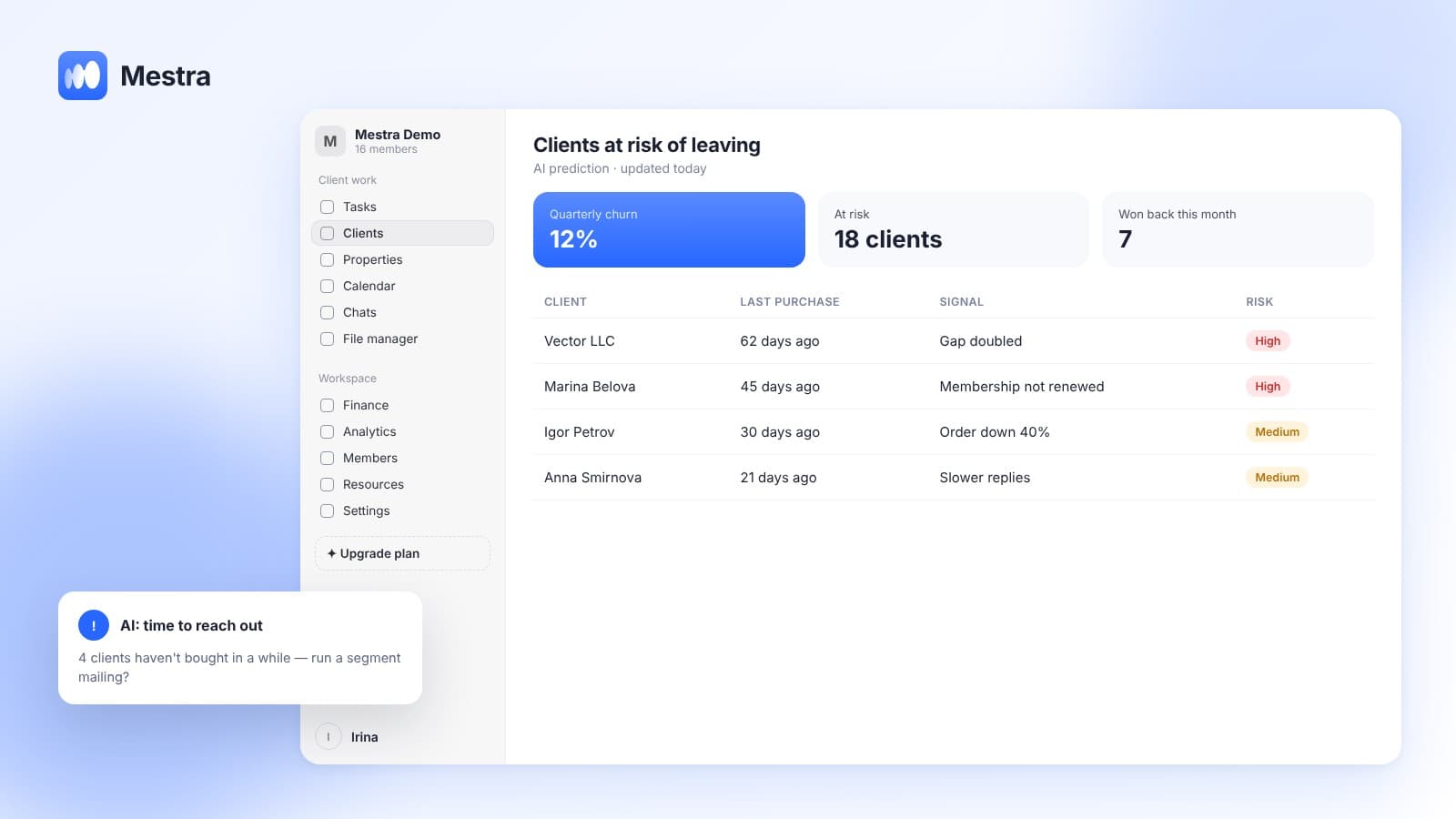
| A client hasn't been in touch for a long time | Drops out of sight | The system flags the churn risk and prepares a message |
We covered when a spreadsheet stops being enough in detail in our article CRM in Excel or Google Sheets. The conclusion here is different: moving from a spreadsheet to a system that also only stores changes almost nothing.
What a CRM with AI does by itself: 7 actions
Matches options to the client's request
This is the main difference from a card index. You describe the client's need once, and the system compares it with your base and shows what fits. In a real estate agency, that means flats by budget, area and size. In a car dealership, cars by make, year and price. The agent doesn't scroll through hundreds of cards but calls straight away with a specific offer.
Fills in the client card from the conversation
A client writes in a messenger: "Looking for a two-bedroom up to 12 million, close to the metro." AI moves the budget, property type and wishes into the card fields by itself. The manager only needs to check.
Sets tasks from agreements
"Let's come back to this on Thursday" becomes a task with a date and an owner. Promises to clients no longer get lost between chats.
Launches a process from a template
When a new deal appears, AI creates a workflow from your industry's template: stages, deadlines, owners. You don't have to assemble it by hand every time.
Suggests the next step and writes texts
AI suggests what the manager should do next and prepares a draft commercial proposal or email. The manager edits and sends it.
Notices an unhappy client
AI analyses the conversation and tells the owner if a client is irritated or disappointed. There's time to fix things before the person leaves.
Reminds you about people who disappeared
The system flags clients who haven't come back for a long time and suggests offering them something new. For an agency, it's a reason to offer a tenant a purchase six months later; for a salon, to book a repeat treatment.
Matching to the client across industries
| Industry | What the system matches |
|---|---|
| Real estate | Listings by budget, area, size and deal type |
| Automotive | Cars by make, year and price |
| Recruitment | Candidates against vacancy requirements |
| Tourism | Tours by destination, dates and budget |
| Retail and clinics | Products and services related to the client's past purchases |
An example in numbers: a real estate agency
Take an agency with four agents. Each gets about 25 new enquiries a week.
One-minute calculation:
- Filling in a card by hand takes about 4 minutes: 25 × 4 = 100 minutes a week per agent.
- For four agents that's 400 minutes — almost 7 hours a week spent just retyping data.
- Searching the base for options by hand takes another 10 minutes per request: 25 × 10 = 250 minutes a week per agent.
- Together that's about 23 hours a week for the whole agency — more than one employee's full working week.
- Mestra on the Standard plan with AI: 4 × 1,090 ₽ = 4,360 ₽ a month.
If the time freed up brings back even one deal a quarter with a 150,000 ₽ commission, the system pays for itself many times over. And winning back "lost" clients adds deals that simply didn't happen before.
How it works in Mestra
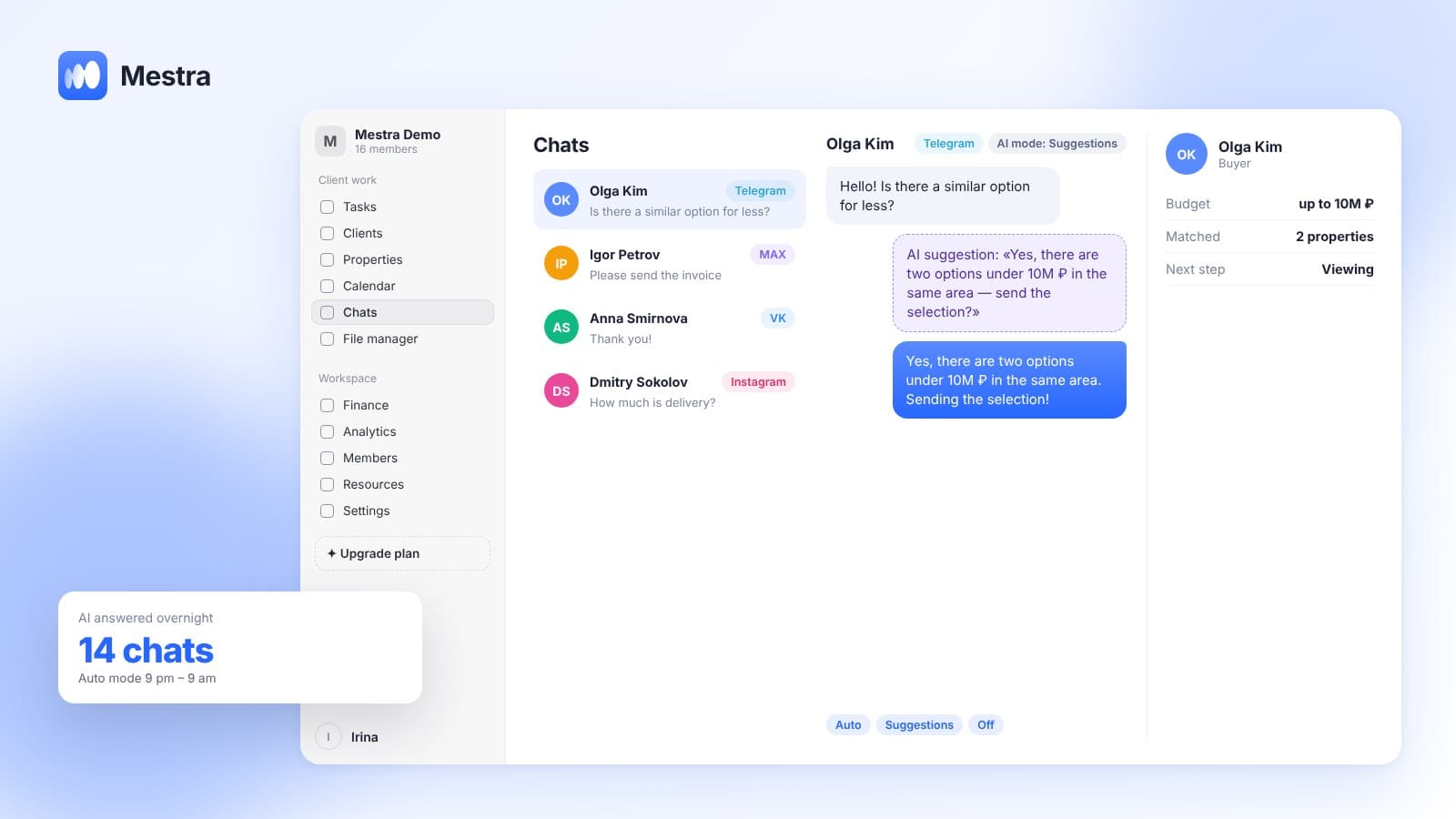
In Mestra, the AI operator works in three modes, switched on for each chat or for all of them at once:
- Auto — AI replies to clients itself using your base of products, services and documents;
- Suggestions — AI proposes a reply, and the manager edits and sends it;
- Off — only people handle the conversation.
All channels are in one window: MAX, Telegram, WhatsApp*, VKontakte, Instagram*, Avito, CIAN. Client cards, listings and forms are set up for each of 23 industries, so matching in real estate works on flat parameters and in recruitment on vacancy requirements.
The owner can give AI instructions straight from Mestra's Telegram bot: write what needs doing or which report to show, and the system does it in the CRM. Signals about stalled cases, duplicate clients and unhappy clients arrive automatically.
AI is available on the Standard (1,090 ₽) and Pro (1,590 ₽) plans per user per month incl. VAT. To see how the process works in an agency, take a look at CRM for a real estate agency.
Read also: candidate search, real estate listing database, upselling, repeat sales, client retention, service quality assessment, commercial proposals with AI.

FAQ
Why do you need a CRM if clients can be kept in a spreadsheet?
If the CRM only stores records, there's almost no difference. It starts to make sense when the system matches options, sets tasks and reminds you about clients by itself — a spreadsheet can't do that.
Will AI replace the manager?
No. AI takes the routine: retyping data, reminders, draft emails. Decisions and real conversation stay with people, and in Suggestions mode no message goes out without the manager.
Why don't managers want to work in a CRM?
Most often because the system demands data entry and gives nothing back. When a CRM suggests the right listing itself and remembers agreements, working in it becomes more worthwhile than working without it. More in our article on CRM implementation.
How is client data protected?
Clients' personal data is processed in line with Federal Law No. 152-FZ, and access to it is configured by role.
Is it hard to switch from another system?
No. Export your data from your current CRM and upload it to Mestra under Settings → Data → Import — no integrator needed.
Bottom line
A CRM earns its keep not by storing clients but by working with them for you: matching options, keeping track of agreements and bringing back people who disappeared. Mestra is a CRM where clients, tasks, finance and an AI operator are brought together in one window. See how it looks in your industry: 15 days free, no card required.
*WhatsApp and Instagram are owned by Meta, which is recognised as extremist and banned in Russia.