CRM Implementation: A 4-Week Plan, 7 Mistakes and the Rules Without Which Managers Won't Use the System
Guides5 min read
How to implement a CRM: a 4-week plan, rules for the team, 7 common implementation mistakes, the downsides of a CRM and how to make sure managers actually use it.

Implementing a CRM isn't buying software — it's moving client work into one system: describing the sales process, setting up stages, moving the base, connecting messengers and classified sites, and rules for the team. For a small team it takes from a few days to a month; for a large one it happens in stages, department by department.
The main risk isn't technical: if managers don't manage deals in the system, even an expensive CRM will show an empty pipeline. That's why the most important thing is for client conversations to happen right in the CRM, not on personal phones.
Start with the process, not choosing software
Before buying, answer four questions in writing:
- Where do enquiries come from: messengers, classified sites, website, calls?
- Who replies to them, and how quickly?
- What stages does a deal go through — from enquiry to payment?
- Where are people being lost right now?
These answers are your requirements for the CRM.
A 4-week implementation plan
| Week | What to do | Result |
|---|---|---|
| 1. Choosing and testing | 2 systems on trial, 5–10 real deals in each | It's clear where the team is more comfortable |
| 2. Moving and setting up | The base from Excel or an old CRM, pipeline stages, messengers and classified sites | The system is ready to work |
| 3. Rules and training | Agreements, a "champion" in the team, roles and permissions | Everyone works by the same rules |
| 4. Checking | Are all enquiries in the system, are deals moving, are there reasons for refusal | It's clear what to fix |
For large teams, add a pilot: first one team or one branch, then the rest in turn.
Why managers don't work in the CRM
- The CRM is seen as control rather than help. It's unclear what the employee gets in return.
- Entering data takes time. If conversations have to be copied in by hand, people will stop copying them.
- There are no consequences. If the head doesn't look at the system, managers quickly notice.
4 rules without which the pipeline will be fiction
- Every enquiry is a card. No "I'll add it later".
- Every deal is at a stage. A stalled deal must be visible.
- Every loss has a reason. Otherwise it's unclear what to fix.
- Every promise is a task with a deadline. "I'll call back on Thursday" lives in the system.
And a fifth, for the head: look at the pipeline with the team once a week. People maintain a system when it's looked at. How to do it without total surveillance — in our article how to oversee managers.
7 CRM implementation mistakes
- Buying it "for show" without understanding what should change.
- Software first, process second.
- All features at once. Start with four: cards, the pipeline, tasks, reports.
- Demo data instead of real deals during the selection stage.
- No rules for filling it in.
- Expecting an instant effect. Results usually show after 1–3 months.
- Copying conversations by hand. If messengers aren't connected, managers will keep working on their phones.
The downsides of a CRM and how to reduce them
| Downside | How to reduce it |
|---|---|
| Subscription and implementation costs | Calculate the full annual cost, and choose a system you can launch without an integrator |
| Team resistance | Show that the CRM saves time: reminders, history, AI suggestions |
| A temporary dip in productivity | Launch in a quiet period, start with one department |
| Storing personal data | Check that the system complies with Federal Law No. 152-FZ |
How it works in Mestra
Mestra is our product. We tried to remove the main reasons implementation stalls:
- Launch in 5–10 minutes: you choose one of 23 business industries — stages, fields and roles are already set up.
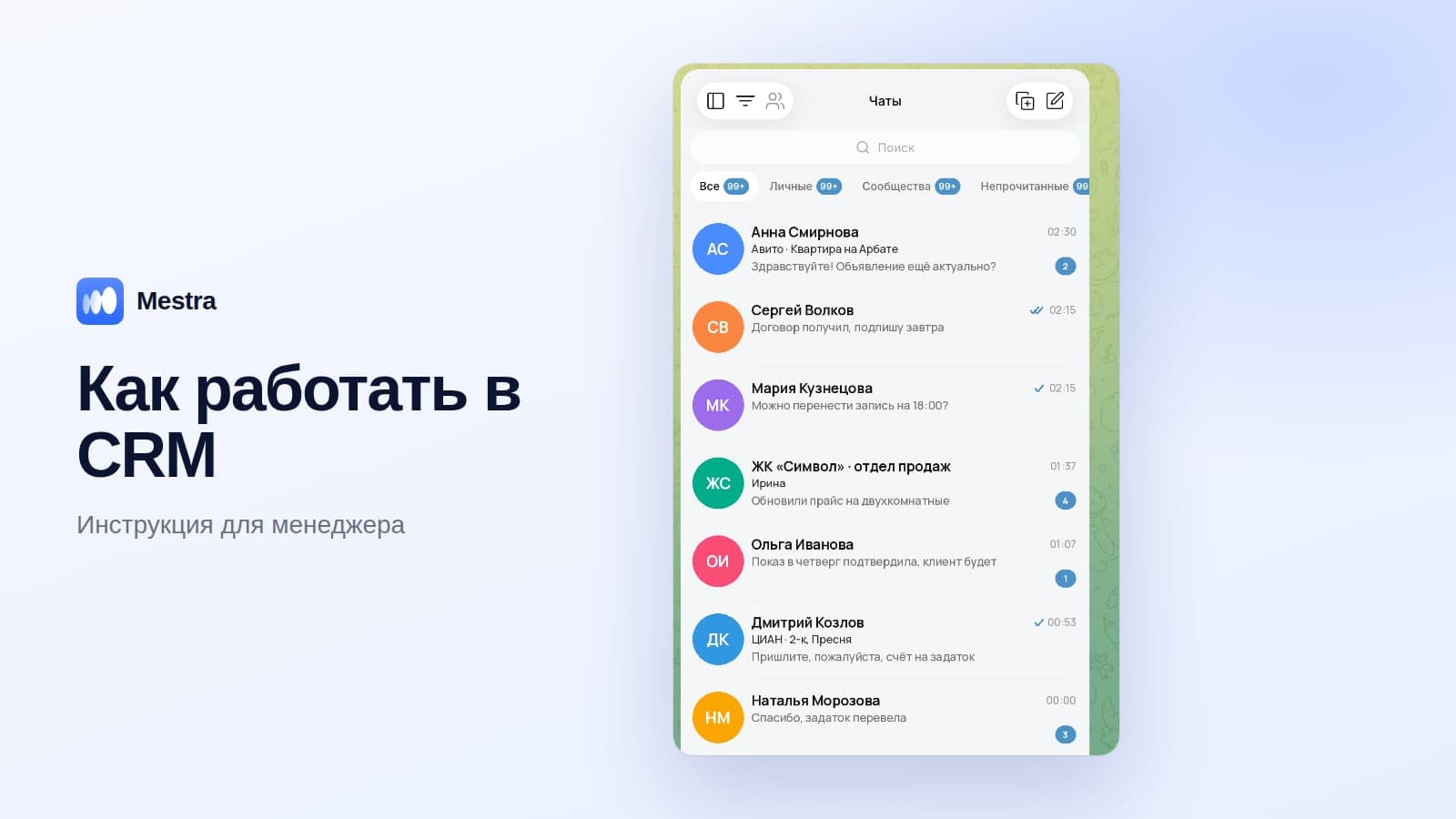
- Messengers and classified sites are connected to cards — conversations don't need to be copied by hand.
- A reason for refusal is required: when a deal is moved to "lost", the system asks for a reason.
- Analytics without manual reports: each employee's conversion and time at each stage.
- Roles and detailed permissions for teams of any kind.
- Moving the base from Excel or an old CRM at launch.
- Enterprise for large companies: the Mestra team designs and configures the system for the client's processes.

FAQ
How long does CRM implementation take?
For a small team, from a few days to a month. Getting the team used to the rules takes longest.
Do you need an integrator?
For complex systems, often yes. A CRM with ready industry solutions can be launched by yourself, and for special processes there's custom implementation.
How do you get managers to fill in the CRM?
Connect messengers so conversations enter the system by themselves, agree on the four rules and look at the pipeline regularly with the team.
When will you see results?
The first lost requests are usually found in the very first week. Conversion growth comes after 1–3 months.
How do you implement a CRM in a large company?
In stages: a pilot group, roles and permissions, then the other departments in turn.
Bottom line
A CRM starts working not on the day you buy it but on the day the whole team manages deals in it.
Describe the process, start small, agree on rules and make sure conversations happen right in the system. Try Mestra free for 15 days.