CRM in an Excel or Google Sheets Spreadsheet: How to Build One, a Free Template and When to Switch to a System
Guides5 min read
How to build a CRM in Excel or Google Sheets: the column structure, 5 useful settings, a free template, pros and cons, and when it's time to switch to a CRM.

A CRM in a spreadsheet is an Excel or Google Sheets file where each row is a client or deal, and the columns are contacts, messenger, source, stage, owner, next step and amount. That's enough to start with: free, familiar, and you can give the team access.
But when enquiries pile up and there are several channels, the file can't keep up with the work: it's filled in late, tasks get forgotten, requests get lost. That's when it's time to switch to a CRM system where the base updates itself.
Mistakes when tracking clients in a spreadsheet
- Every manager keeps their own copy. A month later, the company has three versions of the base and none of them is up to date.
- There's no "next step" field. The spreadsheet stores contacts but doesn't tell you whom to write to and when.
- Conversations stay on phones. The spreadsheet shows the client's name but not what was agreed.
- Everyone has access to the whole base. Any employee can copy all the clients.
How to build a CRM in Google Sheets or Excel
| Column | What to enter |
|---|---|
| Enquiry date | When the person first wrote or called |
| Name and phone | Contacts |
| Messenger | MAX, Telegram, WhatsApp*, VKontakte |
| Source | Avito, website, referral, advertising |
| Interest | What they want to buy |
| Stage | New enquiry, meeting, proposal, paid, lost |
| Owner | Who handles the deal |
| Next step | What to do |
| Next step date | When to do it |
| Deal amount | For calculating revenue by stage |
| Reason for loss | Why the deal fell through |
| Comment | Important agreements |
5 settings that make work easier
- A drop-down list for the stage — so everyone writes the same thing.
- A frozen header row.
- Conditional formatting: an overdue next-step date is highlighted in red.
- Filters by owner and stage.
- A separate summary sheet: how many deals are at each stage and for what amount — using COUNTIF and SUMIF formulas.
A free template
A ready template: a Clients sheet with drop-down lists for stages and messengers, and a Summary sheet that calculates the number of deals, the amount by stage and conversion to payment by itself. The template opens in Excel or can be uploaded to Google Sheets.
Download the client tracking template (Excel)
Pros and cons
| Pros | Cons |
|---|---|
| Free | Doesn't remind you about tasks |
| Familiar and flexible | Doesn't collect messages from messengers |
| Quick to start | Filled in by hand and goes out of date fast |
| You can give the team access | Easy to delete or damage data by accident |
| — | No conversation history or communication quality control |
| — | No access control for clients |
When to switch from a spreadsheet to a CRM
- Enquiries come from several messengers and classified sites.
- More than one person works with clients.
- The file gets filled in "later" and lags behind reality.
- Promises to call back get forgotten.
- You need to see how managers talk to customers.
- You need permissions so an employee can't copy the whole base.
More in our article client tracking: how to keep a base.
How to move your data into a CRM
- Remove duplicates and bring phone numbers into one format.
- Keep only the columns you actually use.
- Upload the file to the CRM — most systems accept Excel.
- Set up the stages the same way as in the spreadsheet — the team will find it easier to adjust.
- Connect messengers so new enquiries enter the system by themselves.
How it works in Mestra
Mestra is our product. If the spreadsheet can no longer cope, you can move the base in one go, and from then on it updates itself:
- Import from Excel or an old CRM at launch.
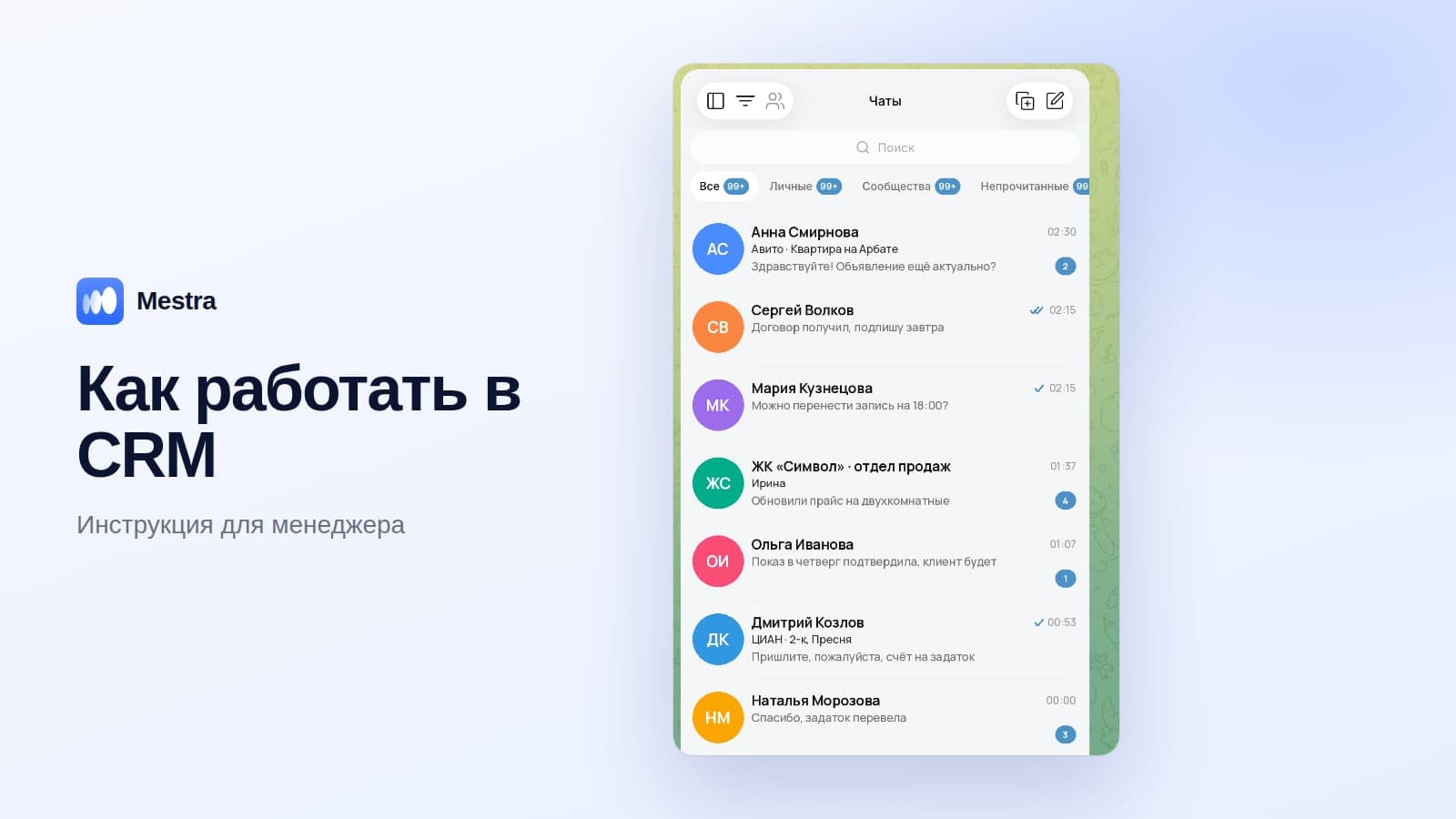
- Enquiries from messengers and classified sites — MAX, Telegram, WhatsApp*, VKontakte, Instagram*, Avito, CIAN — go straight into cards.
- Tasks and reminders instead of a "next step" column.
- Roles and permissions for the base.
- Export to Excel at any time — the data stays yours.
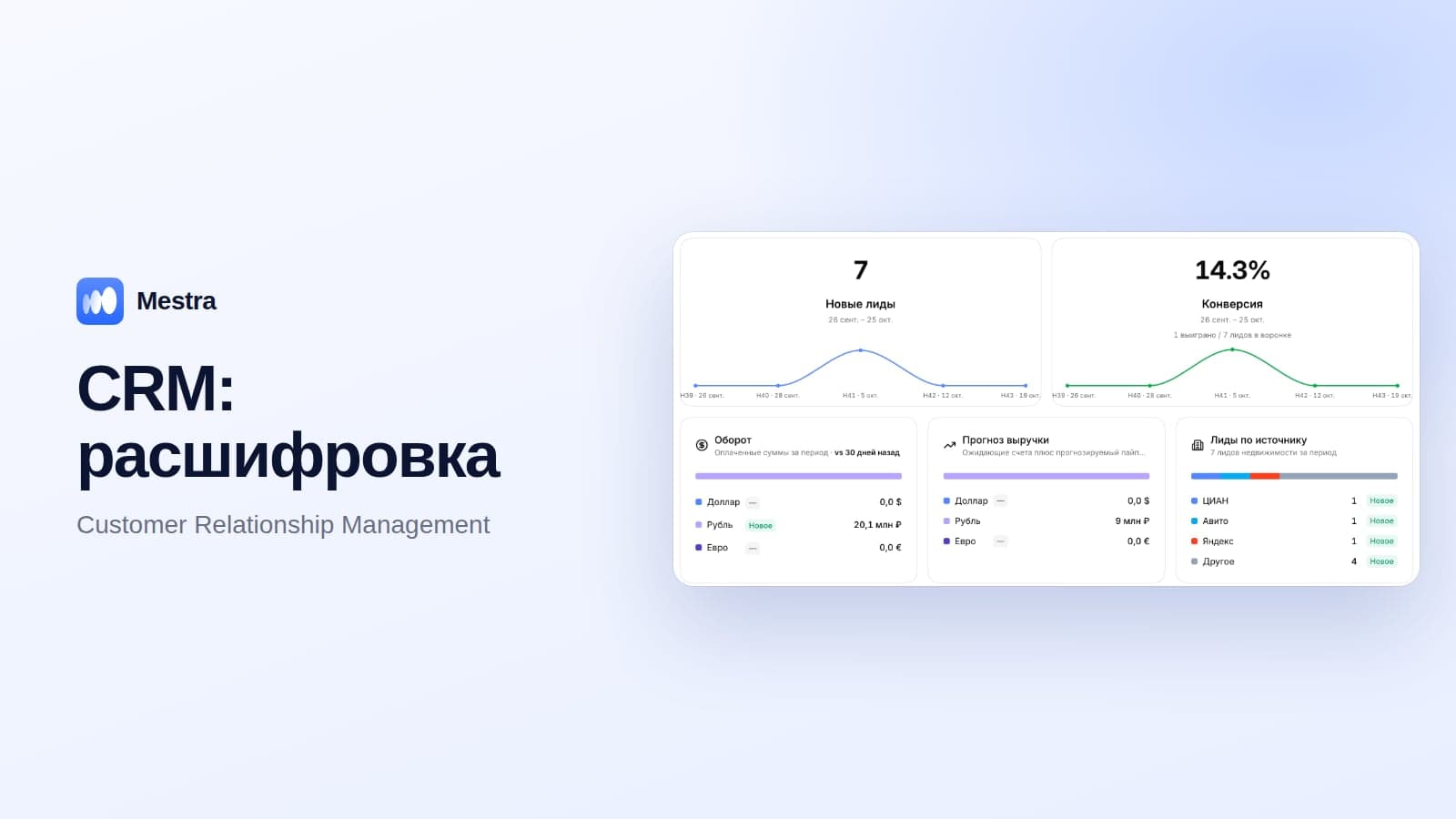
- Analytics without formulas: conversion, sources, reasons for refusal.

FAQ
Can you build a free CRM in Google Sheets?
Yes. Create columns for contacts, source, stage and next step, or use a ready template.
How is a CRM different from a spreadsheet?
A spreadsheet is filled in by hand, while in a CRM enquiries from messengers arrive by themselves, tasks remind you about themselves, and the head sees the pipeline and the conversations.
How do you move clients from Excel to a CRM?
Clean the file of duplicates and upload it via import. In Mestra, the move is part of the launch.
Up to what business size is Excel enough?
Usually while you work alone and don't have many enquiries.
Bottom line
Excel is a good first step, especially with a ready template.
But as soon as requests start getting lost and filling in gets postponed, it's time to move to a system where the base updates itself. Try Mestra free for 15 days: move your base and connect messengers in 10 minutes.
*WhatsApp and Instagram are owned by Meta, which is recognised as extremist and banned in Russia.