Management Accounting: How an Owner Can See Profit, Not Just Revenue — and Where to Start
Finance5 min read
Management accounting in simple terms: how it differs from statutory accounting, the 3 reports an owner needs, where to start and how to avoid spreadsheet chaos.

Statutory accounting answers the tax authority's questions. Management accounting answers the owner's.
Without it, decisions on prices, hiring and advertising are made on gut feeling, not numbers.
One-minute plan
- Gather all of last month's income and expenses in one place.
- Sort expenses into categories.
- Calculate profit and the cost of your main products.
- Repeat every month on the same day.
The purpose of management accounting
The purpose of management accounting is to give the owner and managers numbers for decisions: what prices to set, whom to hire, where to invest in advertising and how much money can be taken out. Financial and management accounting run in parallel: the first is for the state, the second for running the business.
How it differs from statutory accounting
| Statutory | Management | |
|---|---|---|
| Who it's for | Tax authority, bank | Owner, managers |
| Rules | Law and standards | Whatever suits the company |
| Frequency | Quarter, year | Month, week |
| Level of detail | By ledger account | By product, channel, employee |
The three key reports
- The profit and loss report — did we make money. See P&L.
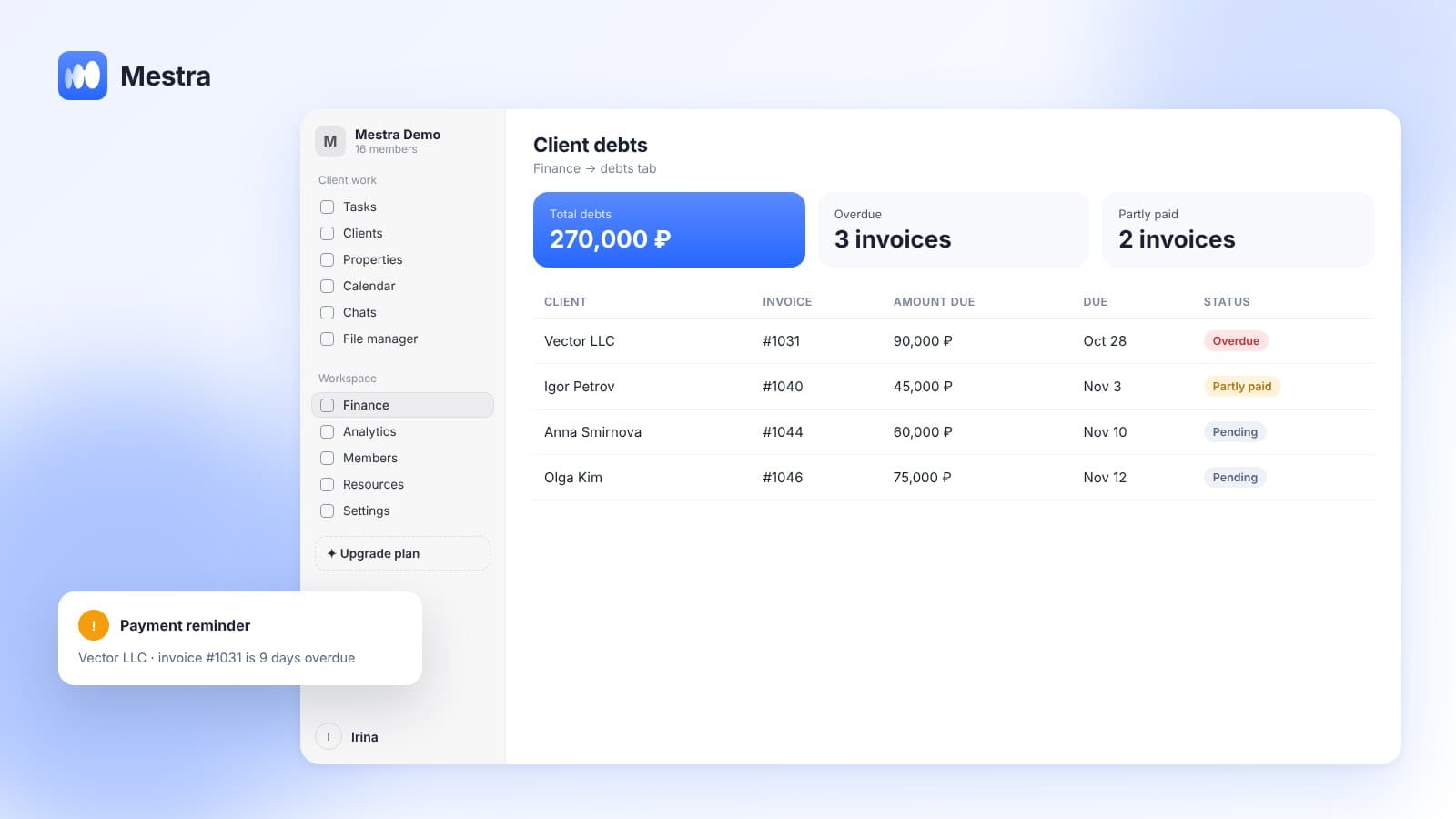
- The cash flow statement — will there be enough money. See profit on paper, no cash.
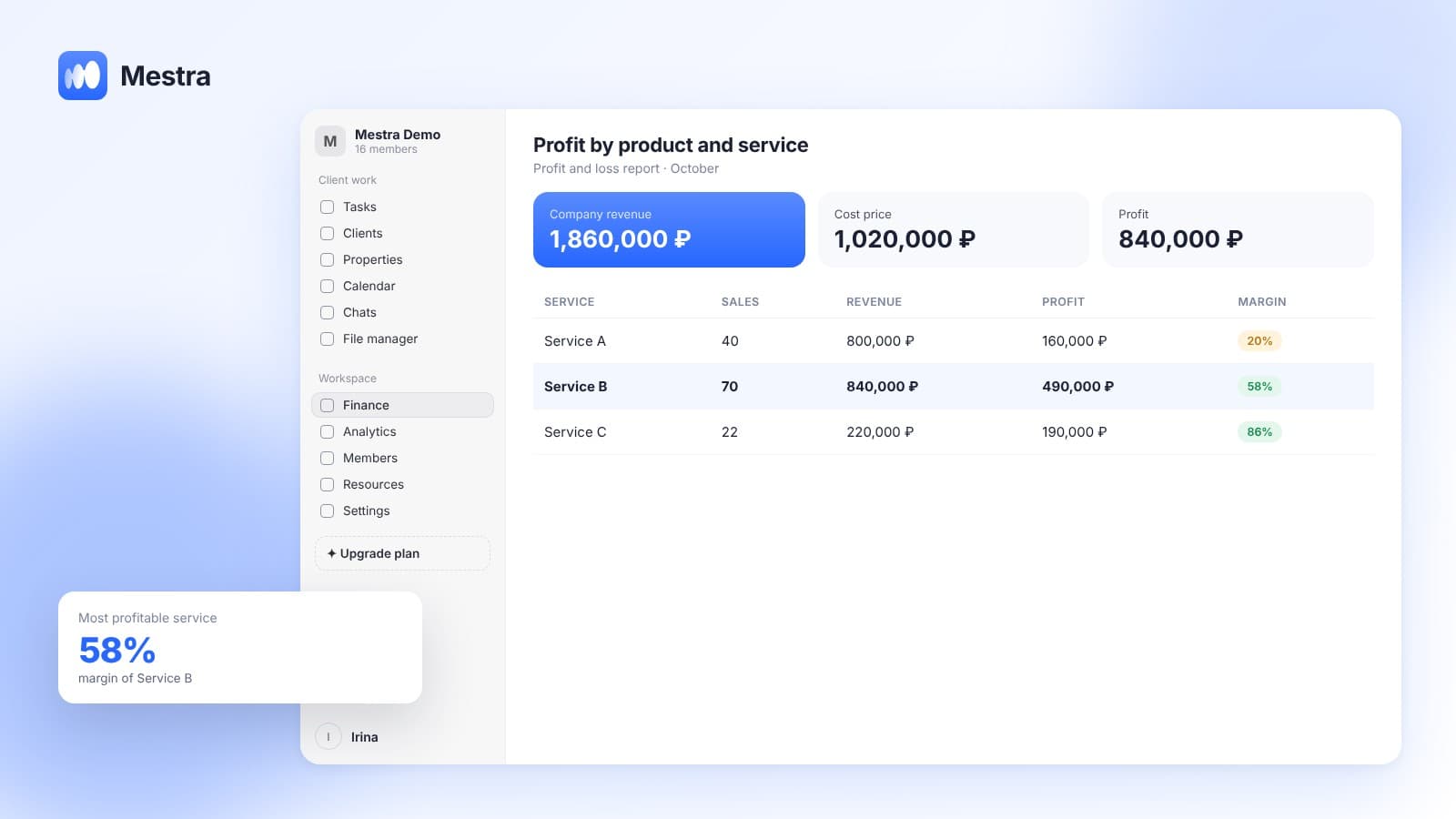
- Cost and profit by product — what do we make money on. See profit by product.
Where to start: 5 steps
- Gather all income and expenses in one place.
- Split expenses into clear categories: materials, delivery, advertising, salaries, rent, services.
- Calculate the full cost of your main products.
- Put together your first profit and loss report for last month.
- Repeat every month and compare with the previous one.
Why accounting falls apart
- Sales are in one system, expenses in a spreadsheet, salaries somewhere else.
- Data is entered once a quarter "for the report".
- There are no consistent expense categories — each month is calculated differently.

Example: management accounts for the first month
The owner of a service company gathered the data for September:
| Metric | Value |
|---|---|
| Revenue | 1,800,000 ₽ |
| Cost of services | 820,000 ₽ |
| Office salaries | 380,000 ₽ |
| Advertising | 240,000 ₽ |
| Rent and services | 160,000 ₽ |
| Profit | 200,000 ₽ — 11% |
| Clients' unpaid invoices | 420,000 ₽ |
Without management accounts, the owner saw only 1.8 million of revenue and an empty account. With them, it became clear: there is a profit, but almost half of it is "stuck" in client debts, and advertising costs more than rent.
Which expense categories to set up straight away
- Cost of sales — materials, purchases, executors' work.
- Marketing — advertising, platforms, promotion.
- Staff — salaries, commissions, contributions.
- Premises — rent, utilities.
- Operations — services, telecoms, transport.
- Finance and legal — bank, card processing, accountant, lawyer.
- Other — anything not covered above.
Seven groups are enough to see the picture, and not so many that you get lost.
The management accounting rhythm
| When | What to look at |
|---|---|
| Every week | Cash in the accounts, unpaid invoices, revenue |
| Every month | The profit and loss report, cost of main products |
| Every quarter | Prices, product range, team, advertising budget |
Statutory accounting is mandatory under Federal Law No. 402-FZ "On Accounting". Management accounting isn't regulated by law — the company decides for itself which reports, categories and frequency it needs.
How it works in Mestra
- Profit and loss report and detailed financial reports.
- Expense items in 7 groups: cost of sales, marketing, staff, premises, operations, finance and legal, other.
- Several accounts and cash desks: bank, cash and cards, in rubles, dollars and euros; transfers between accounts with fees.
- Cost in the product card: purchase price or materials, the executor's share, delivery and packaging are set once and flow into every invoice automatically.
- Employee commissions are calculated automatically by rule — percentage, fixed amount, per session or per hour — after each invoice is paid; the card shows accrued, paid and outstanding.
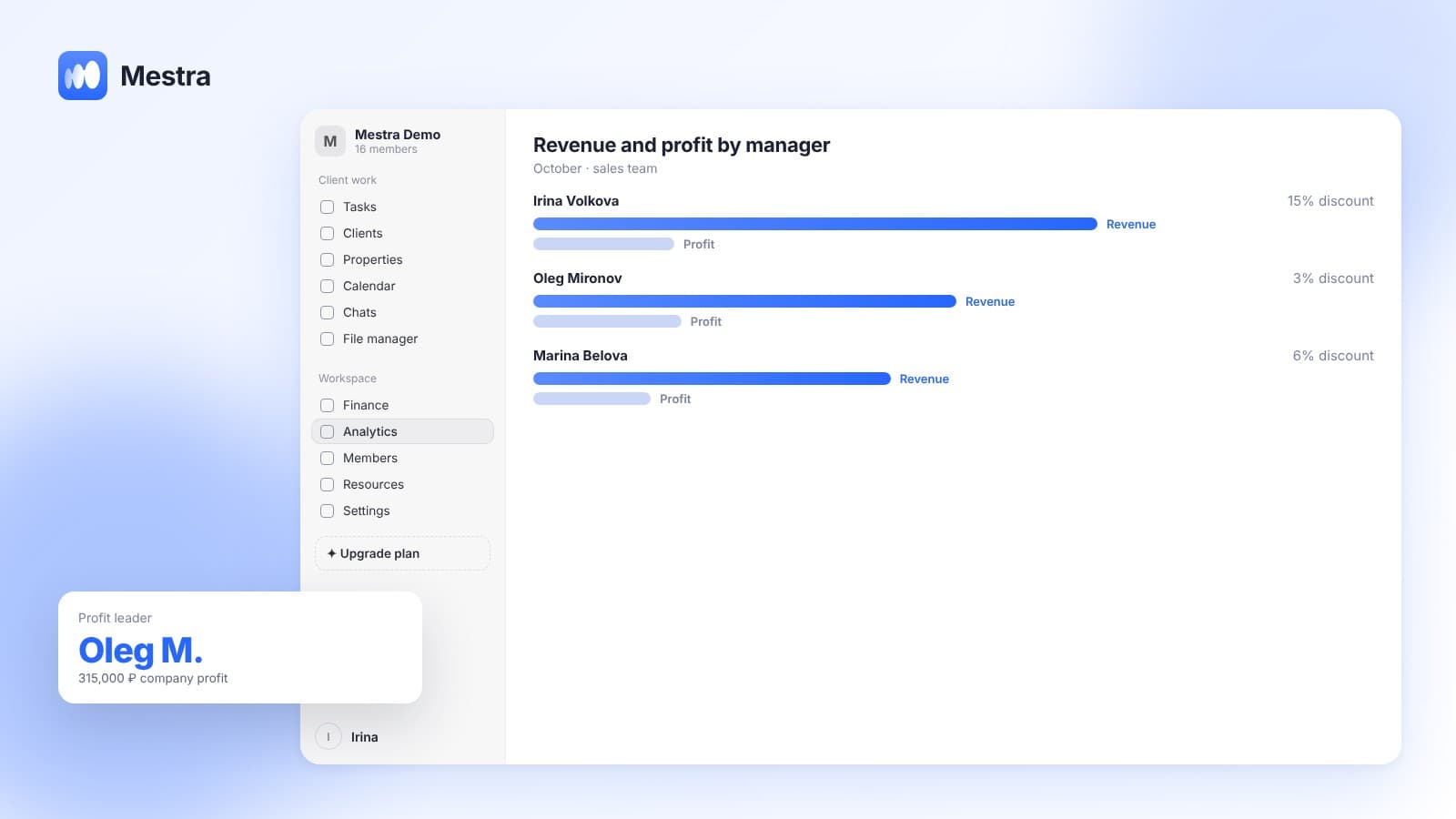
- Analytics by employee, channel and client source: enquiries, conversion, revenue, response speed.
FAQ
Do you need a finance professional for management accounting?
Not to start with. It's enough to record income and expenses in one system using consistent categories.
At what size does a business need management accounting?
From the first employee. The sooner the habit of counting forms, the fewer mistakes as you grow.
Can you keep management accounts in Excel?
You can, but spreadsheets quickly become inconvenient. More in our article management accounting in Excel or a CRM, and how to sort money into categories — in tracking income and expenses.
Bottom line
Management accounting turns revenue into a clear picture: where the profit is, where the losses are, which way to go.
Start with three reports and one system for all the data. In Mestra, they're in the same place where you manage clients.