Tracking Income and Expenses for Companies and Sole Traders: Categories, an Example and Software
Finance5 min read
How to track income and expenses: management accounting and the tax ledger for sole traders, 7 expense groups, accounts and cash desks, a sample month and software.

Tracking income and expenses means recording every incoming and outgoing payment with a date, amount, account and category. Tax records are kept under the Tax Code; management records are kept so that every month you can see how much the company earned and where the money went.
Below: the difference between the two types of records, expense categories, a sample month and what to look for in software.
One-minute checklist
- Set up accounts and cash desks: bank account, cash, card.
- Agree a list of income and expense categories.
- Record every money movement on the day it happens.
- At the end of the month, total income and expenses by category.
- Compare with the previous month and find where expenses grew faster than revenue.
Tax vs management records
| Criterion | Tax (income and expense ledger) | Management |
|---|---|---|
| Who it's for | The Federal Tax Service | The owner |
| Mandatory | For sole traders and organisations on the simplified system (Art. 346.24 of the Tax Code) | No |
| Format | Prescribed | Any convenient format |
| What it shows | The tax base | Profit, expense structure, money in accounts |
The income and expense ledger answers "how much tax do we pay". Management accounting answers "what do we do to earn more".
Expense categories
| Group | Examples |
|---|---|
| Cost of sales | Purchases, materials, executors' shares |
| Marketing | Advertising, marketplaces, promotion |
| Staff | Salaries, taxes and contributions, training |
| Premises | Rent, utilities, repairs |
| Operations | Telecoms, software, stationery, transport |
| Finance and legal | Bank, card processing, accountant, lawyer |
| Other | Anything not covered above |
Example: a month at a service company
| Item | Amount, ₽ |
|---|---|
| Income from services (excl. VAT) | 1,450,000 |
| Cost of sales: materials and stylists' shares | −580,000 |
| Marketing | −160,000 |
| Staff: front desk | −220,000 |
| Premises | −180,000 |
| Operations | −45,000 |
| Finance and legal | −35,000 |
| Other | −20,000 |
| Profit | 210,000 |
Profitability is 210,000 ÷ 1,450,000 ≈ 14.5%. If next month marketing rises to 260,000 ₽ while income stays the same, profit drops to 110,000 ₽ — almost by half.
Common mistakes
- Mixing personal and business money. "Personal" purchases on the business card distort expenses.
- Recording after the fact. A week later, half the small expenses are forgotten.
- Counting advances as income. The money has been received, but the work hasn't been done.
- One big "Other". If "Other" is more than 5% of expenses, it's time to split categories.
Related reading: management accounting, the profit and loss report, management accounting in Excel.
How it works in Mestra

Executor commissions: accrued, paid, outstanding
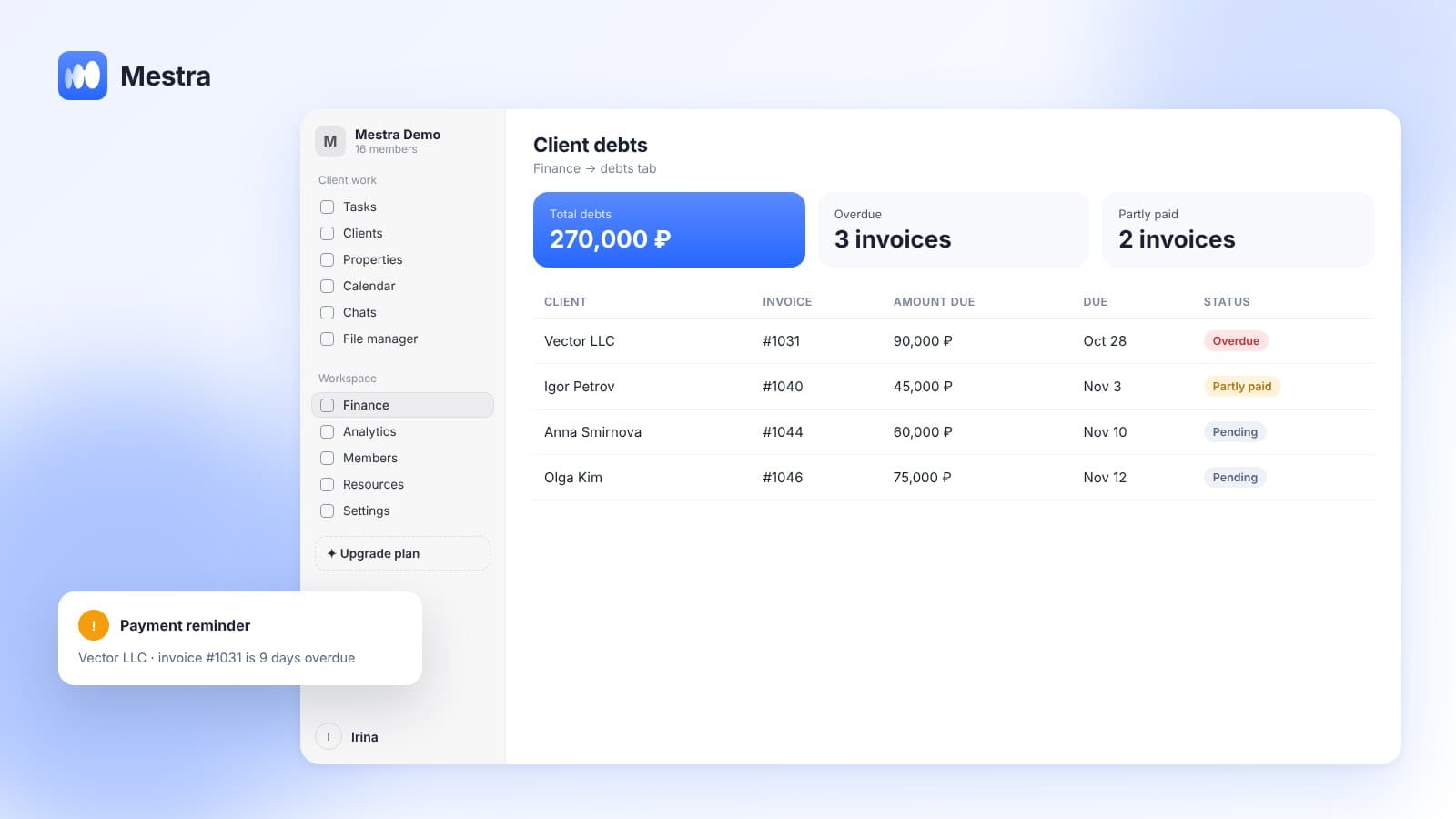
Mestra is a CRM system: clients, messengers and marketplaces, tasks, finance, analytics and an AI operator in one window.
- Income from invoices. A paid invoice becomes income straight away, with no manual transfer.
- Every money movement. Receipts and payments are recorded with a date, account and category.
- Accounts and cash desks. Bank, cash and cards in rubles, dollars and euros; transfers between accounts with fees.
- Expenses in 7 groups. Cost of sales, marketing, staff, premises, operations, finance and legal, other.
- Other people's money kept apart. Pass-through payments, advances and VAT don't count as revenue.
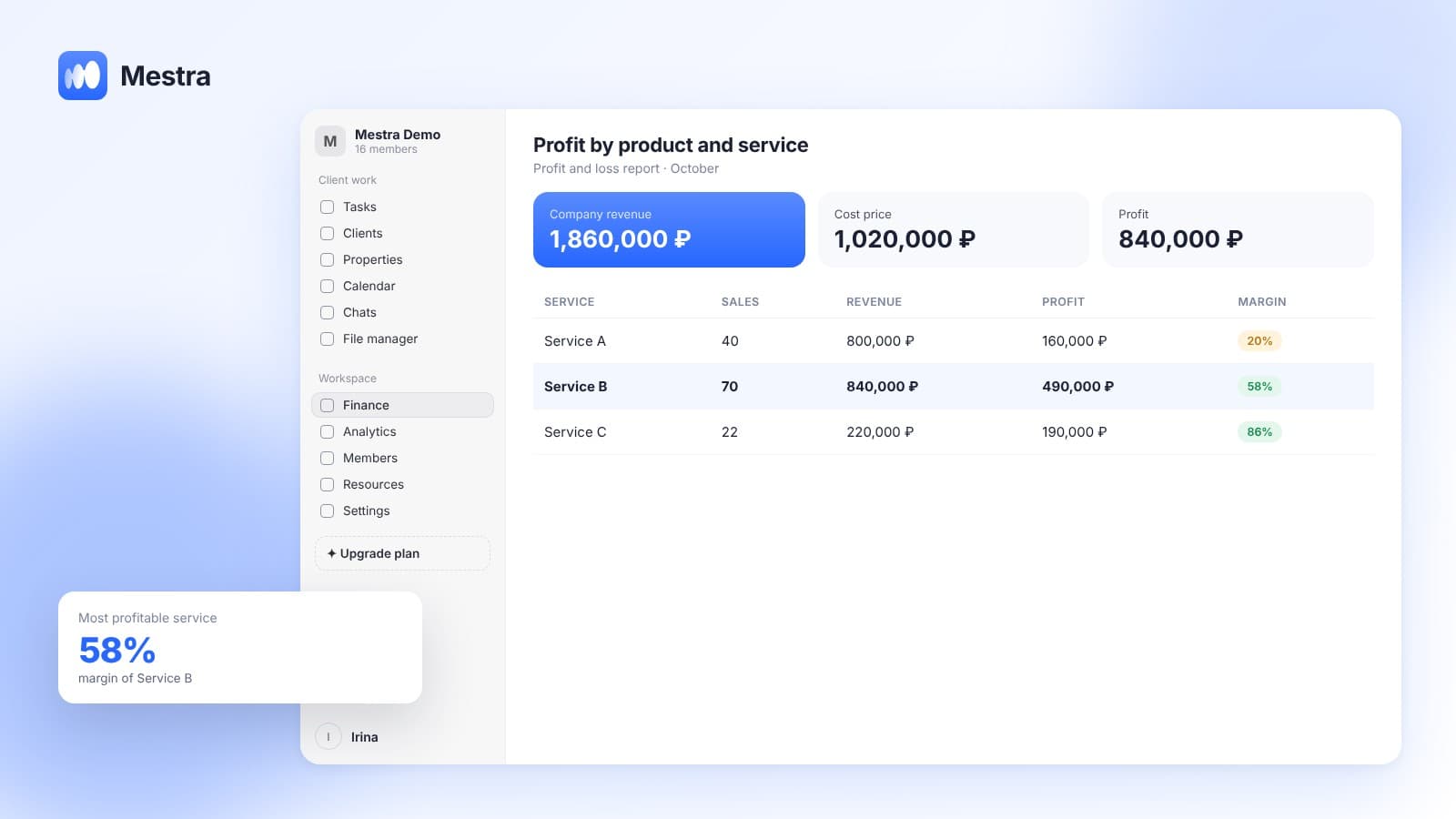
- Profit and loss report. Assembled automatically from invoices and expenses.
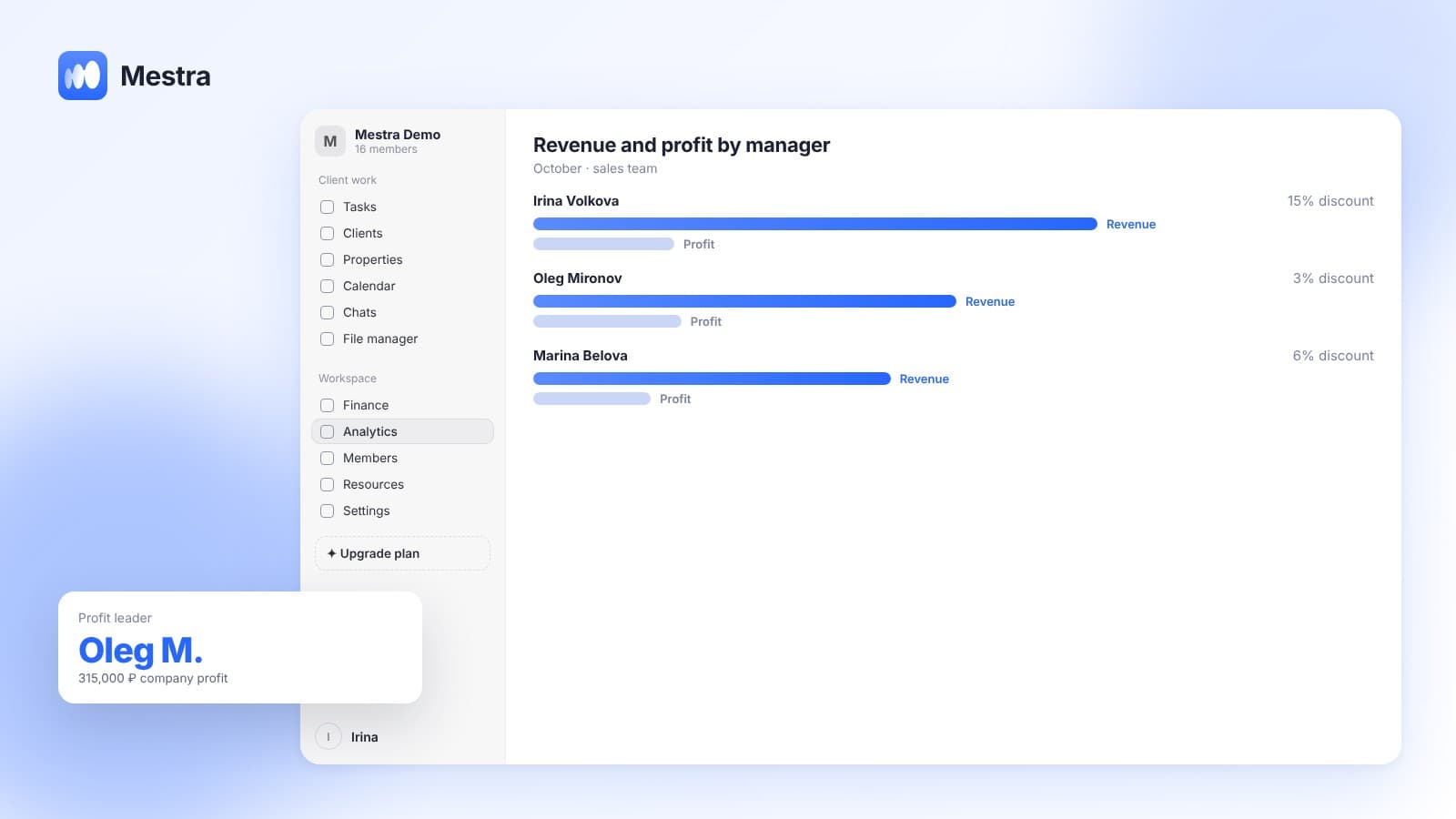
- Salaries and commissions. Salaries as a monthly expense; executors' commissions after the invoice is paid.
FAQ
Do sole traders have to track income and expenses?
Sole traders on the simplified system and several other regimes must keep an income and expense ledger. Management accounting isn't required by law, but without it you can't see your real profit.
Can you track income and expenses in Excel?
At the start, yes. As accounts, cash desks and staff grow, the spreadsheet falls behind and needs manual reconciliation.
How often should you review the results?
Monthly — always; weekly — for money in the accounts and client debts.
Should the owner's salary be included?
Yes, if the owner works in the company. Otherwise profit is overstated by the cost of their work.
Bottom line
Income and expense tracking shows how much the company earned and where the money went. Keep the tax ledger for the Tax Service and management records for decisions, with categories and other people's money kept apart. In Mestra, income comes from invoices and the profit and loss report builds itself — try it free for 15 days.