Profit by Product and Service: Which Product Feeds the Business and Which Eats Money
Finance4 min read
How to calculate profit for every product and service including all costs, find loss-making items and decide what to promote and what to drop from the range.

Almost every business has a product that sells better than anything else while earning almost nothing.
There's only one way to see this — calculate profit separately for each item, including all costs.
Let's look at how to do it and what decisions to make from the results.
One-minute calculation
- Export sales for each product for the month.
- Calculate the full cost per unit.
- Product profit = (price − cost) × sales.
- Split products into three groups: feed, keep the client, eat money.
How to calculate profit by product
Product profit = (price − full unit cost) × number of sales
Alongside profit, it's useful to look at the product's margin — the share of profit in the price: (price − cost) / price × 100%. It lets you compare expensive and cheap items with each other.
Full cost includes materials or purchase price, delivery, advertising, fees, the manager's pay and a share of overheads. More in our article full cost.
Example: three products from one company
| Product | Monthly sales | Revenue | Cost | Result |
|---|---|---|---|---|
| A | 400 pcs | 400,000 ₽ | 380,000 ₽ | 20,000 ₽ |
| B | 120 pcs | 360,000 ₽ | 210,000 ₽ | 150,000 ₽ |
| C | 60 pcs | 300,000 ₽ | 330,000 ₽ | −30,000 ₽ |
Item A is a bestseller but earns almost nothing. Product B delivers most of the profit. Product C runs at a loss, despite decent revenue.
Three groups in the range
- Feed the business — high profit per unit. Promote these first.
- Keep the client — low profit, but clients come for them and buy other things. Keep them, but watch the costs.
- Eat money — negative profit. Review them: price, supplier, logistics or removing them from the range.
What to do with a loss-making item
- Check which cost item has grown: materials, delivery or advertising.
- Recalculate the price from full cost — see how to set a price.
- Cut advertising for this product and move the budget to profitable items.
- If nothing helps and the product doesn't retain clients, drop it.

A similar approach is used in ABC analysis of a product range: products are ranked by their contribution to the result. The difference is that here they're ranked not by revenue but by profit after all costs.
How it works in Mestra
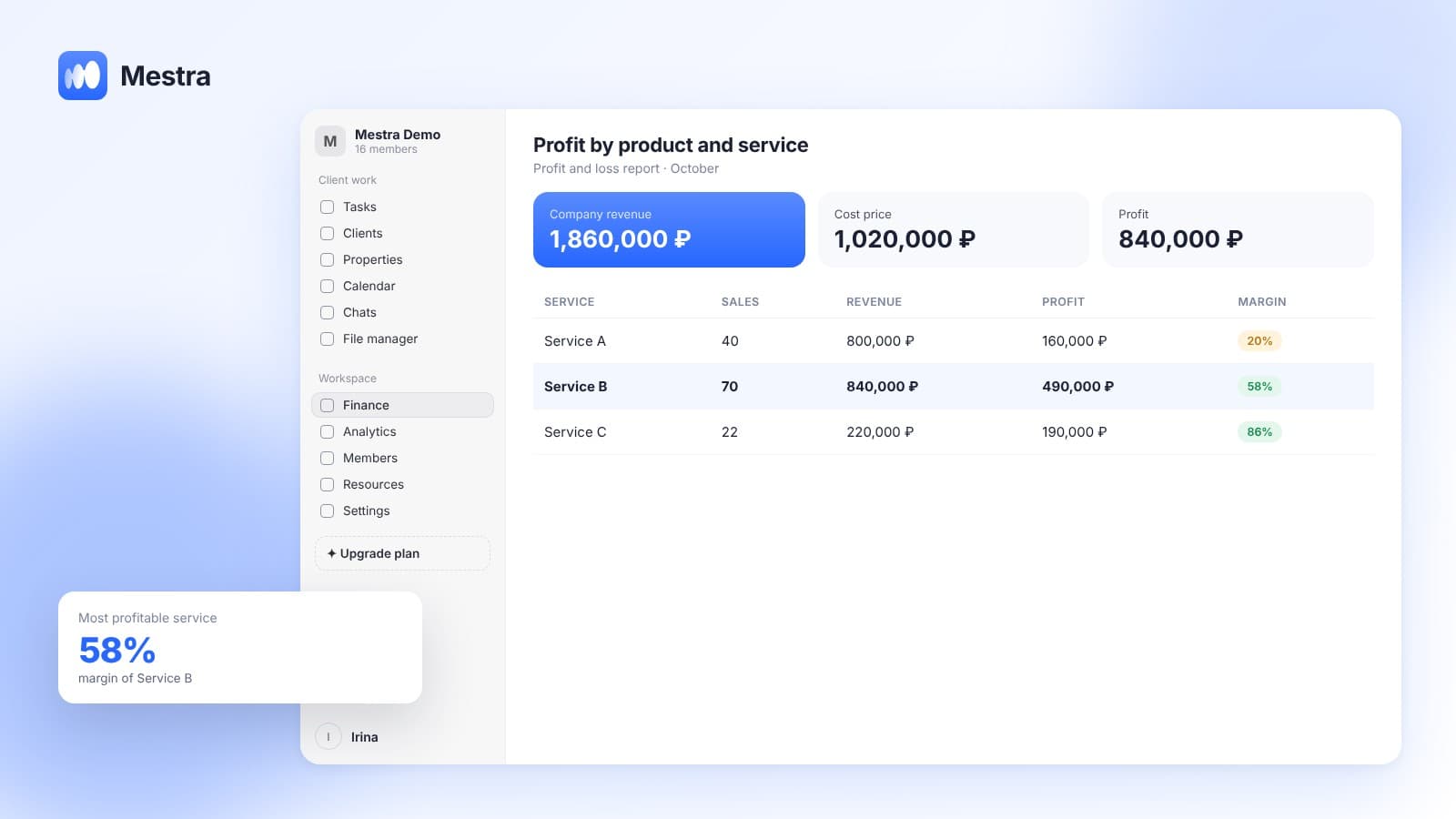
- Profit for every product and service after the cost from the product card and the costs of the sale.
- Cost in the product card: purchase price or materials, the executor's share, delivery and packaging are set once and flow into every invoice automatically.
- Profit and loss report and detailed financial reports.
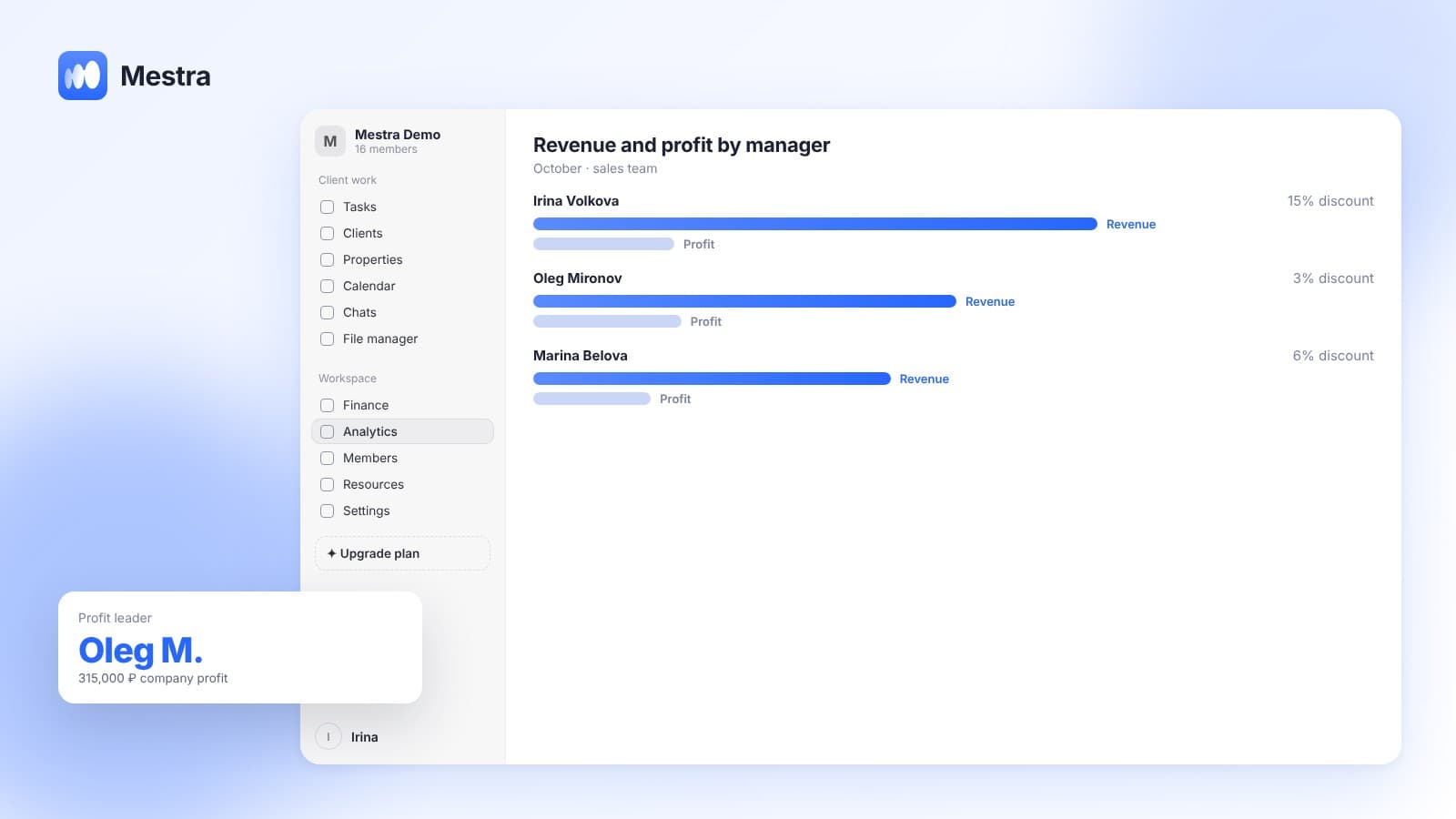
- Analytics by employee, channel and client source: requests, conversion, revenue, response speed.
Related reading: profit by client and product in a CRM.
FAQ
Why can the best-selling product be unprofitable?
High demand is often achieved through a low price or heavy advertising. If full cost is close to the price, high volume brings little profit.
How often should you analyse profit by product?
Once a month is enough for most companies. In season or when supplier prices rise — more often.
Can profit by service be calculated the same way?
Yes. Instead of raw materials, count materials and the specialist's time; the other items are the same.
Bottom line
Total profit shows whether the company is making money. Profit by product shows where it comes from.
Calculate it at least once — and you'll see which items to promote and which to review. In Mestra, you can see it for every product: the cost from the product card and the costs of the sale are accounted for in every invoice.