Profit per manager: why a salesperson's revenue lies and what to look at instead
Finance4 min read
How to calculate the profit each manager brings: revenue, discounts, cost price, commissions. Why revenue-based bonuses are risky and what Mestra shows.

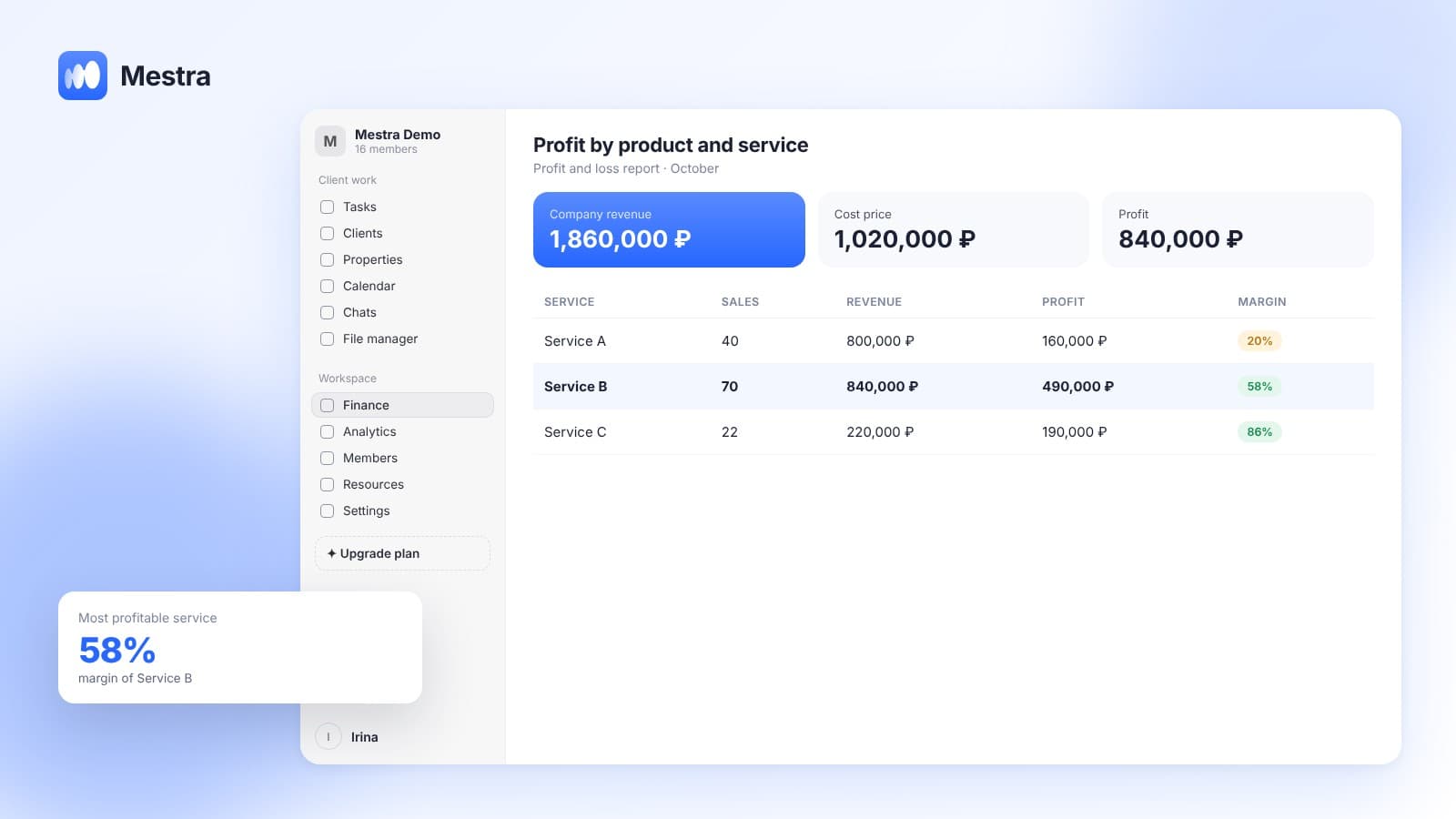
Profit per manager is revenue from their paid deals minus cost price, discounts, direct costs and the commissions paid to them. Mestra adds this up automatically, so the owner compares employees not by turnover but by the money left in the company.
The one-minute math
| Manager A | Manager B | |
|---|---|---|
| Monthly revenue | 1,200,000 ₽ | 900,000 ₽ |
| Average discount | 15% | 3% |
| Cost price and direct costs | 840,000 ₽ | 540,000 ₽ |
| Commission to employee | 60,000 ₽ | 45,000 ₽ |
| Company profit | 300,000 ₽ | 315,000 ₽ |
A leads on revenue. B leads on profit despite selling 300,000 ₽ less. If you pay bonuses on revenue only, you reward discounts.
Why a salesperson's revenue misleads
A discount is the easiest way to sell. A manager who concedes on price closes more deals. But every concession comes out of profit.
Difficult clients cost money too. If an employee sells to clients who demand free revisions, their «good» sales may not pay off.
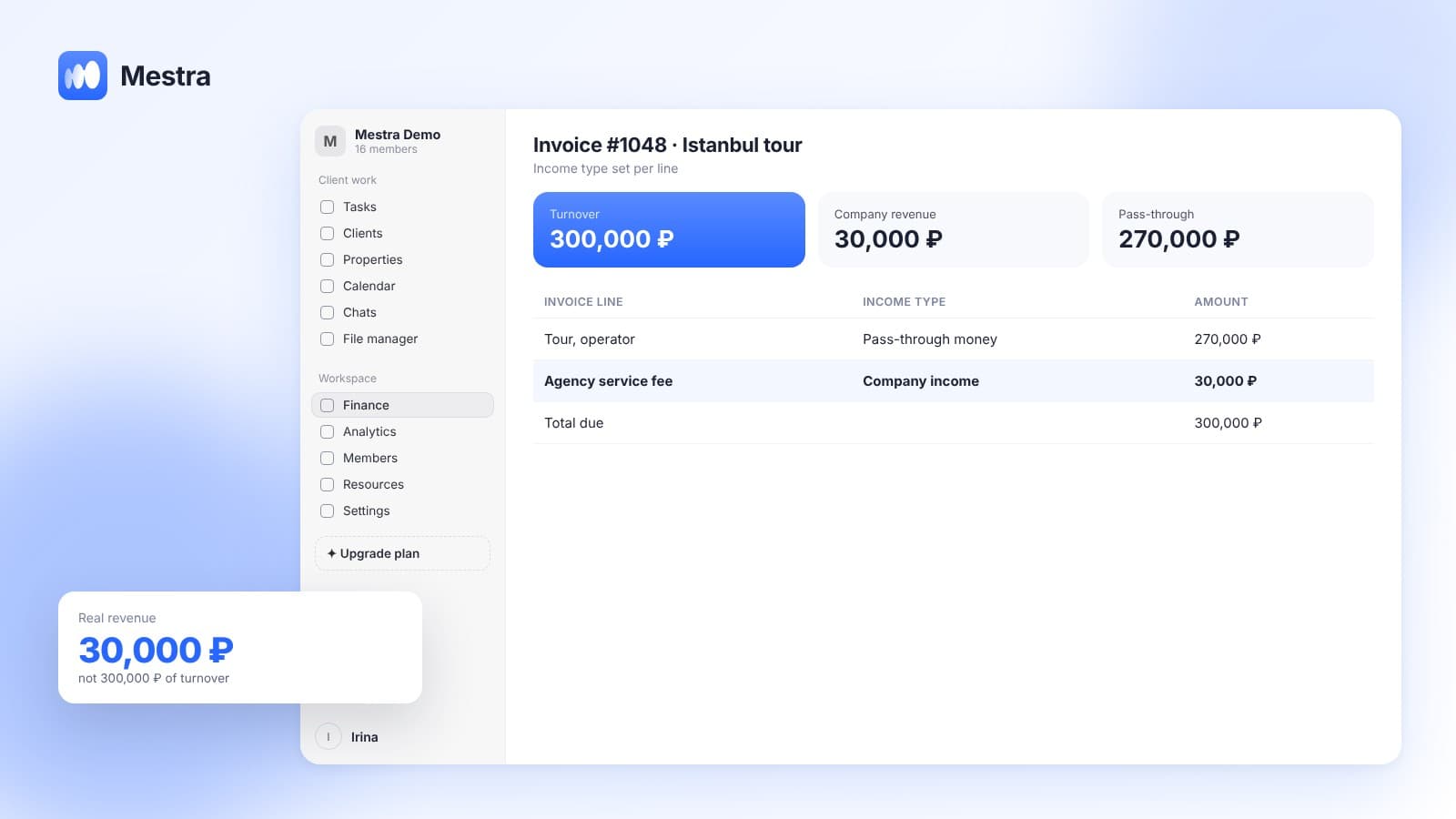
Commission accrues on turnover. If the deal amount includes pass-through money, the bonus is paid on money that isn't the company's.
Metrics to watch together
- Profit per employee — the main one.
- Average discount — how much the manager concedes.
- Conversion — how many requests become payments.
- Response speed — how fast they react.
- Repeat sales — how many clients come back.
- Client rating — average feedback score.
More in «Sales manager KPIs».
How it works in Mestra

- Expenses per employee. Any transaction in «Finance» can be linked to a team member.
- Automatic commissions. Staff and partner commissions accrue by the rule you set — a percentage or fixed amount.
- Income type. Commissions are calculated on real company revenue, not pass-through amounts.
- Member profile. Working hours, workload, licences and certificates, client rating.
- Team analytics. Conversion, response speed, workload and stage funnel.
- AI reviews reply quality and suggests the next step, and the owner can open any chat.
Each employee sees only their own clients; the owner sees the whole picture. On running a sales team, see «Managing a sales department».
How to switch to profit-based incentives
- Fill in cost price in product and service cards.
- Set the income type for services with commission or pass-through amounts.
- Link direct costs to deals and employees.
- For a month, calculate profit per manager alongside the old scheme.
- Discuss the numbers with the team, and only then change bonus rules.
Profit-based incentives for sales managers
Sales manager incentives are usually a percentage of revenue. It's simple but risky: the employee wins on any sale, even a loss-making one.
Profit-based incentives change behavior. The manager protects the price, discounts less often and chooses clients worth working with.
Switch gradually: first show the team profit by manager in reports, then add a small profit-based share to the bonus and increase it after a quarter.
FAQ
How do I calculate the profit a manager brings?
Take revenue from their paid deals and subtract cost price, discounts, direct costs and commissions. Mestra does it automatically.
Can I link expenses to an employee in a CRM?
Yes. In Mestra any transaction can be linked to an employee, client or product.
Why not pay bonuses on revenue only?
It rewards discounts and sales to unprofitable clients. Profit-based bonuses motivate selling profitably.
Does Mestra calculate commissions itself?
Yes. Staff and partner commissions accrue by the rule you set.
Do employees see each other's profit?
It depends on permissions. Roles in Mestra are configured manually.
Summary
The best manager isn't the one who sold the most but the one after whose sales the company kept the most money. Mestra (Местра) links each employee's deals, expenses and commissions and shows real profit across the team. Try it free for 15 days.