Advance and Prepayment: The Difference, When to Refund, and Why It Isn't Revenue Yet
Finance4 min read
Advance vs prepayment: partial and full payment upfront, refunds under the Civil Code, VAT at 22/122 on advances and why prepayment is not revenue yet. Examples.

An advance and a prepayment are money received before the company has shipped goods or delivered a service. Prepayment is any payment upfront, full or partial, while in business practice an advance usually means a partial prepayment; legally they work the same way and are refunded to the client if the deal doesn't go ahead.
The main mistake is treating prepayment as money already earned. Below are the differences, refund rules, taxes and accounting.
One-minute calculation
- Record every payment received upfront as an advance, not as revenue.
- Link the advance to an invoice and a contract.
- If you are a VAT payer, charge VAT on the advance at 22/122.
- After shipment or delivery, move the amount into revenue.
- If the deal is cancelled, refund the advance or offset it as agreed.
Advance, prepayment and deposit
| Criterion | Advance | Prepayment | Deposit |
|---|---|---|---|
| What it is | Partial payment upfront | Full or partial payment upfront | Payment securing the contract |
| If cancelled | Refunded | Refunded | Kept by the recipient if the payer withdrew |
| If the recipient withdraws | Refunded | Refunded | Refunded twice over |
| Legal basis | Contract; Art. 487 of the Civil Code for goods | Contract; Art. 487 of the Civil Code | Arts. 380–381 of the Civil Code |
More on deposits in our article deposit vs advance.
Why prepayment is not revenue
In October, a renovation studio received 900,000 ₽ in advances under five contracts, while the work will be done in November and December. If that money is recorded as October revenue, the month looks like a record and November looks like a failure, even though the crews work at full capacity in November. On top of that, part of the money has to be spent on materials before the work is handed over.
VAT on advances
VAT payers charge VAT on an advance received at the calculated rate of 22/122. An advance of 244,000 ₽ contains VAT of 244,000 × 22 ÷ 122 = 44,000 ₽. After shipment, the VAT on the advance is deducted, and VAT is charged on the sale itself.
Tracking prepayments: what matters
- Link to the contract and invoice. You can see exactly what was paid for.
- Delivery deadline. Overdue advances are a risk of claims and refunds.
- Balance due. A 50% prepayment means the other 50% must be collected after handover.
- Refunds. Record who was refunded and when.
Related reading: revenue vs turnover, how to issue an invoice, cash gap, instalment plans for clients, refunding a client.
How it works in Mestra

Advances and pass-through money are excluded from revenue
Mestra is a CRM system: clients, messengers and marketplaces, tasks, finance, analytics and an AI operator in one window.
- Amount type. Every amount on an invoice is marked as income, commission, pass-through, advance or conditional.
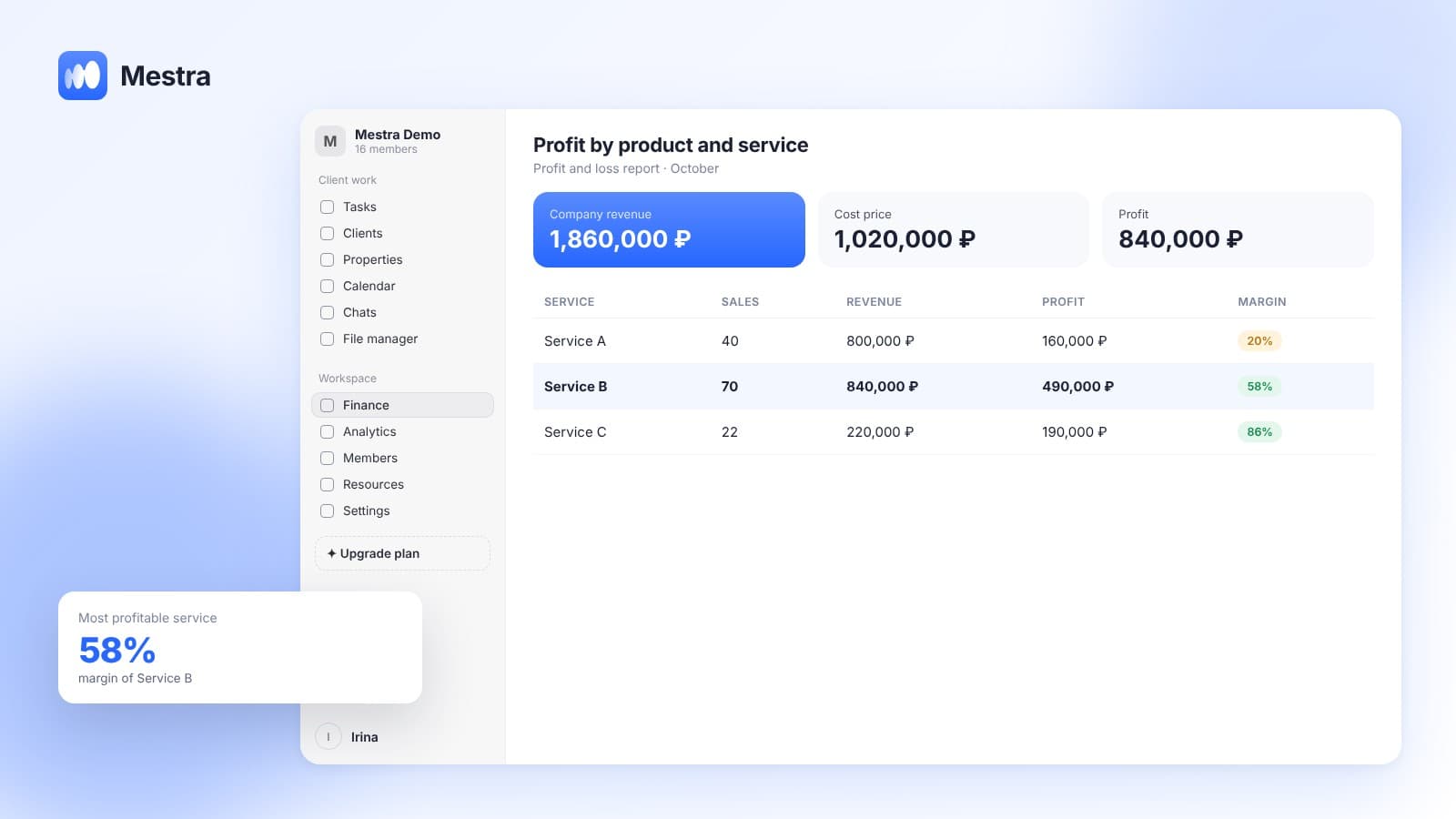
- Revenue without advances and pass-through money. The profit and loss report shows real income, not every incoming payment.
- Payment schedule. Prepayment, instalments or stage-based payments.
- Partial payment. Incoming money is allocated across invoice lines, and the balance due is visible immediately.
- Status based on actual payment. The invoice changes status when money arrives.
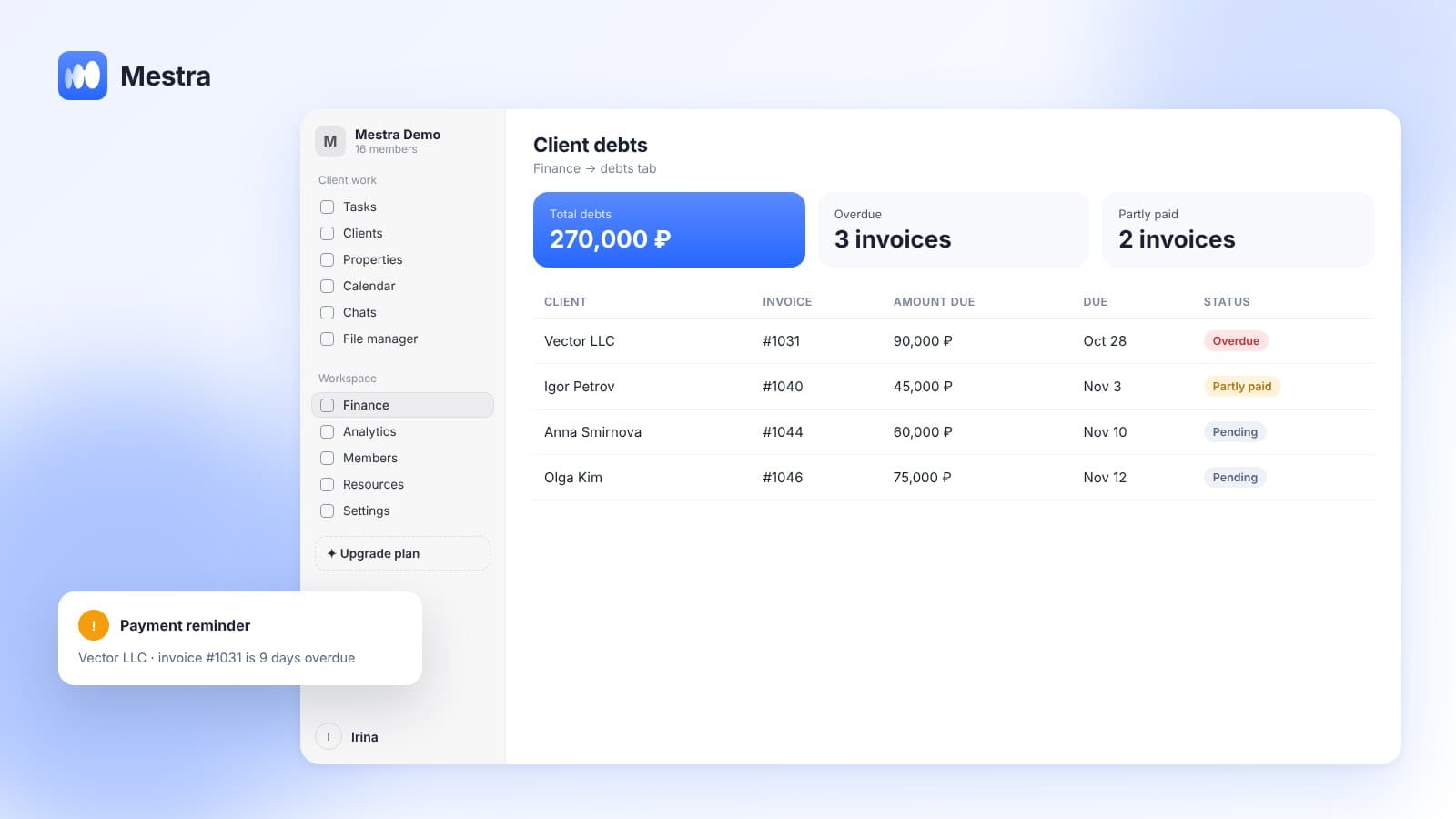
- Debts. Unpaid second instalments are shown in the Debts tab, with a reminder in the chat.
FAQ
What is the difference between an advance and a prepayment, in simple terms?
Prepayment is any payment upfront; an advance is usually part of it. Both are refunded if the deal doesn't happen.
Can an advance be kept and not refunded?
No, if the contract wasn't fulfilled for reasons unrelated to the client or by mutual agreement. A penalty for cancellation can be set separately in the contract.
When does an advance become revenue?
After the goods or services it was paid for have been delivered.
Do you have to pay VAT on an advance?
Yes, if the company is a VAT payer: at 22/122, with a deduction later on shipment.
Bottom line
An advance or prepayment is the client's money until the company fulfils its side of the contract. Keep it separate from revenue, charge VAT at 22/122 and watch the balances due. In Mestra, the advance amount type and payment schedules keep prepayments apart from earned money — try it free for 15 days.