Instalment Plans for Clients: In-House or Bank, Payment Schedules and Debt Control
Finance4 min read
How to offer clients instalments: in-house or via a bank, payment schedules, Article 489 of the Civil Code, the cost to the business, reminders and debt control.

A business can offer clients instalments itself — with a payment schedule in the contract — or connect a bank instalment plan, where the bank pays the seller immediately and keeps a fee. An in-house plan is cheaper but requires discipline: every payment has to be reminded, tracked and, if overdue, work has to be paused in time.
Below: a comparison of the two options, a worked example and the rules that keep an instalment plan from turning into receivables.
One-minute checklist
- Decide which goods or services you offer instalments on, and for what term.
- Compare the bank's fee with the risk of non-payment on an in-house plan.
- Set out the schedule, amounts and consequences of late payment in the contract.
- Take the first payment before work starts or goods are handed over.
- Remind the client about each payment before it's due.
In-house vs bank instalments
| Criterion | In-house | Bank |
|---|---|---|
| Money in your account | In parts, on schedule | Straight away, minus the fee |
| Fee | None | Charged by the bank |
| Risk of non-payment | With the company | With the bank |
| Client vetting | Your own | Bank scoring |
| Suits | Regular clients, course-based services | Expensive goods, new clients |
Selling goods on credit with payment in instalments is governed by Article 489 of the Russian Civil Code: the contract states the price, procedure, timing and amount of payments.
Example: a 120,000 ₽ course
A school sells a 4-month course for 120,000 ₽.
| Option | What the school receives |
|---|---|
| Bank instalment plan, 8% fee | 110,400 ₽ straight away |
| In-house plan, 4 payments of 30,000 ₽ | 120,000 ₽ over 4 months |
| In-house plan, 1 client in 10 stops paying after the second payment | 114,000 ₽ per client on average |
At this rate of non-payment, the in-house plan is still more profitable than the bank's. If non-payments grow, the advantage disappears — which is why payment control matters more than the choice of scheme itself.
How to keep instalments from turning into debt
- First payment upfront. The client has already invested and won't disappear.
- A reminder before the due date. A day before the payment, on the day and 3 days after.
- Pause on late payment. The next module or stage starts only after payment.
- Debt limit. New instalment purchases only if there's no current overdue payment.
Related reading: accounts receivable, how to issue an invoice, CRM for education.
How it works in Mestra

The forecast includes pending invoices and instalments
Mestra is a CRM system: clients, messengers and marketplaces, tasks, finance, analytics and an AI operator in one window.
- Payment schedule on the invoice. One-off payment, prepayment, instalments or payment by deal stage.
- Partial payment. Each payment is allocated across invoice lines, and the balance is visible straight away.
- Status by actual payment. The invoice changes status when money arrives.
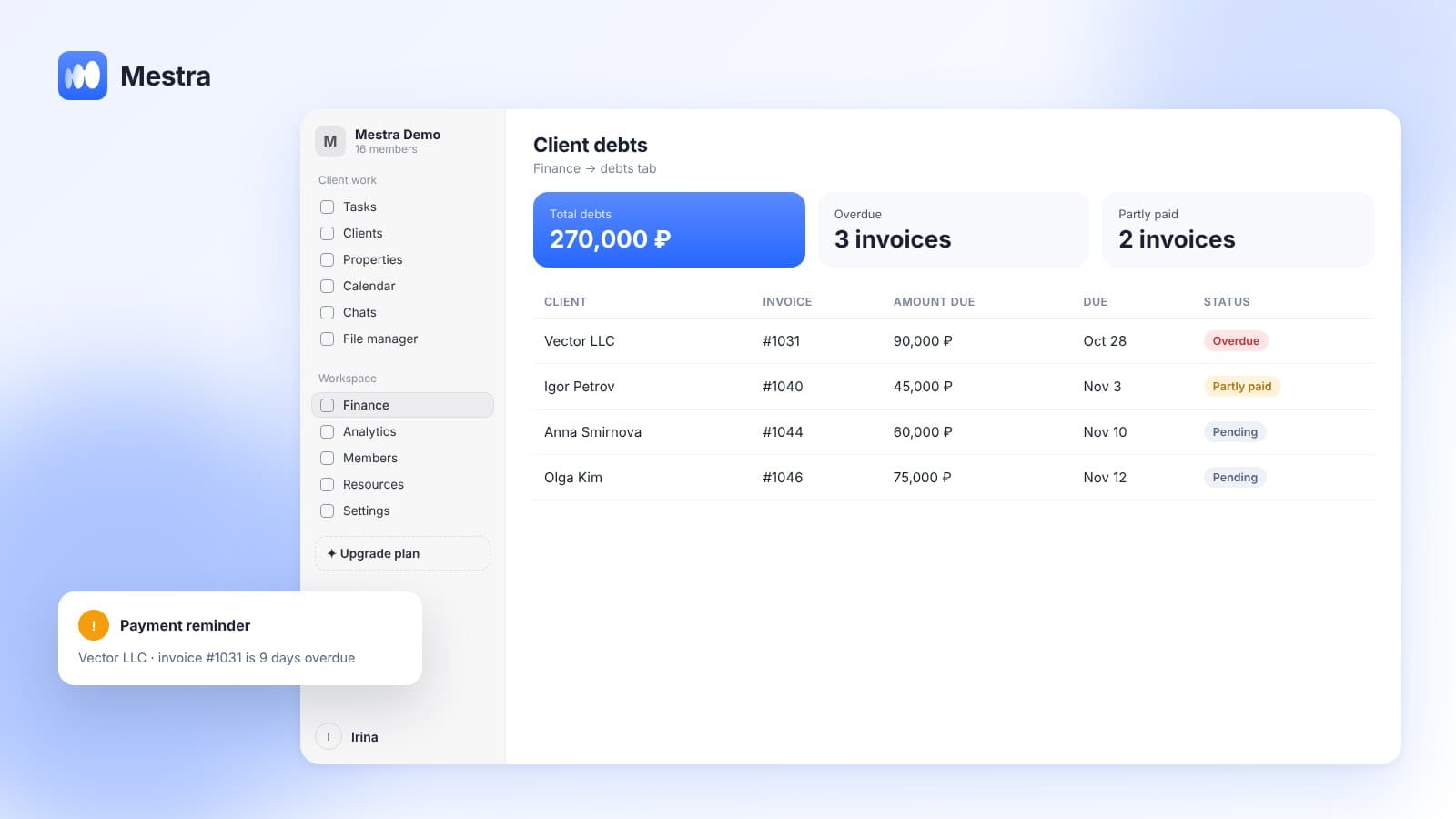
- Debts tab. Unpaid invoices, days overdue and a "Remind in chat" button.
- Automatic reminders. 1 day before the due date, on the day and 3 days after.
- Debt limit. A warning if a client exceeds the permitted amount of debt.
FAQ
Can you offer instalments without a bank?
Yes, if the payment schedule and amounts are set out in the contract. That's an in-house instalment plan from the seller.
Do you need a licence for in-house instalments?
For interest-free instalments under a contract for the sale of goods or services — as a rule, no. If you plan to charge interest, consult a lawyer.
What if a client misses a payment?
Remind them in the messenger, offer to reschedule, and pause the next stage until payment.
How do instalments affect cash flow?
Money comes in later, so the payment schedule must be factored into expense planning to avoid a cash gap.
Bottom line
Instalments help sell expensive goods and services, provided payments are under control. An in-house plan beats a bank's when non-payment is low, but it requires a schedule, reminders and pausing on late payment. In Mestra, the payment schedule, debts and reminders are linked to the invoice — try it free for 15 days.