Cash Gap in Simple Terms: What It Is, How to Spot It in Advance and What to Do If It Happens
Finance5 min read
A cash gap in simple terms: what it is, why it happens, how to spot it in advance with a payment calendar, and how to close the gap without taking a loan.

A cash gap isn't a loss. It's a situation where the money exists "on paper" but isn't in the account on the day you need it.
It usually happens at the worst possible moment: on payday or rent day.
One-minute calculation
- Write down the balance in all accounts and cash desks.
- Add expected client payments by date.
- Subtract mandatory payments by date: salaries, rent, taxes, suppliers.
- If the balance goes negative on any day, that's a future gap.
Example
| Date | Event | Balance |
|---|---|---|
| 1st | Account balance | 300,000 ₽ |
| 5th | Rent 150,000 ₽ | 150,000 ₽ |
| 10th | Supplier payment 50,000 ₽ | 100,000 ₽ |
| 10th | Salaries 400,000 ₽ | −300,000 ₽ — gap |
| 20th | Clients pay invoices worth 600,000 ₽ | 300,000 ₽ |
Over the month, the company is in profit. But on the 10th, there's nothing to pay salaries with.
Why it happens
- Client payment deferrals — sold today, money in a month.
- Seasonality — fewer sales in summer, same rent.
- A large purchase — money goes out all at once.
- Fast growth — new staff and advertising are paid for before sales come in.
How to spot it in advance
Draw up a payment calendar: dates and amounts of all expected receipts and mandatory payments for 4–8 weeks ahead. If the balance goes negative on any day, you'll see the gap a month in advance.
7 ways to close a gap
- Take prepayment from new clients.
- Chase unpaid invoices — see accounts receivable.
- Negotiate a deferral with your supplier.
- Postpone non-essential spending.
- Offer regular clients a discount for early payment.
- Sell off slow-moving stock.
- Only then — a loan or an overdraft.

Payment calendar: a 4-week template
| Week | Opening balance | Expected receipts | Mandatory payments | Closing balance |
|---|---|---|---|---|
| 1 | 300,000 ₽ | 250,000 ₽ | 200,000 ₽ | 350,000 ₽ |
| 2 | 350,000 ₽ | 100,000 ₽ | 520,000 ₽ (salaries, rent) | −70,000 ₽ |
| 3 | −70,000 ₽ | 400,000 ₽ | 150,000 ₽ | 180,000 ₽ |
| 4 | 180,000 ₽ | 300,000 ₽ | 250,000 ₽ (taxes) | 230,000 ₽ |
The gap in week two is visible in advance. You have three weeks to speed up client payments or move a payment.
Signs a gap is approaching
- Unpaid invoices exceed a month's fixed costs.
- Staff increasingly give clients payment deferrals.
- A large purchase is planned for the same week as payday.
- Sales are falling at the start of a seasonal slowdown, while costs stay the same.
What not to do
- Dip into money set aside for taxes — the tax will still have to be paid, with penalties.
- Delay salaries — that means compensation for staff and lost trust.
- Give big discounts for quick cash — they cut profit for a long time.
Delaying salaries is the most expensive way to handle a gap. Under Article 136 of the Russian Labour Code, salaries must be paid at least every half month, and Article 236 requires compensation for delays — at least 1/150 of the Central Bank's key rate for each day.
How it works in Mestra
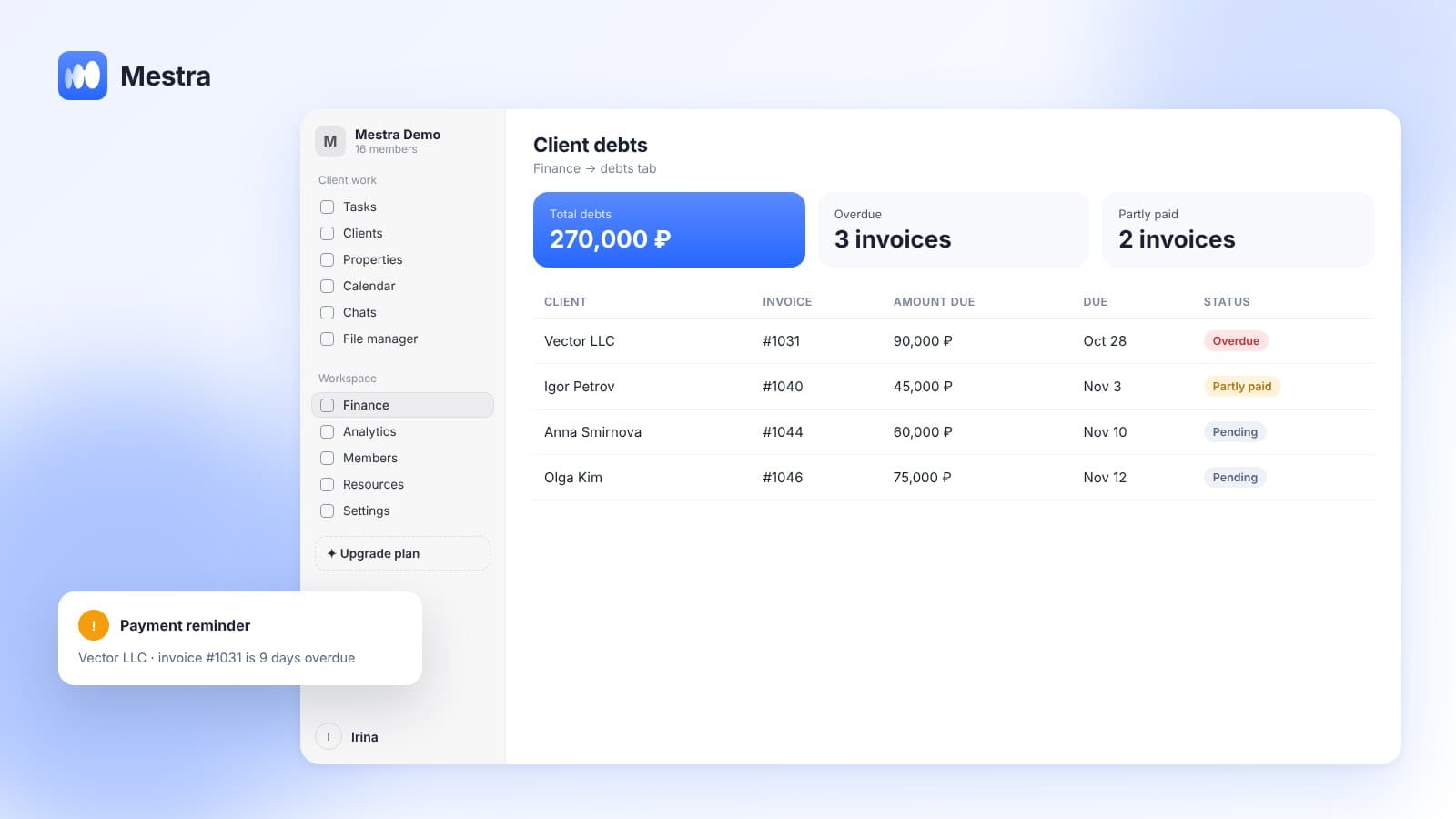
- Debts tab: all unpaid invoices, days overdue and the client's debt right in their card.
- Payment reminders: a "Remind in chat" button and automatic reminders — a day before the deadline, on the day and 3 days after.
- Several accounts and cash desks: bank, cash and cards, in rubles, dollars and euros; transfers between accounts with fees.
- Every receipt and payment is recorded with a date, account and category — you can see where the money went.
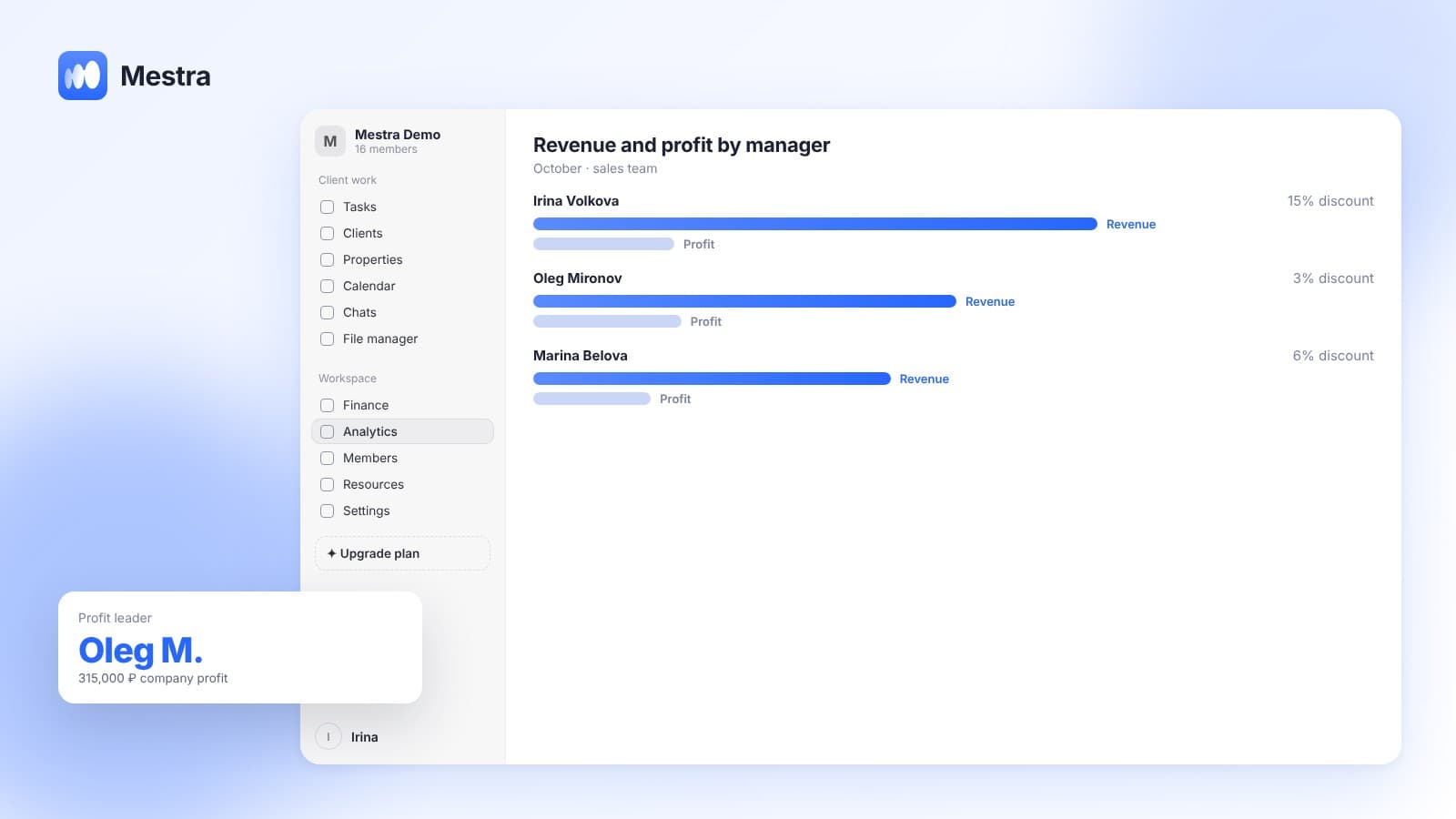
- Salaries are recorded as monthly expenses and commissions as invoices are paid: the main mandatory payments are always visible.
Related reading: payment calendar.
FAQ
Can a profitable company have a cash gap?
Yes, and it's a common situation. Profit is calculated on sales; a gap is about the dates when real money moves.
How often should the payment calendar be updated?
At least once a week. During growth or a seasonal slowdown — more often.
Is a loan a good solution?
Only if the gap is a one-off and you know exactly when the money will come in. A loan doesn't fix recurring gaps.
Bottom line
A cash gap is predictable if you look at the dates of receipts and payments in advance.
Keep track of unpaid invoices and mandatory payments. In Mestra, the Debts tab, account balances and team costs are all in one system.