How to hire a sales manager who will actually sell, not just interview well
Team9 min read
How to hire a sales manager: candidate profile, job post text, interview questions, a practical test in a chat, the probation period and the first 30 days.

Hiring a sales manager means finding someone who fits your type of sales, gets up to speed fast and brings in more revenue than they cost the company. A hiring mistake is expensive: salary during the probation period, the manager's time, lost clients and a second search.
Hiring a sales manager in a minute
| Stage | What we do | Time |
|---|---|---|
| Profile | Describe the type of sales and the requirements | 1 day |
| Job post | Write an honest text with income and responsibilities | 1 day |
| Résumé screening | Filter by experience and motivation | 3–7 days |
| Short call | 15 minutes: check the basics | 1–2 weeks |
| Interview | Walk through real deals | 1–2 weeks |
| Practical test | Role-play sale or a reply in a chat | Together with the interview |
| Decision and offer | Compare candidates, check references | 2–3 days |
| Onboarding | 30-day plan, a mentor | First month |
Step 1. Build the candidate profile
The word "sales" covers very different jobs. An experienced cold caller can fail on inbound leads in messengers, and a strong account manager can fail at quick deals.
| Parameter | Options |
|---|---|
| Source of clients | Inbound leads, cold outreach, repeat clients |
| Deal length | One day, a week, several months |
| Channel | Calls, messengers, meetings, email |
| Clients | Individuals, companies, large companies |
| Average check | Small, medium, large |
| Product complexity | Simple, needs consultation, complex and technical |
Describe your ideal sales manager using these parameters. For example: "Inbound leads from messengers and classifieds platforms, a deal takes 3–10 days, clients are individuals, the product requires consultation."
Step 2. Write the job post
A good job post answers the candidate's questions instead of listing the company's requirements.
| Block | What to include |
|---|---|
| What we sell and to whom | Short and clear |
| Where clients come from | Inbound leads, or you have to find them |
| Income | Base salary + percentage, the actual income of managers after 3 months |
| Target | What the target is and how many managers hit it |
| Format | Office, remote, hybrid, schedule |
| Tools | Which system the team works in, whether there is automation |
| Training | How onboarding works |
State the real income, not "up to 300,000 ₽", which one person in ten earns. How to set up a commission system is covered in detail in the article on commission on sales.
Step 3. Résumé screening and a short call
In a résumé, look for:
- experience in a similar type of sales;
- specific numbers: target, attainment, average check;
- sensible reasons for changing jobs;
- well-written text — especially if clients write to you in messengers and by email.
A 15-minute call is there to check whether the income, format and schedule suit the candidate and whether they can clearly describe their results. It saves time on full interviews.
Step 4. The interview: questions about real deals
Questions like "tell me your strengths" get rehearsed answers. It is far more useful to go through specific experience.
| Question | What we check |
|---|---|
| Tell me about your last big deal: from first contact to payment | Whether they understand the process and give specifics |
| What was your target and how much did you hit over the last 6 months? | Real results |
| Tell me about a deal you lost. Why? | Ability to analyze mistakes |
| How do you reply to a client who writes "too expensive"? | Handling objections |
| How many clients did you handle at once and how did you avoid losing them? | Organization |
| How do you find out what a client needs? | Needs-discovery skills |
| Why are you leaving your current job? | Motivation, risks |
A good sign is a candidate who talks in numbers and specific examples. A bad sign is generic phrases about "an individual approach to every client".
Step 5. The practical test
This is the most important stage. A résumé and an interview show how a person talks about sales; a practical test shows how they sell.
Option 1. Role-play sale
The manager plays a client with a real request. The candidate gets 5 minutes to prepare and a description of the product.
Option 2. Reply in a chat
If clients write to you in messengers, give the candidate a real example of an incoming message and ask them to reply in writing.
Client's message: "Hello, how much does a bathroom renovation cost? The area is about 5 square meters."
Assess the reply:
| Criterion | Strong reply | Weak reply |
|---|---|---|
| Speed | Answered to the point within a couple of minutes | Takes a long time over the wording |
| Questions | Clarifies details in order to give an exact price | Immediately says "from … ₽" and goes quiet |
| Next step | Offers a measurement visit or a call | Waits for the client to come back on their own |
| Tone | Friendly, well-written | Dry, with mistakes |
Option 3. Review of a real conversation
Show the candidate an anonymized conversation between a sales manager and a client that ended in a refusal, and ask them to find the mistakes.
Step 6. Decision and offer
Compare candidates on the same criteria: experience in similar sales, results, the practical test, motivation, fit with the team. Check references from previous jobs — especially the numbers the candidate quoted.
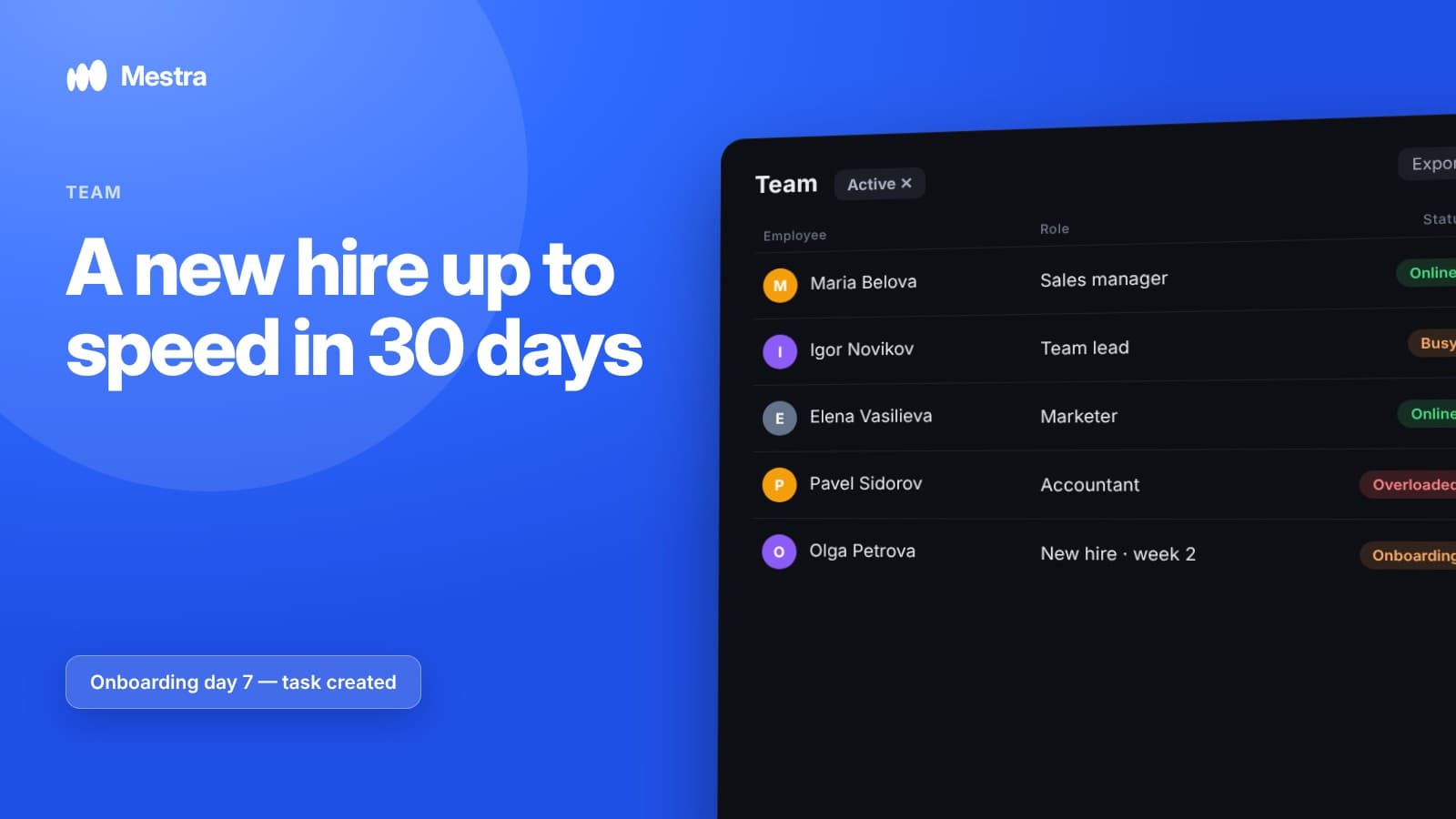
Step 7. The first 30 days
Most new-hire departures happen in the first months. The cause is usually not the people, but that they were "thrown in" without support.
| Week | Goal |
|---|---|
| 1 | Getting to know the product, the system and the procedures; listening to and reading conversations of experienced colleagues |
| 2 | First simple clients under a mentor's supervision |
| 3 | Working on leads independently, daily review with the mentor |
| 4 | Full workload, first results on the metrics |
A detailed plan is in the article on employee onboarding.
Probation period metrics
| Metric | Benchmark by the end of the first month |
|---|---|
| First response speed | No worse than the team average |
| Lead-to-deal conversion | 50–70% of the team average |
| Overdue tasks | Isolated cases |
| Conversation quality | No serious mistakes against the standards |
| Product knowledge | Answers typical questions without help |
Common mistakes
- Hiring a "good person" instead of a salesperson for your type of sales.
- Not testing in practice. Many people interview brilliantly and sell poorly.
- Embellishing the income in the job post. The person leaves after two months, when they see reality.
- Hiring in a rush. A weak manager costs more than two extra weeks of searching.
- No onboarding. The newcomer loses their first clients and their motivation.
- Not watching their work in the first weeks. Mistakes harden into habits.

How it works in Mestra
Mestra helps you bring a newcomer up to speed faster and see their results from the first days:
- Employee profile. Role, department, working hours and access rights are set when you add them.
- Gradual handover of clients. Permissions and distribution let you give a newcomer simple leads first and leave complex clients to experienced colleagues.
- Complete client history. The newcomer sees the client's whole conversation, agreements and invoices and doesn't have to ask again.
- AI draft replies. AI suggests a reply that takes the client's history into account — the newcomer learns the company's standards faster.
- Reply quality check. AI flags weak spots in conversations, and the manager sees them without reading every chat.
- Analytics per employee. Response speed, conversion and workload — an objective picture of the probation period.
Related reading: sales manager job description.
Frequently asked questions
What questions should I ask a sales manager in an interview?
Questions about real deals: how the last big deal went, what the target was and how much they hit, why a deal was lost, how they handle the "too expensive" objection.
How do I test sales skills in an interview?
With a practical task: a role-play sale, a written reply to a real client message or a review of a failed conversation.
How long is a sales manager's probation period?
Usually up to three months. You can draw first conclusions after a month, based on response speed, conversion and conversation quality.
What should a sales manager job post include?
What you sell and to whom, where clients come from, real income and target, work format, tools and how training works.
Why do new sales managers leave so quickly?
Most often because of mismatched income expectations, no onboarding and being thrown straight into complex clients without support.
Summary
A precise profile, an honest job post, an interview about real deals and a mandatory practical test help you hire a strong sales manager. A plan for the first 30 days, a mentor and objective metrics help you keep them.
In Mestra, a newcomer immediately sees the full history of clients and gets AI draft replies, while the manager gets analytics on each employee from day one. Try Mestra free for 15 days at mestra.chat.