Sales Conversion: What It Is in Simple Terms, the Formula, Benchmarks and 12 Ways to Improve It
Sales6 min read
What sales conversion is, how to calculate it with a formula and by funnel stage, what benchmarks look like by niche, and 12 ways to raise it.

Sales conversion is the share of enquiries that turned into a purchase. It's calculated with a formula: the number of sales divided by the number of enquiries, multiplied by 100%.
For example, 30 deals from 200 requests is 15%.
To see where clients are lost, the metric is calculated for each funnel stage, channel and manager.
Results improve fastest through response speed, a next step in every conversation and handling objections.
What conversion is in simple terms
Imagine 100 people wrote to you in a month, and 12 bought. The share of buyers is 12%. This metric reflects how well a company turns interest into money.
Conversion is one of the three multipliers of revenue: revenue = enquiries × conversion × average bill. Growing from 12% to 15% with the same number of requests gives +25% in sales without extra advertising.
The conversion formula
Conversion = Number of sales / Number of enquiries × 100%.
| Example | Enquiries | Sales | Conversion |
|---|---|---|---|
| Beauty salon | 300 messages | 120 bookings that came | 40% |
| Apartment renovation | 200 requests | 30 contracts | 15% |
| Online store | 10,000 visitors | 150 orders | 1.5% |
| B2B services | 80 enquiries | 8 deals | 10% |
Conversion by funnel stage
The overall figure shows the result but not the cause. Break the client's path into stages:
| Stage | Example | Stage conversion |
|---|---|---|
| Enquiry → reply | 200 → 180 | 90% |
| Reply → meeting or measurement | 180 → 70 | 39% |
| Meeting → proposal | 70 → 50 | 71% |
| Proposal → payment | 50 → 30 | 60% |
| Total enquiry → payment | 200 → 30 | 15% |
In this example, 20 enquiries got no reply at all, and the biggest loss is between the reply and the meeting.
So the work should focus on response speed and offering a next step. More in our article on the sales funnel.
Types of conversion
- Website conversion — visitors into requests.
- Enquiry-to-sale conversion — the sales department's main metric.
- Manager conversion — deals relative to the enquiries assigned to them.
- Channel conversion — Avito, messengers, website, repeat clients.
- Repeat purchase conversion — the share of clients who bought again.
What conversion depends on
- Response speed — the client writes to several companies.
- Quality of the first reply — a full answer with the price and a next step.
- Targeted enquiries — advertising brings people who need the product.
- Handling objections — "too expensive" and "I'll think about it" don't end the conversation.
- Trust — reviews, case studies, guarantees.
- Ease of buying — clear prices, payment, delivery.
Conversion benchmarks
There are no universal benchmarks: the result depends on the niche, price, channel and quality of requests.
The right reference point is your own past results and their trend. If the metric falls month on month with the same sources, look for the problem in how enquiries are handled.
12 ways to raise sales conversion
- Reply within minutes. First response speed is the main factor in messengers and on marketplaces.
- Cover evenings and weekends with a staff member on duty or an AI assistant.
- Gather all channels into one window, so messages aren't lost between apps.
- Offer a next step in every reply: a meeting, measurement, quote, reservation.
- Use ready replies to frequent questions. Templates in our collection of sales scripts.
- Handle objections with a method — more in our article handling objections.
- Follow up with clients who went quiet after a day or two.
- Show proof: reviews, photos of work, case studies.
- Make buying simple: an invoice and payment right in the conversation.
- Reduce risk: a guarantee, a trial period, staged payment.
- Review lost deals once a week.
- Record reasons for refusal, to see what most often gets in the way of sales.
Mistakes in calculating conversion
- Counting clients instead of enquiries — one client may write several times.
- Ignoring unanswered enquiries — they drop out of the statistics.
- Mixing channels — Avito and repeat clients have different results.
- Calculating once a quarter — problems become visible too late.
How Mestra helps calculate and raise conversion
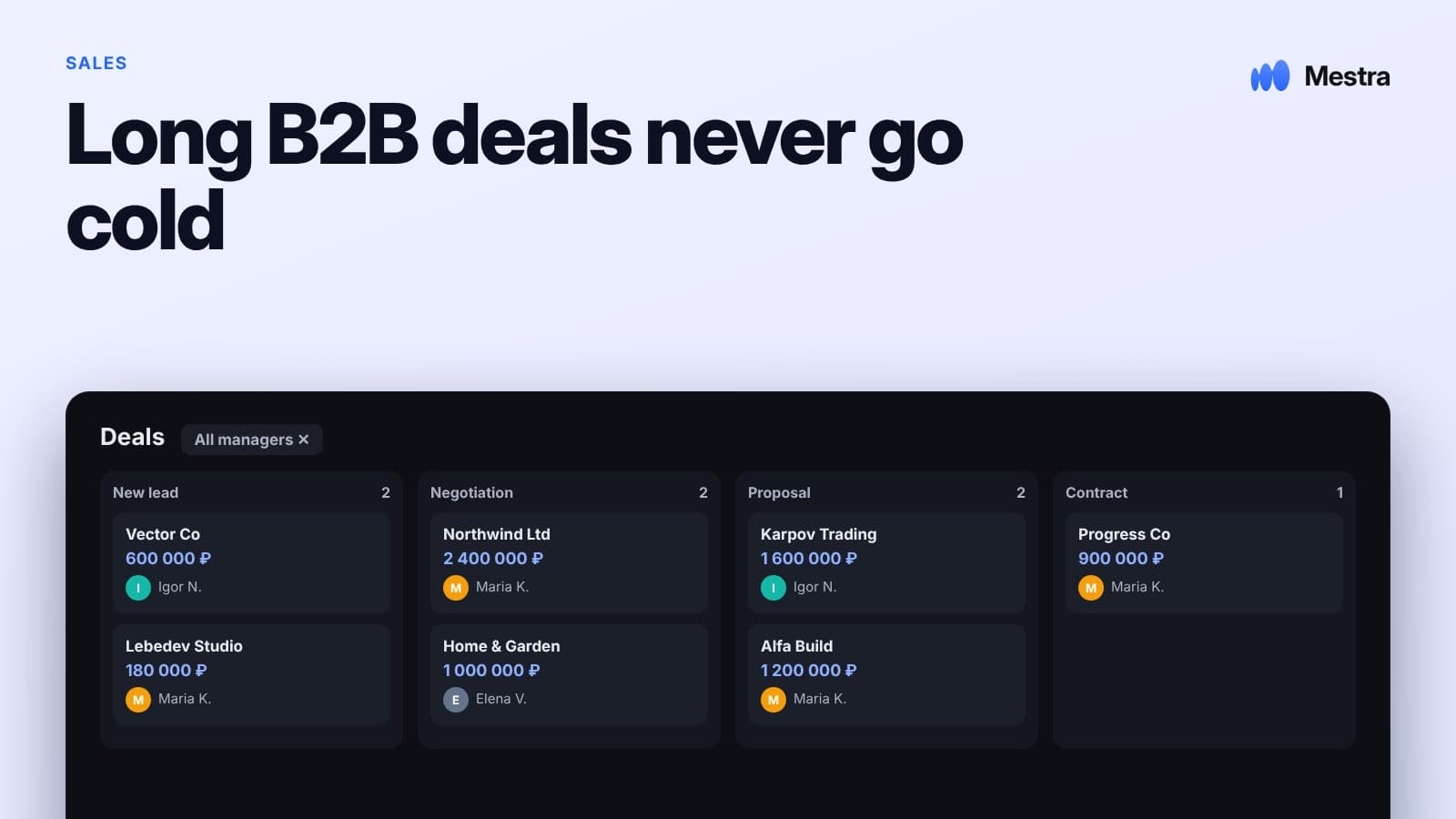
- All enquiries in one feed: MAX, Telegram, WhatsApp*, VKontakte, Avito, CIAN — none drop out of the statistics.
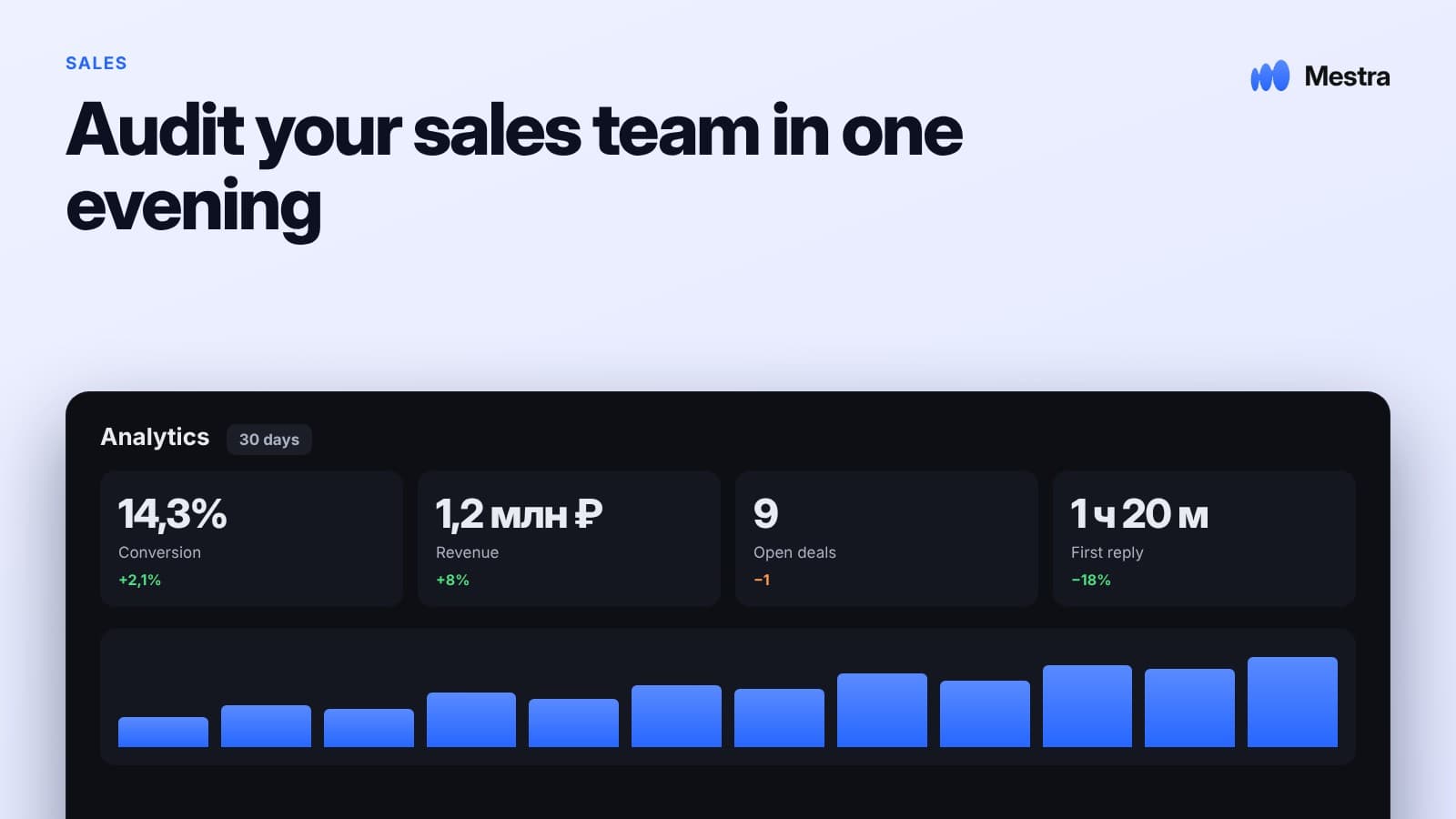
- Analytics: conversion for the company and each employee, leads by source, revenue.
- AI assistant 24/7 replies at night and at weekends, and suggests replies to managers during the day.
- Reasons for refusal are recorded in the card.
- Suits companies of any size: unlimited users, standard plans for teams of up to 300 people, Enterprise with custom implementation.

Plans start from 390 ₽ per user per month; the AI assistant comes with Standard for 1,090 ₽. The first 15 days are free.
FAQ
How do you calculate sales conversion?
Divide the number of sales by the number of enquiries for the same period and multiply by 100%.
What conversion is considered good?
It depends on the niche and channel. Compare with previous periods and watch the trend.
How is conversion different from the average bill?
Conversion shows how many enquiries became sales; the average bill shows for how much. More in our article average bill.
How can you raise conversion quickly?
Cut first response time, cover evening enquiries and add a next step to every reply.
Should conversion be calculated by manager?
Yes — it helps you see who needs help and scale up the techniques of the best.
Bottom line
Sales conversion is the main indicator of how a company works with the clients who have already come to it.
Calculate it by stage, channel and manager, find the weakest stage and start there. Results improve fastest through response speed, a next step in every conversation and handling objections.
*WhatsApp is owned by Meta, which is recognised as extremist and banned in Russia.