Break-Even Point: The Formula, a Worked Example and What It Tells You About Your Business
Finance4 min read
How to calculate the break-even point in money and in sales: the formula, an example for a service company, the margin of safety and how to lower the threshold.

The break-even point answers a simple question: how much do you need to sell a month to avoid running at a loss.
Knowing it, the owner understands the minimum sales plan and how much buffer the business has in case of a downturn.
One-minute calculation
- Add up fixed costs for the month.
- Find the contribution margin per sale: price − variable costs.
- Fixed costs / contribution margin = break-even point in sales.
- Compare with actuals: the difference is your margin of safety.
The formula
Break-even point (in sales) = fixed costs / (price − variable cost per unit)
- Fixed costs don't depend on sales: rent, salaries, services.
- Variable costs grow with every sale: materials, delivery, advertising per sale, the manager's percentage.
Example
| Metric | Value |
|---|---|
| Fixed costs per month | 600,000 ₽ |
| Average bill | 10,000 ₽ |
| Variable costs per sale | 6,000 ₽ |
| Contribution margin per sale | 4,000 ₽ |
| Break-even point | 150 sales, or 1,500,000 ₽ of revenue |
With 200 sales a month, profit = 50 × 4,000 = 200,000 ₽.
Margin of safety
Margin of safety = (actual sales − break-even point) / actual sales × 100%
At 200 sales, the margin of safety is 25%. Sales can fall by a quarter before the company goes into the red.
How to lower the break-even point
- Cut fixed costs.
- Reduce variable costs: supplier, logistics, advertising — see full cost.
- Raise the average bill.
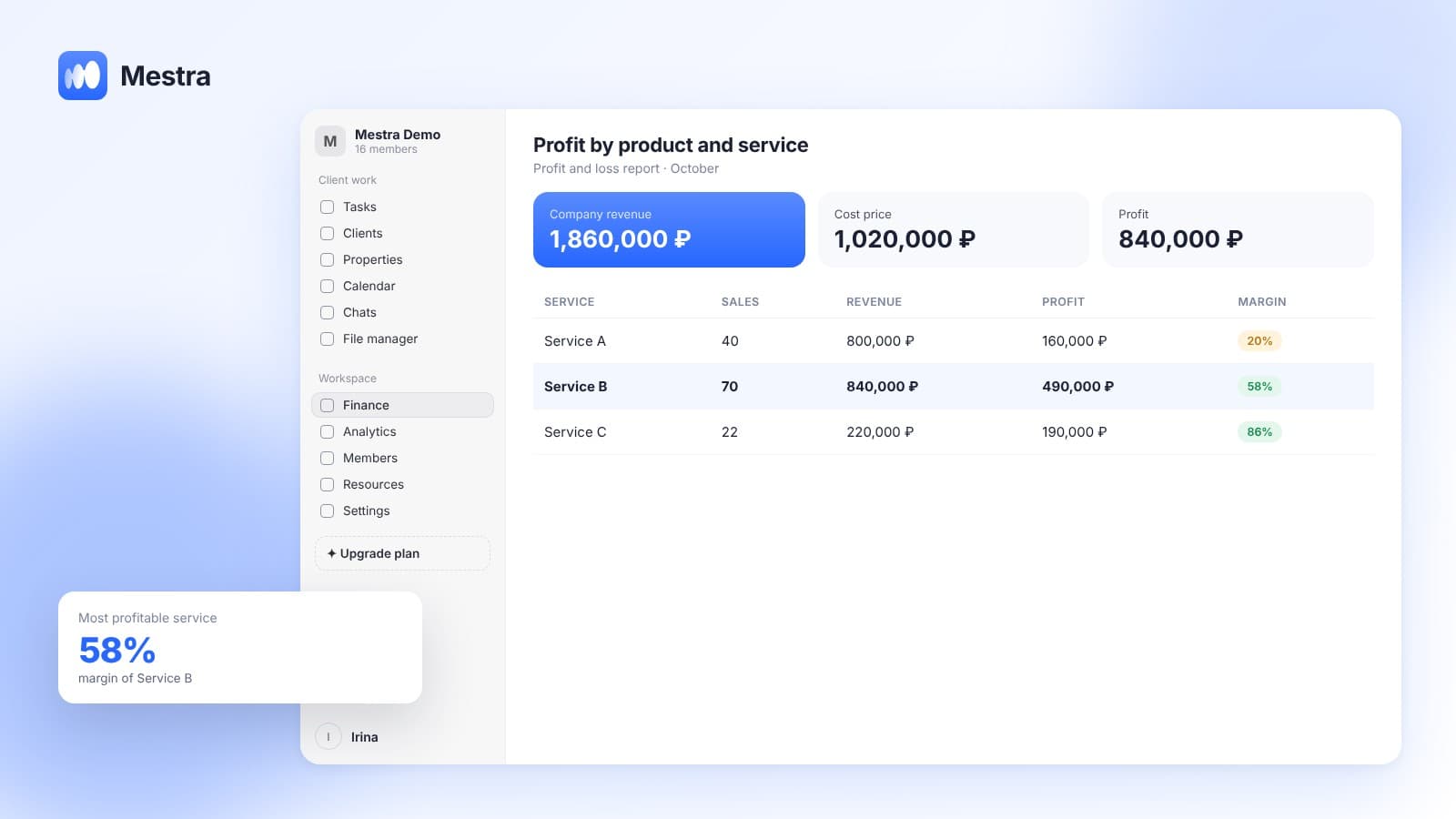
- Promote high-margin products — see profit by product.

The formula above gives the break-even point in physical terms — the number of sales. Below is the version in money terms, in rubles of revenue.
The break-even point in money
Break-even point (in rubles) = fixed costs / contribution margin ratio
Contribution margin ratio = (revenue − variable costs) / revenue. In the example above: 4,000 / 10,000 = 0.4. So the break-even point = 600,000 / 0.4 = 1,500,000 ₽.
Examples for different businesses
| Business | Fixed costs | Average bill | Contribution margin | Break-even point |
|---|---|---|---|---|
| Beauty salon | 450,000 ₽ | 3,500 ₽ | 1,400 ₽ | 322 visits |
| Car service | 700,000 ₽ | 8,000 ₽ | 3,200 ₽ | 219 orders |
| Online school | 400,000 ₽ | 25,000 ₽ | 15,000 ₽ | 27 sales |
How to use the break-even point
- For the sales plan: a plan below the break-even point is a guaranteed loss-making month.
- For hiring: a new employee raises fixed costs — calculate how much the point will rise.
- For discounts: a discount reduces the contribution margin and pushes the point up.
- For rent: moving to an expensive office changes fixed costs for years to come.
Common mistakes
- Treating the manager's percentage as a fixed cost — it's variable.
- Using the average bill before discounts.
- Not recalculating the point after hiring or a rent increase.
Break-even analysis is a classic cost–volume–profit tool that banks use when assessing business plans. The higher the margin of safety, the more resilient the business is to a drop in sales.
How it works in Mestra
- Cost in the product card — variable costs per unit are visible immediately.
- Expense items in 7 groups: cost of sales, marketing, staff, premises, operations, finance and legal, other.
- Profit and loss report and detailed financial reports.
- Salaries as monthly expenses — the main part of fixed costs.
FAQ
How often should the break-even point be recalculated?
Whenever prices, rent, headcount or cost change — and in any case once a quarter.
Is salary a fixed or variable cost?
Base salary is fixed; sales commission is variable.
What if sales are below the break-even point?
Look urgently at fixed costs and the average bill, and only then at increasing advertising.
Bottom line
The break-even point is your minimum sales bar. Everything above it turns into profit.
Calculate it for your business and compare it with actuals. In Mestra, cost, expenses and revenue are in one system.