Full Cost of Products and Services: Delivery, Advertising, Materials and 5 More Items People Forget
Finance6 min read
Full cost: which items it includes — materials, delivery, advertising, fees, the manager's pay — how to allocate overheads and where profit gets lost.

Full cost is the sum of all the costs a company incurs to sell one unit of a product or service.
A few items almost always "go missing" from it. Each seems small on its own, but together they eat a third of the profit.
Below: 8 items you need to account for, and an example of how profit changes once they're included.
One-minute calculation
- Take the cost from purchasing or production.
- Go through the 8 items in the table below and mark those you don't account for.
- Add an amount per unit for each.
- Compare profit "before" and "after" — the difference is your hidden losses.
The full cost formula
Full cost = production cost (materials, the executor's labour) + delivery costs + selling costs (advertising, fees, the manager's percentage) + a share of overheads
Full cost is production cost plus all the costs needed for the product to reach the client and be sold.
8 items of full cost
| Item | Why it gets forgotten |
|---|---|
| 1. Materials or purchase price | Not forgotten — this is where it all starts |
| 2. Delivery from the supplier | Paid at once for the whole batch |
| 3. Delivery to the client | Sometimes "included in the price" without calculation |
| 4. Advertising per sale | The budget is counted separately from the product |
| 5. Marketplace and platform fees | Deducted automatically, so they're invisible |
| 6. Card processing and bank fees | 1.5–3% on every card payment |
| 7. The manager's percentage or bonus | Ends up in salaries, not in the product |
| 8. Returns and defects | Happen "sometimes", but regularly |
How to allocate overheads
Rent, admin salaries and services can't be tied to one product. They're allocated using one of these methods:
- in proportion to revenue — expensive products carry a bigger share;
- in proportion to quantity — every unit carries the same share;
- in proportion to time — for services: how many hours the work takes.
The key is to choose one method and apply it consistently, so the numbers can be compared month to month.
Example: how profit changes
A service costs 5,000 ₽. Materials are 1,200 ₽. "A profit of 3,800 ₽" — or so it seems at first glance.
| Item | Amount |
|---|---|
| Materials | 1,200 ₽ |
| Advertising per client | 900 ₽ |
| Specialist's pay for the service | 1,000 ₽ |
| Card processing 2% | 100 ₽ |
| Share of rent and front desk | 600 ₽ |
| Full cost | 3,800 ₽ |
| Profit | 1,200 ₽ |

How hidden items eat profit: a monthly example
A company sells 300 units at 3,000 ₽. The owner counts only the purchase price — 1,500 ₽ per unit — and sees a profit of 450,000 ₽.
| Item not accounted for | Per unit | Per month |
|---|---|---|
| Delivery to the client | 180 ₽ | 54,000 ₽ |
| Advertising per sale | 350 ₽ | 105,000 ₽ |
| Platform fees | 240 ₽ | 72,000 ₽ |
| Card processing | 60 ₽ | 18,000 ₽ |
| Manager's percentage | 150 ₽ | 45,000 ₽ |
| Returns and defects | 90 ₽ | 27,000 ₽ |
| Total hidden costs | 1,070 ₽ | 321,000 ₽ |
The real profit is 129,000 ₽, not 450,000 ₽. Six "small" items took more than two-thirds of the result.
How to list the items for your business
- Follow an order's path from supplier to client and write down every payment along the way.
- Look at the bank statement for the month: every regular payment should fall into one of the items.
- Ask managers what discounts and bonuses they give — these are selling costs too.
- Account for returns over the last three months and convert them into an amount per unit.
Common mistakes in allocating overheads
- Changing the allocation method every month — the numbers can no longer be compared.
- Splitting everything equally between cheap and expensive products — cheap ones look loss-making.
- Not allocating at all — then every item looks profitable while the company is in the red.
For comparison: in Russian accounting, an organisation's expenses are governed by Accounting Regulation PBU 10/99 "Expenses of an Organisation", and in tax accounting by Articles 318–320 of the Tax Code. A management calculation is freer: its goal is to show what one sale really costs.
How it works in Mestra
- Cost in the product card: purchase price or materials, the executor's share, delivery and packaging are set once and flow into every invoice automatically.
- Costs of a specific sale — such as property advertising or a site visit — are added to the invoice line, and you see the profit after all costs.
- Expense items in 7 groups: cost of sales, marketing, staff, premises, operations, finance and legal, other.
- General channel advertising is recorded as an expense in the profit and loss report.
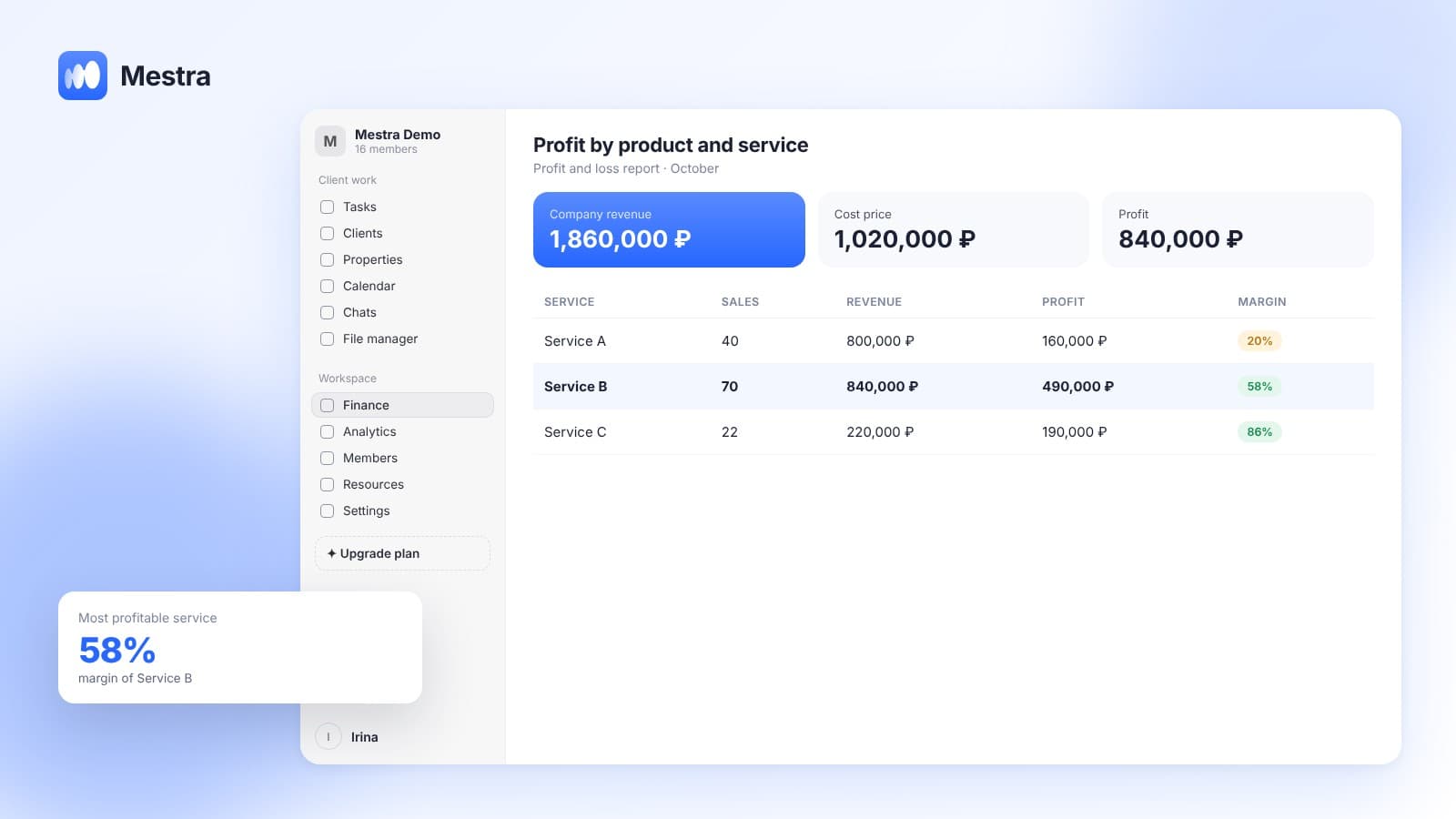
- Profit and loss report and detailed financial reports.
The basic formula is in our article cost of goods and services. How to calculate client acquisition cost — in what a client costs.
FAQ
Is advertising part of cost?
For management accounting — yes. Advertising spent on attracting a buyer is part of the cost of a sale.
How do you account for delivery paid for a whole batch?
Divide the delivery cost by the number of units in the batch and add it to the cost of each unit.
How is full cost different from production cost?
Production cost covers only the cost of making the product. Full cost also includes logistics, promotion and selling.
Bottom line
Full cost is almost always higher than it seems. Eight "small" items together can turn a good product into a loss-maker.
Enter all your expense items at least once — and prices and product range will start to look different. In Mestra, fixed per-unit costs are set once in the product card and then accounted for automatically.