Average Bill: What It Is, the Formula and 15 Ways to Increase It
Sales6 min read
What the average bill is, how to calculate it with a formula, how it differs in retail and services, what drives it, and 15 ways to increase it, with examples.

The average bill shows how much one purchase brings the company on average.
To find it, divide the total of all payments for the chosen period by the number of receipts or deals over the same period.
For example, 600,000 ₽ of revenue and 200 sales give an average bill of 3,000 ₽.
The average bill is increased through upselling, service bundles, "good — better — best" options, free delivery thresholds and training managers to sell value rather than discounts.
What the average bill is and why to calculate it
The average bill is one of the three multipliers of revenue: revenue = number of clients × average bill × purchase frequency. This metric helps you:
- plan sales — it's used to calculate how many deals are needed to meet the plan;
- assess the effectiveness of managers and promotions;
- see whether advertising pays off: client acquisition cost is compared with the average bill and margin.
How the average bill is used in calculating the plan — in our article the sales plan.
The average bill formula
Average bill = Revenue for the period / Number of sales for the period.
| Example | Revenue | Sales | Average bill |
|---|---|---|---|
| A coffee shop for a day | 48,000 ₽ | 160 | 300 ₽ |
| A beauty salon for a month | 850,000 ₽ | 340 | 2,500 ₽ |
| An online store for a month | 1,200,000 ₽ | 400 | 3,000 ₽ |
| Apartment renovation for a quarter | 4,800,000 ₽ | 24 | 200,000 ₽ |
Important: count receipts or deals as "sales", not the number of clients — one client can buy several times.
How to analyse the average bill properly
The overall company figure hides the details, so break the metric down:
- by period — day of the week, month, season;
- by channel — website, Avito, messengers, repeat clients;
- by manager — who sells more and why;
- by category — which goods and services pull the bill up;
- by new and regular clients.
If one manager's bill is 30% higher than their colleagues', study their conversations: there's often a ready-made upselling script for the whole team.
What the average bill depends on
- Product range — whether you have something to offer on top of the main purchase.
- Managers' work — whether they offer more or just answer the question.
- Discounts — constant sales teach buyers to put off purchases until the next promotion.
- Sales channel — in a messenger it's easier to show an additional product than in a short call.
- Client segment — B2B and regular clients usually buy more.
15 ways to increase the average bill
Upselling and bundles
1. Complementary products. Add to the main purchase whatever makes it more convenient: an aftercare product after a treatment, a protective coating after a renovation.
2. The "bigger" version. Show an extended version of the same service: more sessions, a longer guarantee, a larger volume.
3. Packages. Combine several services into one package — for example, "cut, styling and treatment" for a bit less than the sum.
4. A three-tier ladder. When "Basic", "Optimal" and "Premium" sit side by side, most people choose the middle rather than the cheapest.
5. Ready-made selections. "Frequently bought together", "the complete set for…" — it's easier for the client to take a ready solution.
Terms and incentives
6. A free delivery threshold slightly above your current average bill.
7. A gift above a certain amount: "a gift with orders over 5,000 ₽".
8. A loyalty programme for regular clients.
9. Memberships and subscriptions — paying for several visits at once.
10. Limited-time offers on additional items rather than a discount on everything.
Managers' work
11. An upselling script in every conversation: "With this service, people usually also take…". Templates in our collection of sales scripts.
12. Selling value instead of discounts. Explain what's included in the price. How to respond to "too expensive" — in our article handling objections.
13. Motivation based on the average bill, not just the number of deals. More in our article on motivating managers.
Data and service
14. Personal offers based on purchase history: a client who bought cat food gets cat litter and vitamins.
15. Fast, complete replies. A client who got a quick, detailed answer is more willing to take additional items.
Mistakes when increasing the average bill
- Pushy upselling. Offer one relevant addition, not five.
- Discounts on everything. The number of receipts grows, but the bill and margin fall.
- Growing the bill at the cost of losing clients. Make sure conversion doesn't fall.
- No tracking. Without data by channel and manager, it's unclear what worked.
How Mestra helps calculate and increase the average bill
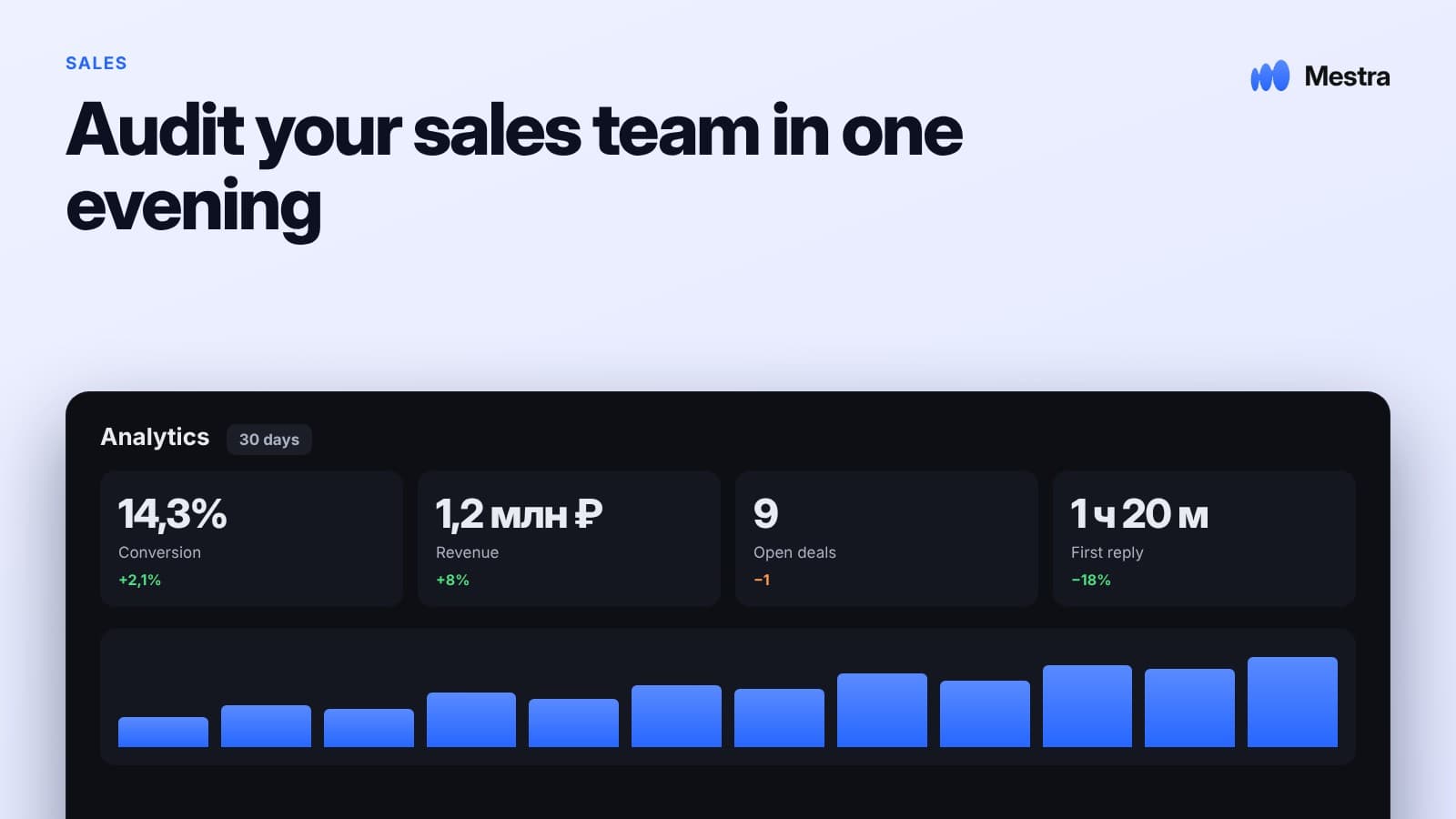
- Revenue analytics by period, source and employee — no manual spreadsheets.
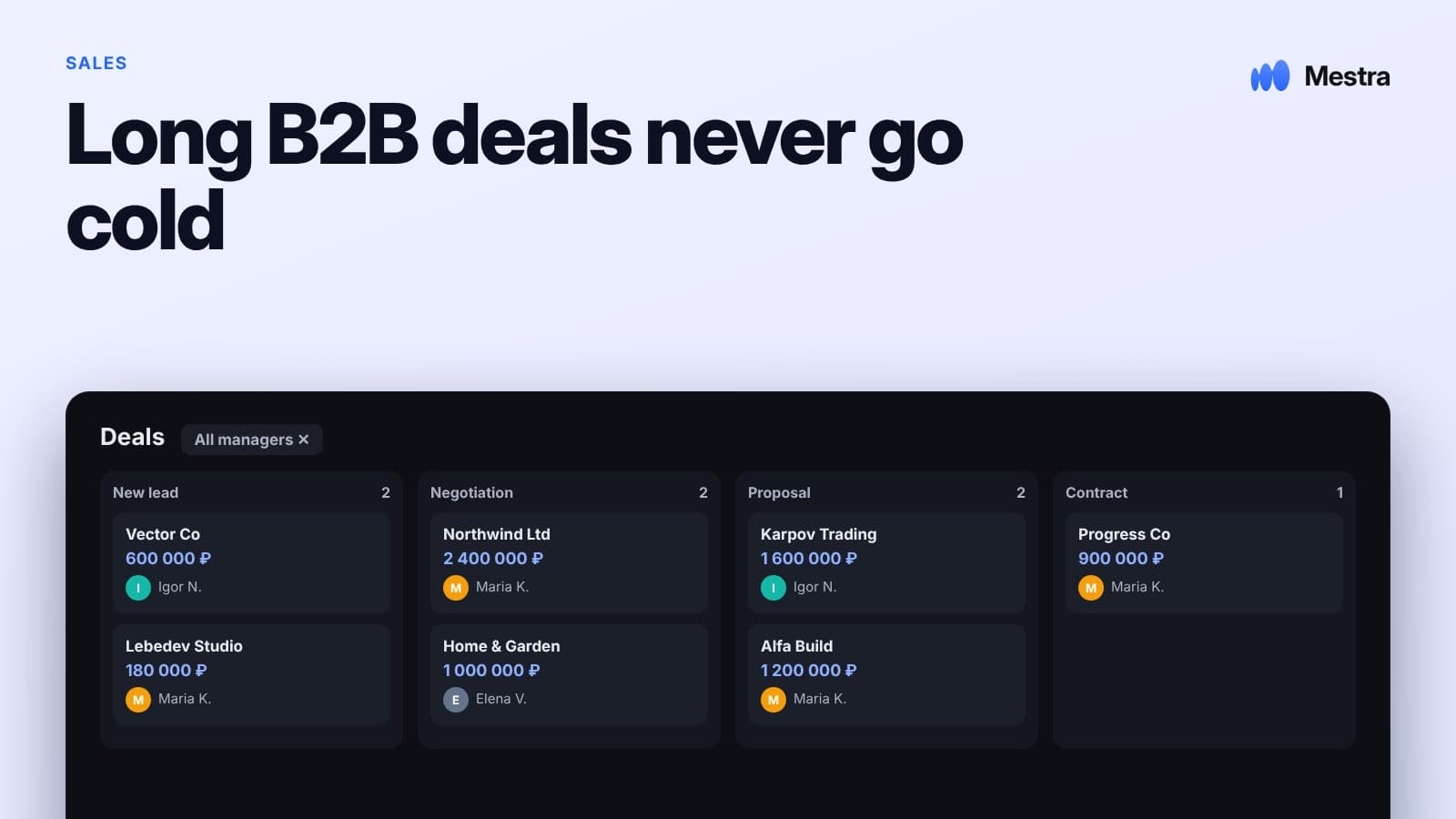
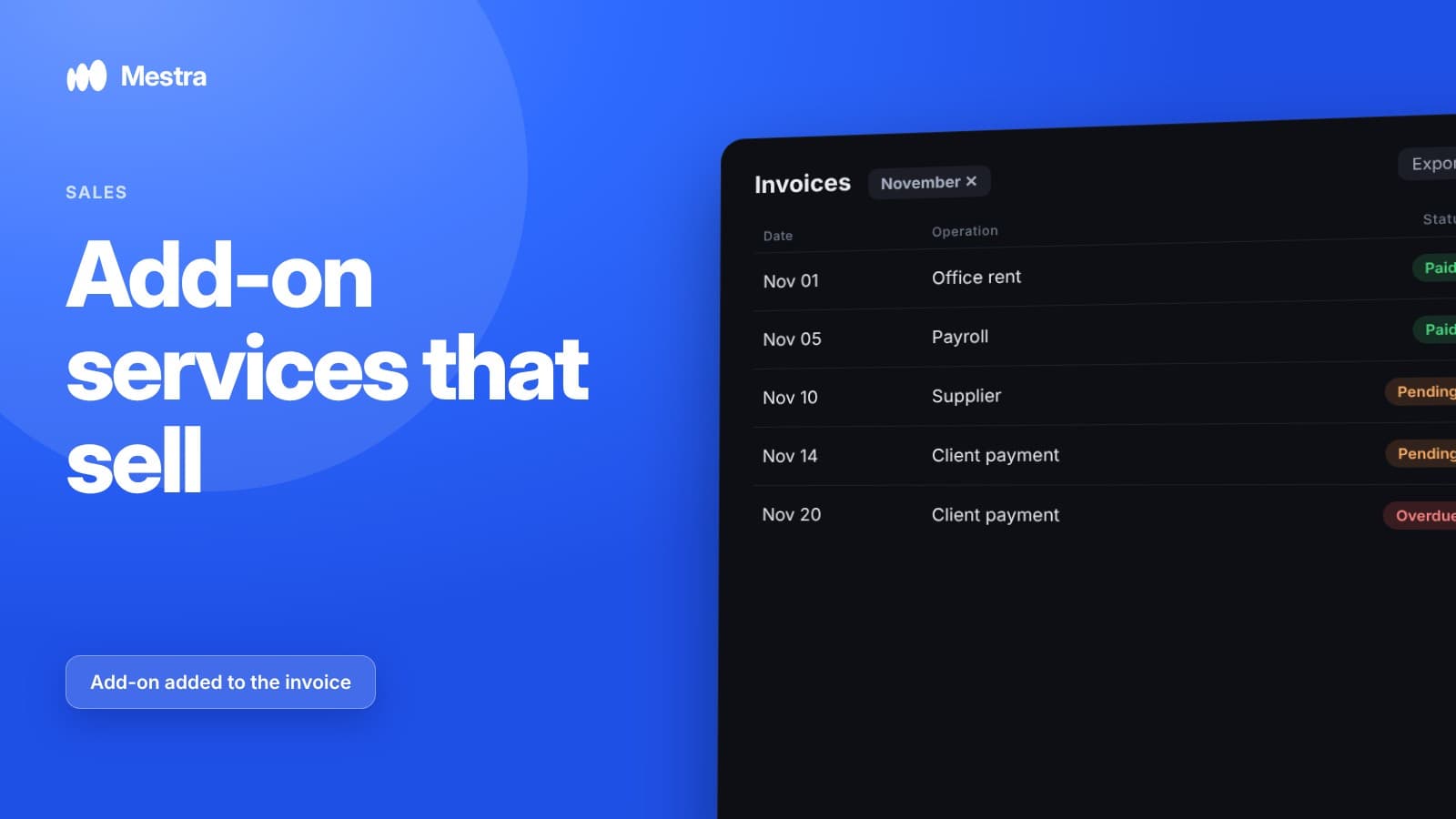
- Invoices and payments in the client card — you can see how much and what each client bought.
- AI suggestions for managers with ready offers of additional products from your catalogue.
- Reminders and mailings to your base — for personal offers.
Mestra suits companies of any size: standard plans are designed for teams of up to 300 people, and Enterprise for larger ones. Plans start from 390 ₽ per user per month, or 1,090 ₽ with the AI assistant. The first 15 days are free.

FAQ
How do you calculate the average bill?
Divide revenue for the period by the number of sales for the same period.
What average bill is considered good?
There's no universal benchmark — compare with previous periods and averages for your niche.
How is the average bill different from LTV?
The average bill is the value of one purchase; LTV is how much a client brings over the whole relationship.
How can you increase the average bill quickly?
Add one relevant upsell to every conversation and a package offer — the effect shows within a few weeks.
Should returns be taken into account?
Yes — for an accurate calculation, subtract returns from revenue and the number of sales.
Bottom line
The average bill is a simple metric with a big impact on profit.
Calculate it in different breakdowns, find who has the highest bill and in which channels, and scale those techniques: upselling, bundles, three price levels and personal offers. Grow the bill without discounting everything — and make sure conversion doesn't fall along with it.