Cost of Goods and Services: How to Calculate It Accurately — Formula, Example and Common Mistakes
Finance6 min read
How to calculate the cost of a product or service: the formula, a worked example, what cost includes and why profit is overstated without delivery and ads.

Cost is the answer to the question "what does one sale actually cost us".
Until you know the answer, you can't tell which products make money and which just create turnover, or whether your prices are right.
Let's look at the formula, a worked example and the mistakes that make businesses sell at a loss without noticing.
One-minute calculation
- Add up the purchase price or materials per unit.
- Add delivery, packaging and the executor's share.
- Add advertising and fees per sale.
- Divide rent, services and admin salaries by the number of sales in the month.
- Price − total = the real profit per unit.
Calculating the cost of products and services
In manufacturing they talk about production cost, in retail about the cost of goods, in services about the cost of a service. The principle is the same: add up all the costs needed to produce and sell one unit, and compare them with the price.
What's included in cost
| Cost group | Examples |
|---|---|
| Direct | Raw materials, supplies, the product's purchase price, a specialist's work on a specific service |
| Logistics | Delivery from the supplier, delivery to the client, packaging |
| Promotion | Advertising, marketplace and platform fees |
| Sales | The manager's percentage or bonus per sale |
| Indirect | Rent, admin salaries, services, telecoms |
Direct costs are easy to tie to a specific product. Indirect costs are spread across all sales — for example, in proportion to revenue or number of units.
The cost formula
Unit cost = direct costs per unit + indirect costs for the period / number of units sold
Worked example
A company sells a product for 1,000 ₽. It seems the profit is 650 ₽, since the purchase price is 350 ₽. Let's calculate in full:
| Item | Per unit |
|---|---|
| Purchase price or materials | 350 ₽ |
| Delivery | 80 ₽ |
| Advertising per sale | 120 ₽ |
| Manager's percentage | 100 ₽ |
| Share of rent and services | 50 ₽ |
| Full cost | 700 ₽ |
| Real profit | 300 ₽, not 650 ₽ |
That's more than a twofold difference. This is exactly how companies sell "profitable" products for years that barely break even.
Common mistakes
- Counting only the purchase price. Logistics and advertising per sale are often comparable to the cost of materials.
- Ignoring the manager's pay. A percentage per sale is also part of cost.
- Calculating once a year. Carrier rates and advertising costs change every month.
- Mixing products. An average cost across the company hides loss-making items.

Examples by industry
Beauty salon: hair colouring for 6,000 ₽
| Item | Amount |
|---|---|
| Dye and consumables | 900 ₽ |
| Stylist's share 40% | 2,400 ₽ |
| Advertising per new client (average) | 500 ₽ |
| Card processing 2% | 120 ₽ |
| Share of rent and front desk per visit | 700 ₽ |
| Total costs | 4,620 ₽ |
| Profit | 1,380 ₽ — 23% |
Online store: a 2,500 ₽ product on a marketplace
| Item | Amount |
|---|---|
| Purchase price | 1,000 ₽ |
| Marketplace fee | 500 ₽ |
| Logistics and storage | 250 ₽ |
| In-platform advertising | 200 ₽ |
| Packaging | 50 ₽ |
| Total costs | 2,000 ₽ |
| Profit | 500 ₽ — 20% |
Renovation company: a bathroom renovation for 180,000 ₽
| Item | Amount |
|---|---|
| Materials | 70,000 ₽ |
| Crew | 55,000 ₽ |
| Material delivery and waste removal | 8,000 ₽ |
| Measurement and estimate | 3,000 ₽ |
| Advertising per order | 12,000 ₽ |
| Total costs | 148,000 ₽ |
| Profit | 32,000 ₽ — 18% |
A calculation template
To calculate the costs for your own item, fill in five lines:
- Direct costs per unit — purchase price, materials, the executor's work.
- Logistics per unit — delivery from the supplier and to the client, packaging.
- Promotion per sale — advertising and platform fees.
- Cost of the sale — the manager's percentage or bonus, card processing.
- A share of overheads — rent, services, admin, divided by the number of sales.
The sum of the five lines is the full cost per unit. Compare it with the price: if profit is less than 15–20% of the price, the item needs attention.
The split into direct and indirect costs is also established in tax accounting: Article 318 of the Russian Tax Code classifies materials and the pay of production staff as direct expenses. For management decisions, that's not enough — the cost of a sale should also include logistics and promotion.
How it works in Mestra
- Cost in the product card: purchase price or materials, the executor's share, delivery and packaging are set once and flow into every invoice automatically.
- Costs of a specific sale — such as property advertising or a site visit — are added to the invoice line, and you see the profit after all costs.
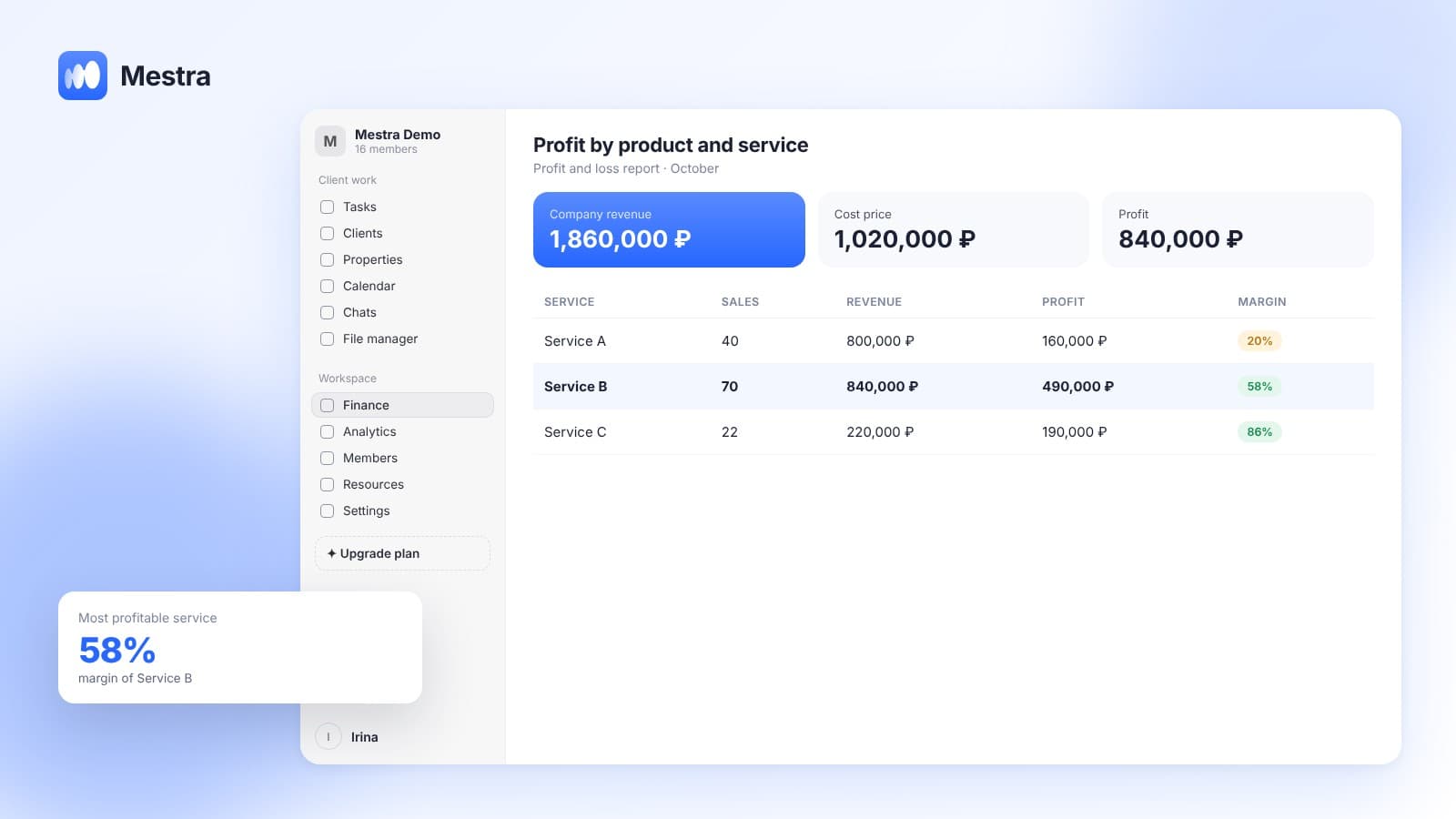
- Profit and loss report and detailed financial reports.
- Sales and invoices in the same system — no need to combine calculations from different spreadsheets.
More on what full cost includes in our article full cost: delivery, advertising, materials. How to find loss-making items — in profit by product.
FAQ
How is cost different from the purchase price?
The purchase price is only part of cost. Full cost also includes delivery, advertising, the manager's pay and a share of overheads.
How often should cost be recalculated?
At least once a month. Immediately if supplier prices or advertising costs rise sharply.
Should rent be included in cost?
For management decisions — yes, as a share of indirect costs. Otherwise the price may not cover fixed costs.
Can cost be calculated automatically?
Yes. In Mestra, per-unit costs are set in the product card and flow into every invoice automatically, while the costs of a specific sale are added manually.
Bottom line
Cost is the foundation of price and profit. If you count only the purchase price, the business sees a profit that doesn't exist.
Calculate full cost for at least your five main products — the result often changes your pricing policy. In Mestra, cost is set once in the product card and then accounted for in every invoice — try it free for 15 days.