Calculating Production Cost: Methods, a Formula and a Worked Batch Example
Finance5 min read
Calculating production cost in manufacturing: methods, a per-unit and per-batch formula, a sewing workshop example with numbers, defects and overhead allocation.

Calculating production cost means adding up all the costs of producing a batch and dividing by the number of good units. The formula is simple, but mistakes almost always lie in which costs are included: the workshop counts materials and forgets rent, contributions and defects.
Below: calculation methods, the formula, a sewing workshop example and a check that shows where profit is being lost.
One-minute calculation
- Collect the batch's direct costs: materials, fittings, piece-rate pay, contributions, energy.
- Add the period's share of production overheads: workshop rent, depreciation, repairs.
- Subtract defects and count the good units.
- Divide costs by the good units — that's the unit production cost.
- Add packaging, delivery and a share of management to get full cost.
The production cost formula
Unit cost = (Materials + Labour + Contributions + Energy + Share of overheads) ÷ Number of good units.
The rules for determining the cost of inventory in accounting are set out in Federal Accounting Standard FSBU 5/2019 "Inventory", approved by Order of the Russian Ministry of Finance No. 180n of 15.11.2019. A management calculation follows the same logic, but the company chooses items to suit its decisions.
Costing methods
| Method | Type of production | How it's calculated |
|---|---|---|
| Job order | Made-to-order furniture, equipment | Costs are collected for each order |
| Process | Uniform output: bread, water | Period costs are divided by output |
| Stage-based | Several stages: fabric → cutting → sewing | Cost is calculated for each stage |
| Standard | Serial production | Standards are compared with actuals to find variances |
Process costing suits workshops making one model per batch. If models and orders vary, use job order costing.
Example: a batch of hoodies in a sewing workshop
The workshop sews 200 hoodies per batch, 1,000 items in total per month.
| Item per unit | Amount, ₽ |
|---|---|
| Fabric: 2.1 m × 450 ₽ | 945 |
| Thread and fittings | 85 |
| Labels and tags | 35 |
| Seamstress's piece-rate pay | 350 |
| Insurance contributions (approx. 30%) | 105 |
| Electricity | 20 |
| Share of rent and depreciation: 150,000 ₽ ÷ 1,000 items | 150 |
| Production cost | 1,690 |
| Packaging | 40 |
| Delivery to the wholesale buyer | 60 |
| Share of management | 50 |
| Full cost | 1,840 |
The wholesale price excluding VAT is 2,600 ₽. Profit per item: 2,600 − 1,840 = 760 ₽; per batch: 760 × 200 = 152,000 ₽.
How defects change the cost
Batch costs at production cost: 1,690 × 200 = 338,000 ₽. If 10 items are defective, 190 good ones remain, and the cost of one good item is 338,000 ÷ 190 ≈ 1,779 ₽. Every percent of defects raises the item's cost to the workshop, even though material usage looks unchanged on paper.
Where workshops lose profit
- Counting only materials. Without labour, contributions and rent, the hoodie appears to cost 1,065 ₽ instead of 1,840 ₽.
- Not updating raw material prices. Fabric went up by 50 ₽ per metre — the cost rose by 105 ₽, but the price stayed the same.
- Ignoring downtime. With output of 700 items instead of 1,000, the rent share rises from 150 to 214 ₽ per item.
- Dividing by output, not good units. Defects hide in general costs.
Related topics: cost calculation by item, break-even point and CRM for manufacturing.
How it works in Mestra

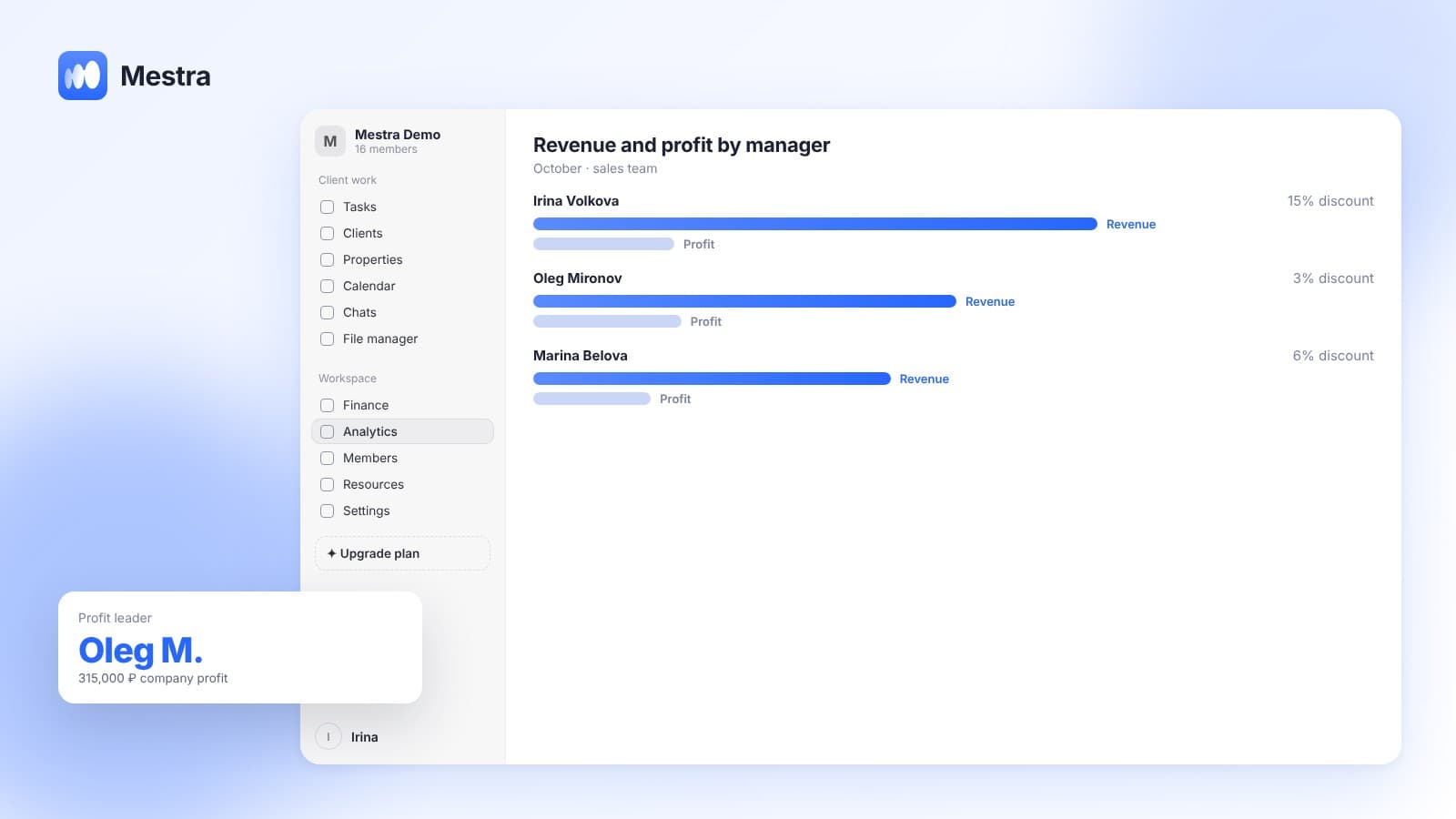
Payouts to executors: accrued, paid, outstanding
Mestra is a CRM system: clients, messengers and marketplaces, tasks, finance, analytics and an AI operator in one window. For manufacturing, it links orders, warehouse and money.
- Cost in the product card. Materials, the executor's share, delivery and packaging are set once and filled into every invoice.
- Profit on every sale. Before sending an invoice, you can see how much the company will earn on the order.
- Costs of a specific order. Express delivery or extra packaging is added to the invoice line.
- Warehouses. Stock is tracked for each warehouse, decreasing on sale and increasing on receipt or return.
- Order as a project. Production stages with responsible people and deadlines, a kanban view and a manufacturing process template.
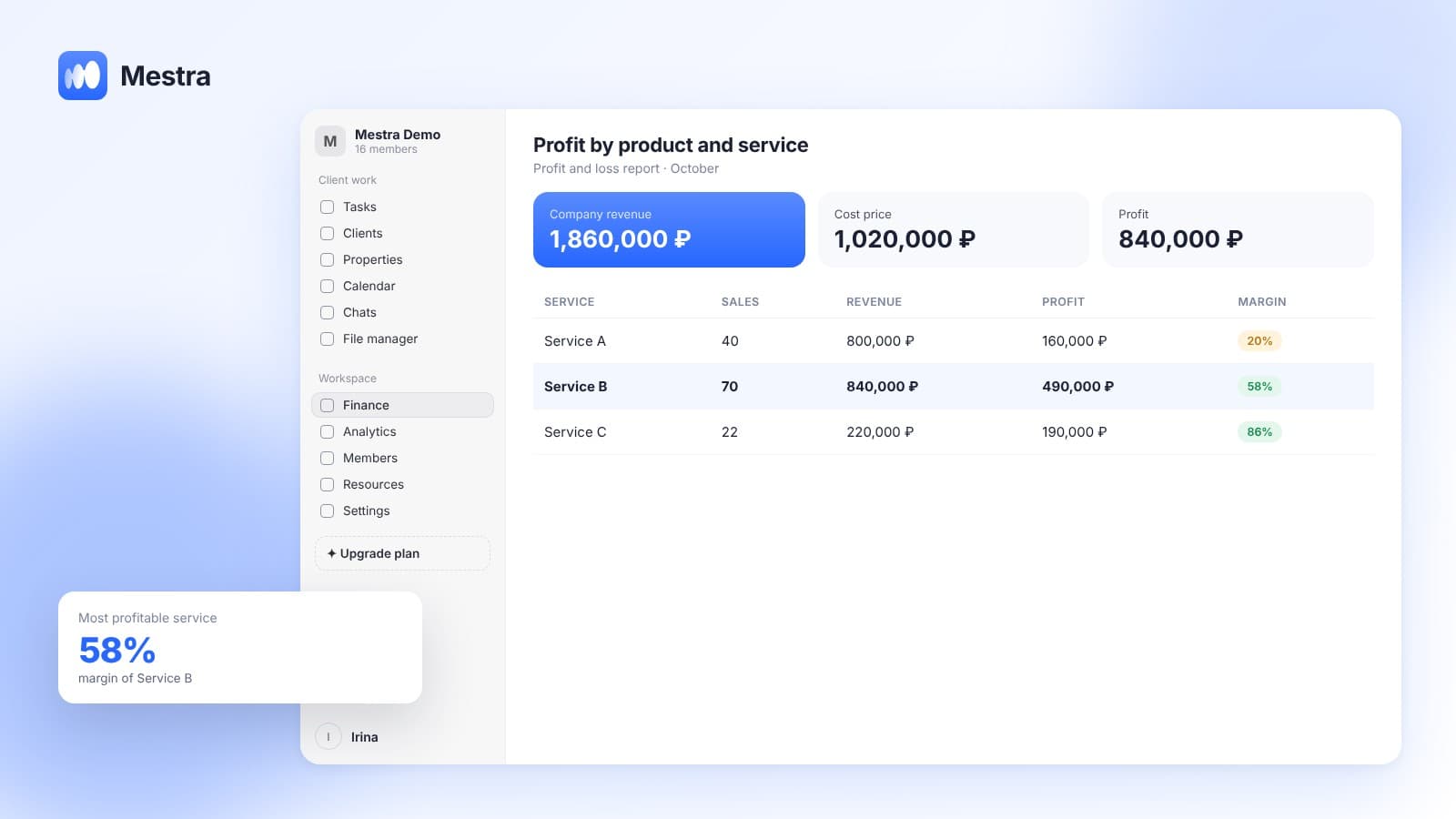
- Profit and loss report. Workshop rent, management and marketing are recorded as operating expenses, and the bottom-line profit is calculated automatically.
FAQ
How do you calculate cost if a batch has different models?
Direct costs are calculated separately for each model, and production overheads are allocated on a base: labour intensity, labour cost or machine hours.
Is advertising part of production cost?
Not of production cost. Advertising is a selling expense and is counted in full cost or as an operating expense of the period.
How often should cost be recalculated?
Whenever raw material prices, executor rates or production volume change. At least once a month.
What about work in progress?
Costs of items still in production aren't included in the cost of the finished batch. They are carried over to the next period, when the items are completed.
Bottom line
Production cost is calculated per good unit and with all costs included: materials, labour, contributions, energy and a share of overheads. Defects and downtime change the figure more than it seems. In Mestra, unit cost is stored in the product card, and the profit on every order is visible before the invoice is issued — try it free for 15 days.