Cost Calculation: Cost Items, a Worked Example and a Ready-Made Template
Finance6 min read
Unit cost calculation step by step: which cost items to include, a worked example for a wardrobe, and how to keep the calculation current as prices rise.

A cost calculation is a table that breaks down the cost of one unit of output by item: materials, labour, energy, overheads and selling costs. The total shows what one product costs the company, and that number drives the price, discounts and decisions about what to produce next.
Without a cost calculation, the owner sees revenue but can't see which product makes money and which breaks even. Below: the cost items, a worked example and a process that suits manufacturing, retail and services alike.
One-minute calculation
- Choose the costing unit: piece, batch, order, hour of work.
- Calculate direct costs per unit: materials, components, piece-rate pay plus contributions.
- Add a share of production overheads: workshop rent, depreciation, equipment maintenance.
- Add administrative and selling costs: management, packaging, delivery.
- Compare the full cost with the selling price and calculate the profit per unit.
Cost calculation items
Each company sets its own list of items. For accounting of inventory, Federal Accounting Standard FSBU 5/2019 "Inventory" (approved by Order of the Russian Ministry of Finance No. 180n of 15.11.2019) applies: it describes which costs are included in the cost of inventory. For a management calculation, it's convenient to start from a standard list and drop what you don't need.
| Item | What it includes | Cost type |
|---|---|---|
| Raw materials | Main materials including waste | Direct |
| Purchased components | Fittings, parts, product packaging | Direct |
| Process energy | Electricity and gas for machines and kilns | Direct |
| Executor pay | Piece-rate pay or the craftsperson's share | Direct |
| Insurance contributions | Contributions on production staff pay | Direct |
| Production overheads | Workshop rent, depreciation, equipment repair | Indirect |
| Administrative | Management, accounting, office | Indirect |
| Selling | Delivery, installation, packaging for the client | Indirect |
Direct costs are easy to attribute to a specific item. Indirect costs are allocated using a base: machine hours, labour cost or number of items.
Example calculation: a sliding-door wardrobe from a furniture workshop
The workshop makes made-to-order sliding-door wardrobes. Selling price excluding VAT: 52,000 ₽.
| Item | Amount per wardrobe, ₽ |
|---|---|
| Chipboard and mirror | 18,400 |
| Fittings and components | 6,200 |
| Electricity for machines | 600 |
| Assembler's piece-rate pay | 5,000 |
| Insurance contributions (approx. 30%) | 1,500 |
| Production overheads (share of workshop rent and depreciation) | 2,300 |
| Production cost | 34,000 |
| Administrative (share of management) | 1,500 |
| Delivery and installation | 2,500 |
| Packaging | 400 |
| Full cost | 38,400 |
Profit per wardrobe: 52,000 − 38,400 = 13,600 ₽, a return on sales of about 26%.
If you only count materials and fittings (24,600 ₽), profit appears to be 27,400 ₽ — twice the real figure. This is the mistake that leads companies to give discounts that eat up all their earnings.
Production cost vs full cost
Production cost shows what the product cost up to the moment it leaves the workshop. Full cost adds management and selling costs. For pricing decisions you need the full cost: the client pays for a wardrobe that has already been delivered and assembled.
More on the difference in our article on full cost.
How to allocate indirect costs
Indirect costs are the main source of disputes. Three workable methods:
- By number of items. Workshop rent of 200,000 ₽ a month, output of 80 wardrobes — 2,500 ₽ per wardrobe. Suits uniform products.
- By labour cost. The share of costs is proportional to piece-rate pay. Suits products that vary greatly in labour intensity.
- By machine hours. Suits workshops with expensive equipment.
Fix your chosen method and don't change it every month, or you won't be able to compare periods.
Cost calculation for retail and services
In retail the calculation is shorter: purchase price, delivery from the supplier, packaging, marketplace commission, delivery to the client. In services, the main items are materials, the executor's share and time. Separate guides: calculating the cost of a service and profit by product.
How often to update the calculation
Recalculate whenever a supplier's price, the delivery rate or the executor's rate changes. If chipboard goes up by 10%, the wardrobe's cost rises by 1,840 ₽ and profit drops to 11,760 ₽. Without recalculation, the workshop only finds out at the end of the quarter.
How it works in Mestra

The executor's share is calculated on the invoice line — profit is visible before sending
Mestra is a CRM system: clients, messengers and marketplaces, tasks, finance, analytics and an AI operator in one window. Cost calculation is part of the product card, not a separate file.
- Unit costs in the product card. Purchase or materials, the executor's share, delivery and packaging are set once.
- Automatic transfer to the invoice. When you issue an invoice, the cost is filled into every line, and the profit on the sale is visible before it's sent to the client.
- Costs of a specific sale. Installation at a distant site or separate delivery is added to the invoice line manually.
- The executor's share. The craftsperson's or assembler's commission is accrued automatically after the invoice is paid: as a percentage, a fixed amount, per session or per hour.
- Indirect costs. Rent, management and marketing are recorded as operating expenses in one of seven groups and flow into the profit and loss report.
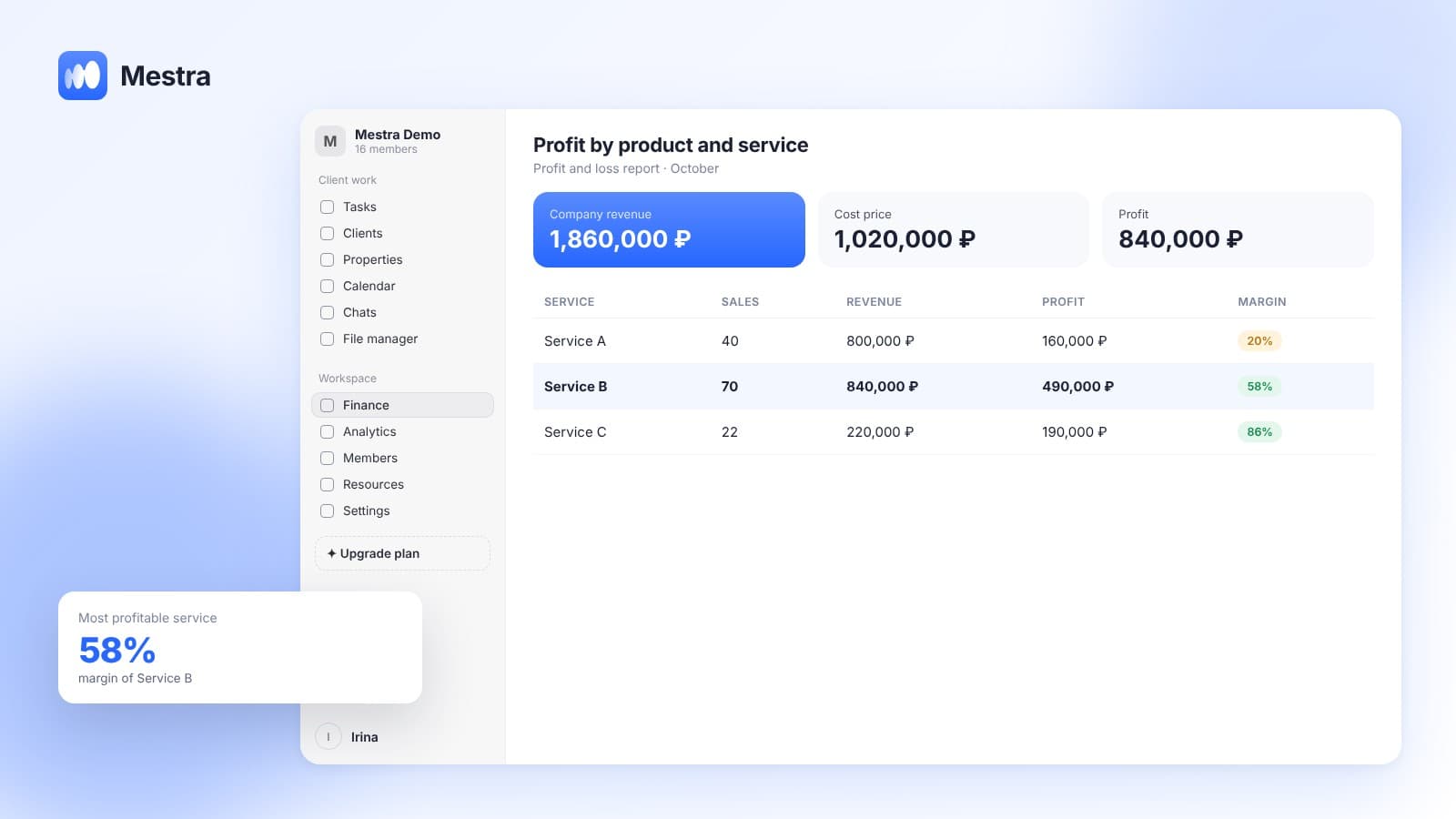
- Profit by product. You can see which items make money after all costs.
FAQ
How is a cost calculation different from an estimate?
An estimate calculates the costs of a specific order or site before work starts. A cost calculation shows the cost per unit of output and is used constantly — for pricing and profit analysis.
Should VAT be included in the cost calculation?
VAT payers calculate cost excluding input VAT, because it is deducted. Companies without the right to deduct include VAT in the cost of materials.
Who approves the cost items?
The list of items and the method of allocating indirect costs are set in the company's accounting policy. For a management calculation, a decision by the manager is enough.
What if the calculation shows a loss?
Options: review the price, find another supplier, reduce waste or discontinue the item. Decide based on full cost, not on materials alone.
Bottom line
A cost calculation shows the real cost of every unit of output. Break costs down by item, allocate indirect costs on a single base and recalculate whenever prices change. In Mestra, cost is set in the product card and flows into invoices automatically — try it free for 15 days.