Payment calendar: how to plan incoming and outgoing payments so the money is there on the right day
Finance11 min read
A payment calendar in plain words: why you need it, how to build it step by step, a sample table, payment priorities and how to spot a cash gap in time.

A payment calendar is a table that lays out, by day or by week, the company's expected cash receipts and mandatory payments, along with the projected balance for each day. It shows when money may run short and gives you time to prepare: speed up payment from clients, move a supplier payment or postpone a non-essential purchase.
In this article: How a payment calendar differs from a budget and a profit and loss statement · What a cash gap is · How to build a payment calendar: 7 steps · A sample payment calendar for a week · How to prioritize payments when money is short · How to reduce cash gaps · Where to get the data for a payment calendar · Common mistakes · Case study: how a cash gap appears in a profitable month · 30-day plan
A payment calendar in a minute
| Question | Answer |
|---|---|
| What is it? | A plan of receipts and payments by date |
| What for? | To see a cash gap in advance |
| For what period? | Usually 4–13 weeks, by day or by week |
| What does it consist of? | Opening balance, receipts, payments, closing balance |
| Who maintains it? | The owner, a finance manager or an accountant |
| How often to update it? | At least weekly, daily in tight periods |
How a payment calendar differs from a budget and a profit and loss statement
These three tools are often confused, though they answer different questions.
| Tool | Question | Example |
|---|---|---|
| Profit and loss statement | Did we earn money? | In October revenue was 3 million, expenses 2.6 million, profit 400 thousand |
| Budget | How much do we plan to earn and spend? | For November — revenue 3.2 million, expenses 2.7 million |
| Payment calendar | Will there be enough money on a specific day? | On November 15 we must pay 900 thousand, and the account will hold 600 thousand |
A company can be profitable and still not have the money to pay salaries on the 10th. Clients will pay in three weeks, but the bills are due now. That is exactly what a payment calendar shows.
What a cash gap is
A cash gap is a situation where on a particular day there are more payments due than money in the account. It doesn't necessarily come from losses. Typical causes:
- clients pay with a delay, while suppliers must be paid immediately;
- seasonality: expenses are even, while revenue dips in certain months;
- a large purchase or a prepayment for a big order;
- a client delayed payment of a large invoice;
- taxes, rent and salaries fall in the same week.
How to build a payment calendar: 7 steps
1. Choose the horizon and the step
For most companies this works well: the next 2 weeks by day, the following 2–3 months by week. Beyond that the forecast becomes too imprecise.
2. Record the opening balance
The amount of money in all bank accounts and the cash register today. Only real money, no "coming soon".
3. Enter mandatory payments
These are the payments you cannot skip or move without consequences:
| Payment | Usual date |
|---|---|
| Salary and advance | Fixed dates of the month |
| Taxes and contributions | According to the tax calendar |
| Rent | Per the contract |
| Loans and leasing | Per the schedule |
| Subscriptions and telecom | On the charge dates |
4. Enter supplier payments
Based on real contracts and invoices: date, amount, whether it can be moved. Mark which payments are flexible — that is your room for maneuver when there's a gap.
5. Enter receipts from clients
The hardest part. The rule: only receipts against issued invoices and signed contracts with a clear payment date go into the calendar. "The client promised to think about it" is not a receipt.
For each invoice, take into account the client's actual habits: if they usually pay 5 days late, put in the date with that shift.
6. Calculate the balance for each day
End-of-day balance = opening balance + receipts − payments. If the balance goes negative anywhere, or below your minimum reserve, that is a signal.
7. Set a minimum balance
Don't plan for zero in the account. Set a "minimum balance", for example the amount of a week's mandatory payments. If the forecast drops below it, act in advance.
A sample payment calendar for a week
| Day | Opening balance | Receipts | Payments | Closing balance |
|---|---|---|---|---|
| Mon, Nov 9 | 420,000 | 180,000 (invoice #214) | 60,000 (rent) | 540,000 |
| Tue, Nov 10 | 540,000 | — | 380,000 (salary) | 160,000 |
| Wed, Nov 11 | 160,000 | 95,000 (invoice #219) | 40,000 (supplier) | 215,000 |
| Thu, Nov 12 | 215,000 | — | 250,000 (purchase) | −35,000 |
| Fri, Nov 13 | −35,000 | 310,000 (invoice #221) | 20,000 (subscriptions) | 255,000 |
On Thursday there is a gap of 35 thousand, although by Friday everything evens out. Seeing this on Monday, you can agree with the supplier to move the purchase to Friday or ask the client on invoice #221 to pay a day earlier.
How to prioritize payments when money is short
If a gap is unavoidable, payments need to be put in order:
| Priority | Payments | Why |
|---|---|---|
| 1 | Salaries, taxes | Fines, risks for the team and the business |
| 2 | Critical suppliers | Work would stop without them |
| 3 | Rent, loans | Penalties and loss of trust |
| 4 | Other suppliers | You can negotiate a deferral |
| 5 | Non-essential expenses | They can be postponed |
And the main rule: warn the counterparty about a delay in advance, not on the payment day. It preserves the relationship.
How to reduce cash gaps
Speed up receipts
- issue the invoice right after the agreement, not at the end of the month;
- take a prepayment or payment in stages;
- track payment deadlines and remind the client 1–2 days before the due date;
- offer a discount for early payment if it is cheaper than a loan.
Manage payments
- negotiate deferrals with suppliers;
- spread large payments across different weeks;
- don't make big purchases in salary week.
Keep a reserve
A financial cushion of 1–2 months of fixed expenses removes most problems. How to manage expenses so that a reserve builds up is covered in the article on how to cut costs.
Where to get the data for a payment calendar
The main problem is the data on receipts. If invoices are issued from different places and payment information arrives late, the calendar is always inaccurate.
| Data | Where to get it |
|---|---|
| Account balances | Online banking, accounting system |
| Mandatory payments | Contracts, salary schedule, tax calendar |
| Supplier payments | Incoming invoices, contracts |
| Receipts from clients | Issued invoices with due dates and payment statuses |
| Client payment habits | Each client's payment history |
The last two items are easiest to get from the system where reps work with clients and issue invoices. More on invoices in the article on how to issue an invoice.
Common mistakes
- Entering receipts based on promises. The calendar becomes optimistic and useless.
- Updating once a month. By mid-month it no longer reflects reality.
- Ignoring client delays. The contractual and actual payment dates are usually different.
- Planning down to zero. Any delay leads to a gap.
- Keeping it separate from invoices. The data is transferred by hand and goes stale.

Case study: how a cash gap appears in a profitable month
A hypothetical example. At the start of the month the account holds 200,000 ₽. Over the month the company will earn 1,000,000 ₽ in revenue, but the client's money arrives only on the 20th.
| Day | Event | Amount | Balance |
|---|---|---|---|
| 1 | Balance | 200,000 ₽ | |
| 1 | Rent | −150,000 ₽ | 50,000 ₽ |
| 5 | Salary | −300,000 ₽ | −250,000 ₽ |
| 10 | Payment to supplier | −400,000 ₽ | −650,000 ₽ |
| 20 | Receipt from client | +1,000,000 ₽ | 350,000 ₽ |
In the profit and loss statement the month is profitable: revenue 1,000,000 ₽, expenses 850,000 ₽. But from the 5th to the 20th there isn't enough money — that is the cash gap, peaking at 650,000 ₽.
What you can do if you see the gap in advance:
- Negotiate a 10-day deferral with the supplier — the gap disappears.
- Take a 30% advance from the client — that is 300,000 ₽ by the 5th.
- Shift some payments that are not critical.
- Arrange short-term financing before the gap arrives.
Without a calendar you learn about the problem on the 5th; with one, three weeks earlier.
30-day plan
| Week | What to do |
|---|---|
| 1 | Collect all regular payments and expected receipts for 3 months |
| 2 | Build the calendar by day, calculate the balance for each day |
| 3 | Find the dates where the balance goes negative, prepare measures |
| 4 | Negotiate deferrals and advances, set a weekly calendar update |
How it works in Mestra
Mestra has no separate payment calendar module, but it holds the data without which one can't be built:
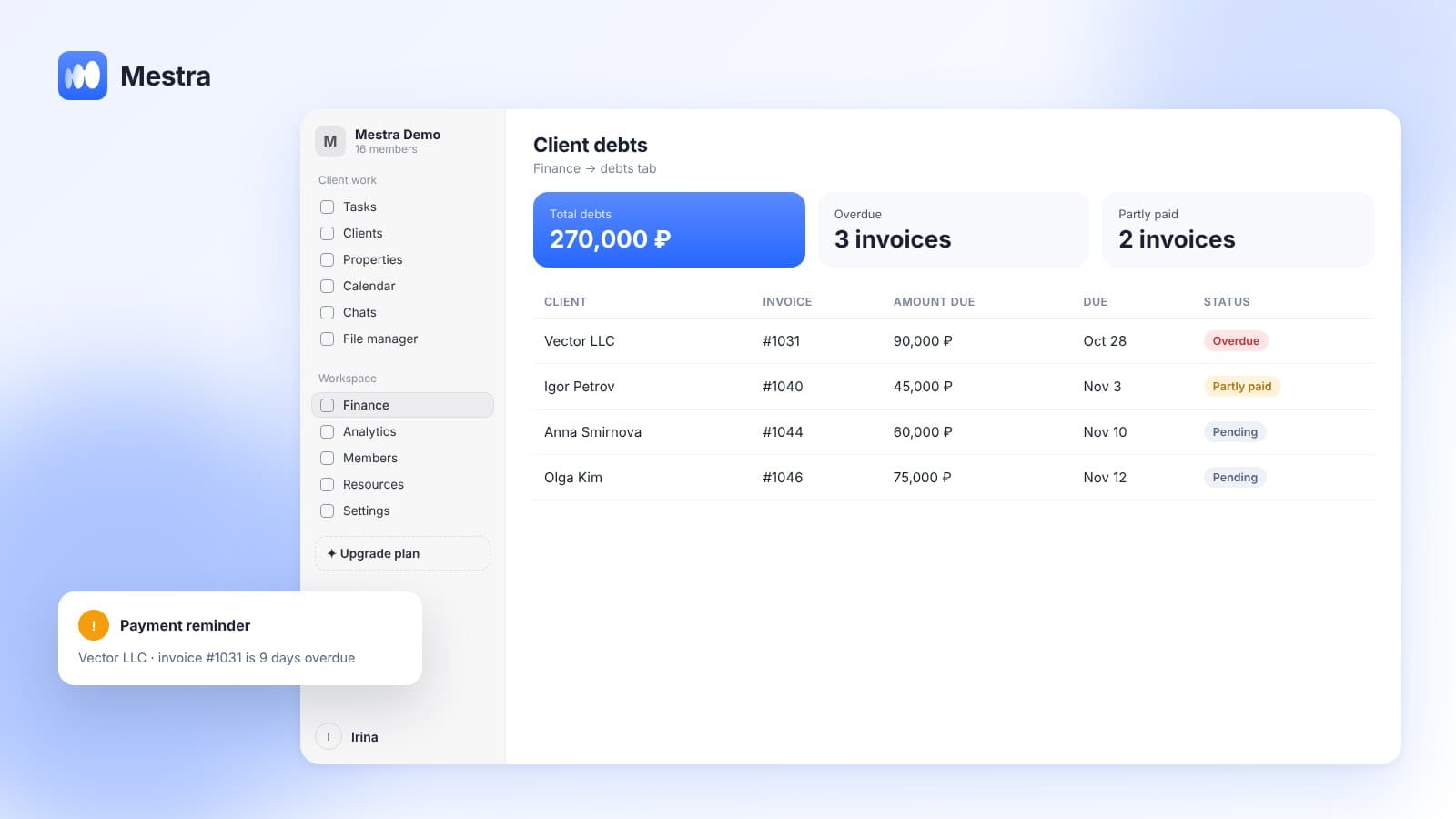
- Client invoices with due dates. An invoice is issued right from a chat or the client record; each invoice has an amount, a date and a payment status.
- Client payment history. The record shows how the client paid before: on time or late.
- Company accounts and money movement. Receipts and expenses are tracked by company account, and balances are visible in one section.
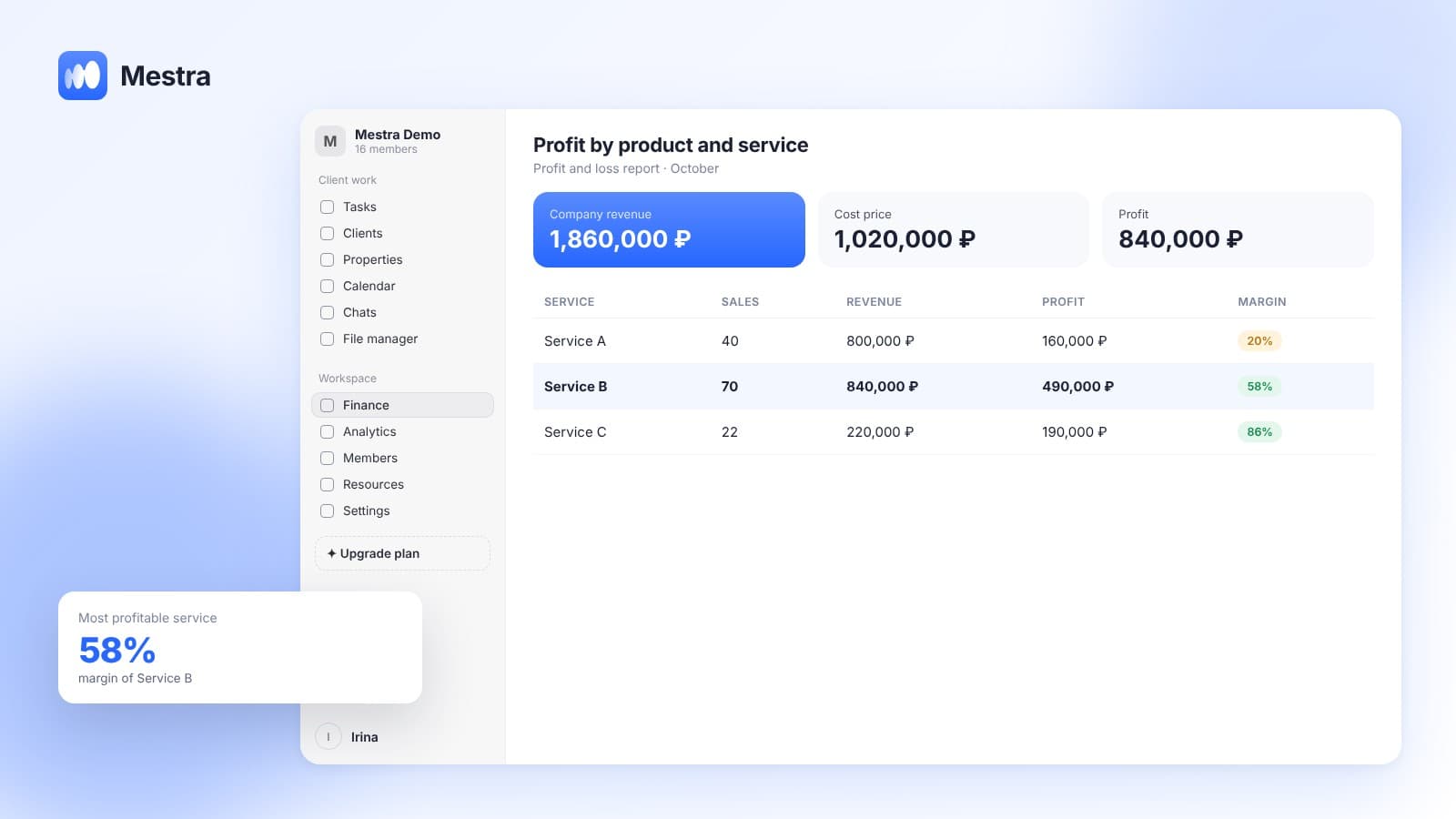
- Profit and loss statement. It builds itself from invoices and expenses, with no manual consolidation.
- Payment follow-up tasks. The due date can be set as a task for the responsible rep so they contact the client before it goes overdue.
- Currencies. Invoices and transactions can be kept in different currencies.
By exporting invoices with due dates and statuses, a finance person builds the payment calendar from current data, not promises.
Frequently asked questions
What is a payment calendar in simple terms?
It is a plan that lays out by day when and how much money will arrive, how much needs to be paid, and how much will be left in the account each day.
How is a payment calendar different from a cash flow budget?
A cash flow budget shows receipts and payments by month, while a payment calendar shows them by day or week. The calendar is for operational management, the budget for planning.
For what period should you build a payment calendar?
Usually 1–3 months: the next two weeks by day, then by week.
How often should you update a payment calendar?
At least weekly. In periods of tight liquidity — every day.
Can you keep a payment calendar in a spreadsheet?
Yes, at the start that's fine. What matters is that receipt data comes from real issued invoices and is updated regularly.
Summary
A payment calendar shows whether there will be enough money on each specific day and gives you time to prevent a cash gap. Its foundation is honest data on receipts from issued invoices, accounting for clients' real payment habits, and regular updates.
In Mestra, invoices with due dates and payment statuses, clients' payment history, money movement across company accounts and the profit and loss statement are gathered in one place. Try Mestra free for 15 days at mestra.chat.