Head of sales duties: what a sales manager does every day, week and month
Sales12 min read
Head of sales duties in plain language: 9 areas of responsibility, a daily rhythm, KPIs, common mistakes and how to free your sales head from routine work.

The head of sales is responsible for the whole team hitting its sales plan: they set goals, distribute work, train sales reps, watch the pipeline and remove the obstacles that get in the way of selling. Their product is not their own deals but a predictable team result.
Head of sales duties in a minute
| Area | What the head of sales does | How to tell it works |
|---|---|---|
| Plan | Breaks the company plan down by rep and by week | Everyone understands the plan, and any gap shows up before the month ends |
| Pipeline | Finds the stages where clients drop off | Conversion by stage is stable or growing |
| People | Runs team meetings and one-on-ones | Reps know their numbers and their next step |
| Hiring | Defines the profile, interviews, onboards | A new hire reaches plan in 2–3 months |
| Training | Reviews real conversations and calls | Repeated mistakes become less frequent |
| Processes | Describes deal stages and client handover rules | No client is lost when the rep changes |
| Quality | Checks conversations and response speed | No "forgotten" clients and no complaints about waiting |
| Reporting | Prepares the numbers for the owner | A report takes minutes to build, not an evening |
| Cross-department work | Works with marketing, finance, production | Leads are good quality, delivery times are known |
How a head of sales differs from a strong sales rep
The most common mistake when appointing a manager is promoting the best seller. The logic is clear: they know the product and the clients better than anyone. But the job changes completely.
A strong sales rep is responsible for their own deals. Their success is measured by their own revenue. A head of sales is responsible for other people's deals. Their success is measured by how much everyone else sells. The skills are different: instead of the ability to close a client, the ability to teach five people to do it; instead of personal pace, the ability to build a rhythm for the whole team.
So the first question for a candidate is not "how much did you sell" but "how did you help others sell". If there is no answer, it is better to keep the person as a strong rep with a high rate than to lose both a seller and a manager.
9 duties of a head of sales
1. Planning and breaking the plan down
The head of sales gets a figure from the owner — say, 6,000,000 ₽ of revenue a month — and turns it into clear tasks. How many deals are needed at an average order of 120,000 ₽? Fifty. How many meetings are needed for that at a 25% meeting-to-deal conversion? Two hundred. How many leads at a 40% lead-to-meeting conversion? Five hundred.
Then these numbers are split between reps and between weeks. A plan a rep sees only once a month does not work: by the end of the month it is too late to change anything. For more on the calculations, see our article on the sales plan.
2. Managing the pipeline
The head of sales must know exactly where clients are lost. Not "sales dropped", but "leads from one channel stopped reaching a meeting" or "half of the clients disappear after the proposal is sent". That takes conversion for every stage and the time a deal spends in each stage.
A good practice is to look once a week at deals that have stayed in one stage longer than usual and decide on each: push to close, hand over to another rep, or close as lost with a reason.
3. Working with people
This is the main duty, and the one most often postponed. A team meeting once a day, a one-on-one every week or two, a results review at the end of the month. In a one-on-one you discuss not only the numbers but also what gets in the way of work: overload, conflict, an unclear task.
A head of sales who communicates with the team only through reports usually learns about a problem when the employee has already handed in their notice.
4. Hiring and onboarding
The head of sales builds the candidate profile, conducts interviews and is responsible for how the new hire gets started. Good onboarding is a plan for the first weeks: what to study, which clients to start with, who the mentor is, what numbers are expected in the first month.
This also covers departures. When a rep leaves, the head of sales makes sure their clients, conversations and agreements stay with the company.
5. Training
Courses from the internet work worse than a review of the team's own conversations. The head of sales picks a few real conversations and calls each week and goes through them with the reps: where the client lost interest, which question went unanswered, where the next step was missing.
6. Processes and standards
The head of sales describes how selling works: which stages a deal goes through, what must happen at each, who is responsible for moving it on. This includes the rules for distributing leads, handing a client from one rep to another, and handling returns and repeat sales.
A good process is short. If the policy is 40 pages long, nobody reads it. It is better to have five stages with a clear result for each and a checklist inside the task.
7. Quality control
Quality in sales is response speed, completeness of information and kept promises. The head of sales checks conversations selectively, looks at how many clients have been waiting for a reply for more than an hour, and goes through every complaint.
It is important not to turn checking into surveillance. The goal is to find repeated mistakes and fix them through training, not to punish a specific person.
8. Reporting
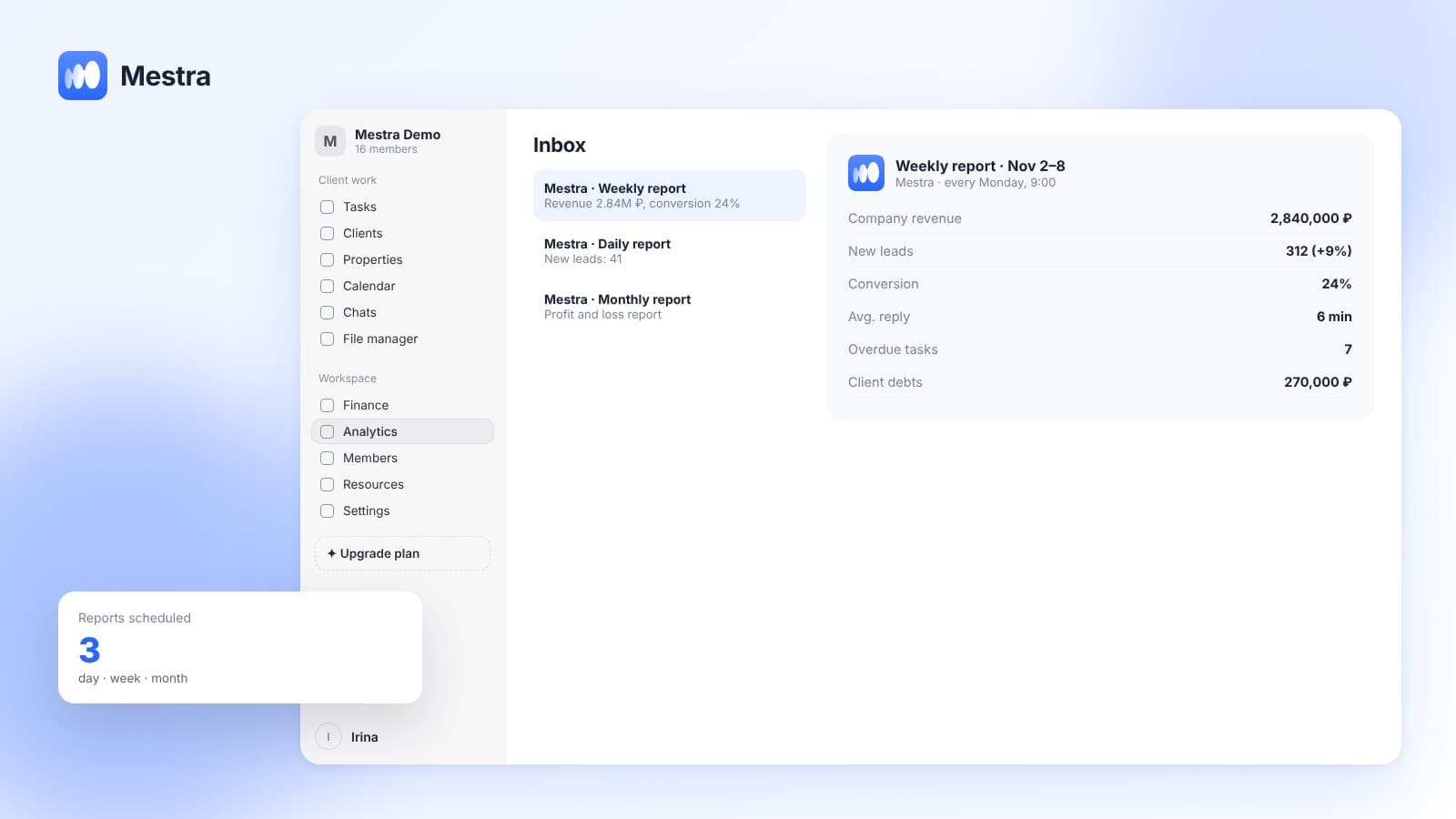
The owner needs a few numbers: revenue and the forecast to the end of the month, conversion, average order, client sources, problem areas. The head of sales makes sure these numbers are honest and on time. We covered which reports are really needed in the article on CRM analytics.
9. Working with other departments
Sales depend on marketing (lead quality), finance (payment terms, discounts) and production or the warehouse (lead times and availability). The head of sales agrees on the rules: which leads count as good, who approves a discount above 10%, how a rep finds out delivery times.
The head of sales' working rhythm
| Period | What to do | Time |
|---|---|---|
| Every morning | 15-minute team meeting: yesterday's numbers, today's plan, who needs help | 15–20 min |
| Every day | Check overdue tasks and clients waiting for a reply | 20–30 min |
| Every week | Review stalled deals, one-on-ones, conversation reviews | 3–4 hours |
| Every month | Plan results, plan for the next month, report to the owner | 4–6 hours |
| Every quarter | Review processes, incentives, the hiring profile | 1–2 days |
KPIs of a head of sales
A head of sales is judged by the team's result, not by their own deals.
| KPI | What it shows | Benchmark |
|---|---|---|
| Plan completion by the team | The head of sales' main result | 90–110% consistently, without a last-week scramble |
| Conversion by stage | Where clients are lost | Stable or growing month over month |
| Speed of first reply | How fast the client gets a response | Minutes during working hours, not hours |
| Share of overdue tasks | How orderly the team's work is | The lower the better; growth signals overload |
| New hire reaching plan | Quality of hiring and onboarding | 2–3 months for a typical B2C/B2B cycle |
| Team turnover | Stability of the team | Departures do not repeat after every hire |
The benchmarks are approximate: every industry has its own deal cycle. The trend matters more than the absolute figure. For more on rep metrics, see the article on sales rep KPIs.
Common mistakes of sales heads
- Sells instead of the team. Closing the deal yourself is faster than teaching. But a month later the team depends on one person.
- Manages only by month-end results. When the plan is already missed, nothing can be changed. You need weekly and daily numbers.
- Distributes leads by gut feeling. The best people get more work and burn out, the weaker ones get less and don't grow.
- Doesn't record the reasons for lost deals. Without them it's unclear what to fix: the price, the product or the reps' work.
- Drowns in collecting numbers. An evening spent on spreadsheets instead of working with people is a sign that reporting is not automated.
How to free a head of sales from routine
Look at the working rhythm above: a significant part of the time goes not on managing but on collecting information. Who received how many leads, which tasks are overdue, where deals have stalled, how much money will come in by the end of the month. This is work a system should do.
The head of sales' job is to make decisions based on this data, not to collect it by hand.

How it works in Mestra
Mestra takes over the part of a manager's job that involves collecting data and distributing routine work:
- Distribution of leads and tasks. AI looks at each employee's current workload — open and overdue tasks, meetings, schedule — and gives the new task to someone who has time. Specialization can be taken into account. Manual assignment is still available.
- Tasks from conversations. If a client asks in a chat to be called back on Thursday, a task with a deadline appears on its own. The head of sales sees all the team's promises, not only the recorded ones.
- Analytics for the manager. Conversion for each employee, workload distribution, the funnel of stages, client sources, turnover and a revenue forecast based on issued invoices. The period ranges from a week to a year.
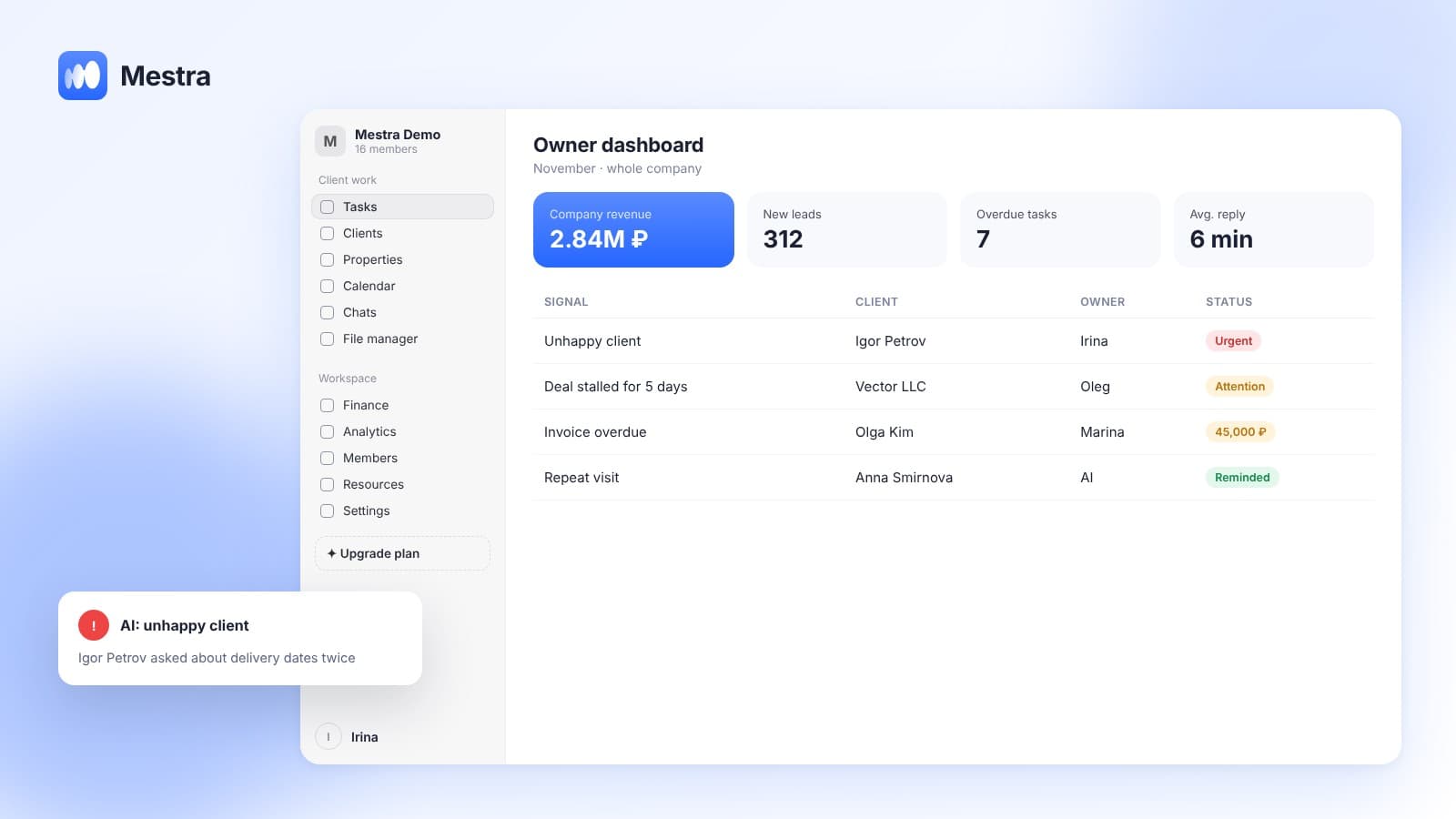
- Reply quality checks. AI flags weak spots in reps' conversations and notices dissatisfied clients. The head of sales goes through a short list instead of hundreds of conversations.
- Roles and access rights. Each rep sees their own clients, the manager sees everyone's. Permissions are set manually and precisely.
- Answers for the owner. The owner can ask the Mestra Telegram bot in text or by voice "how much did we sell this week" and get the numbers without involving the head of sales.
When data collection and work distribution run on their own, the manager has time for what matters most — people and decisions.
Frequently asked questions
How is a head of sales different from a commercial director?
A head of sales manages one team of sellers and is responsible for that team hitting its plan. A commercial director is responsible for the company's entire commercial strategy: sales, marketing, pricing, channels and sometimes purchasing. When a company is only building its sales function, these roles are often combined.
Should the head of sales sell personally?
If the team has up to five people, yes, but in a limited way. The benchmark: no more than 20% of time on their own deals, usually the largest or most complex ones. If the head of sales sells more, there is simply no time left to manage the team.
How many reps can one head of sales manage effectively?
Usually 5–8 people with close work with each. If there are more reps, you need a senior rep or a second team lead. Otherwise one-on-ones and conversation reviews become a formality.
What KPIs should you set for a head of sales?
Plan completion by the team, conversion at key stages, speed of replies to clients, the share of overdue tasks and new hires reaching plan. It is better to have 3–5 metrics tied to the team's result than a dozen scattered ones.
How can you tell the head of sales is not coping?
Warning signs: the plan is hit in a scramble in the last week, strong reps leave, the manager cannot name the conversion and the problem pipeline stage within a minute, and the report for the owner is put together by hand in the evenings.
Summary
The duties of a head of sales come down to one thing: making the team's result predictable. To do that, the head of sales plans, watches the pipeline, trains people, builds processes and reports honestly to the owner. The less time goes on collecting numbers by hand and handing out tasks, the more is left for people.
Mestra takes over the routine: it distributes tasks by workload, creates tasks from conversations, and shows conversion and workload for each employee. Try Mestra free for 15 days at mestra.chat.