Responsibility matrix: how to assign who is in charge of what and stop losing tasks
Management10 min read
The RACI responsibility matrix in plain words: the R, A, C, I roles, building one step by step, a sales team example, common mistakes and moving it into tasks.

A responsibility matrix is a table showing who in the company is in charge of each task or process: who does the work, who makes the decision and answers for the result, who needs to be consulted and who needs to be kept in the loop. It exists so tasks don't fall between people and departments.
RACI in a minute
| Letter | Role | What they do | How many there can be |
|---|---|---|---|
| R — Responsible | Doer | Does the work | One or several |
| A — Accountable | Owner | Answers for the result, makes the final decision | Strictly one |
| C — Consulted | Adviser | Is consulted before the decision | As many as needed |
| I — Informed | Informed party | Is told after the decision | As many as needed |
Why you need a responsibility matrix
Almost every company knows the problem the matrix solves:
- the sales rep thought the accountant would issue the invoice, the accountant was waiting for a request from the rep, and the client has been waiting a week for the invoice;
- three people approve a discount, and the decision takes three days;
- the warehouse wasn't told about a new client, and the order isn't picked;
- after a mistake the search for someone to blame begins, because nobody understands who was supposed to do it.
The matrix makes responsibility explicit. Everyone knows what they do, what they answer for and whom to ask.
How to build a responsibility matrix: 6 steps
- Pick a process. For example, "closing a deal" or "order processing". Don't try to describe the whole company at once.
- List the tasks. 8–15 key steps of the process — as rows.
- List the roles. Not people, but job titles or roles — as columns: sales rep, head of sales, accountant, warehouse.
- Assign the letters. For each task, determine R, A, C and I.
- Check the rules. Each task has exactly one A and at least one R; no single role has too many As.
- Discuss with the team. A matrix nobody has seen is a matrix nobody follows.
Example: a responsibility matrix for a sales team
| Task | Sales rep | Head of sales | Accountant | Warehouse | Owner |
|---|---|---|---|---|---|
| Replying to an inbound lead | R/A | I | — | — | — |
| Preparing a proposal | R | A | — | C | — |
| Discount up to 10% | R/A | I | — | — | — |
| Discount over 10% | R | A | — | — | C |
| Issuing an invoice | R/A | — | C | — | — |
| Payment monitoring | R | A | C | — | — |
| Shipment | I | — | — | R/A | — |
| Refund to a client | C | R | R | — | A |
| Monthly sales report | C | R/A | C | — | I |
If one role combines R and A, that's fine: the doer answers for the result themselves. What matters is that every row has one A.
Rules for checking the matrix
| Sign | What it means | What to do |
|---|---|---|
| No A in a row | Nobody answers for the result | Assign one owner |
| Several As in a row | Responsibility is blurred | Keep one A |
| No R in a row | Nobody does the work | Assign a doer |
| Many Cs in a row | Decisions are made slowly | Shorten the list of advisers |
| One role has A almost everywhere | Overload and a bottleneck | Delegate part of the responsibility |
| A role has no letters at all | The role is redundant in the process or forgotten | Check whether it's needed |
Other models for assigning responsibility
| Model | How it differs | When to use |
|---|---|---|
| RACI | The basic one: doer, owner, adviser, informed party | Most processes |
| RASCI | Adds the role S — Support, who helps the doer | Complex projects with supporting teams |
| RAPID | Focuses on decision-making: who recommends, agrees, decides | Strategic decisions |
| DACI | Driver, Approver, Contributor, Informed — for projects and launches | Projects with a "driver" as owner |
For everyday work RACI is almost always enough.
Example: a matrix for order processing
A matrix is useful not only in sales. Here is an example for a company that sells goods with delivery:
| Task | Sales rep | Warehouse | Logistics | Accountant | Manager |
|---|---|---|---|---|---|
| Taking the order | R/A | — | — | — | — |
| Checking availability | C | R/A | — | — | — |
| Invoice and prepayment | R/A | — | — | C | — |
| Picking the order | I | R/A | — | — | — |
| Arranging delivery | I | C | R/A | — | — |
| Notifying the client | R/A | — | C | — | — |
| Quality complaint | R | C | C | — | A |
| Closing documents | C | — | — | R/A | — |
Here you can immediately see who is responsible for each point where an order can get "stuck".
How to roll out the matrix in your team
A matrix doesn't work if a manager wrote it alone and emailed it around. The rollout sequence:
- Gather the people in the process. A 45–60 minute meeting — one representative of each role.
- Walk through a real case. Take the last order or deal where something went wrong and go through who should have done what.
- Fill in the table together. Arguments about who is A are the most useful part of the meeting.
- Move it into tasks. For each step of the process, specify an assignee and a deadline in the work system.
- Check after a month. Review two or three cases and see whether the assignment is being followed.
The matrix and access rights
Assigning responsibility is closely tied to rights in the system. If a rep is responsible for a discount up to 10% and a manager decides above that, the system should support this rather than rely on memory.
| Responsibility | Right in the system |
|---|---|
| A rep is responsible for their clients | Sees their clients and chats |
| A manager is responsible for the department | Sees all the department's clients |
| An accountant is responsible for documents | Access to invoices and finances |
| The warehouse is responsible for availability | Access to products and warehouses |
When rights match the roles in the matrix, responsibility doesn't have to be reiterated — it is built into the work.
Signs you need a matrix right now
- the same tasks regularly "fall between the cracks";
- decisions on discounts and exceptions take several days;
- after a mistake people spend a long time working out who is to blame;
- a new employee asks "who is responsible for this?" more than once a day;
- the manager takes part in almost every decision and becomes a bottleneck.
Common mistakes
- A matrix for the whole company at once. You get a huge table nobody uses. Start with one process.
- Names instead of roles. An employee leaves and the matrix goes stale. Use job titles or roles.
- Several As. "They're responsible together" means "nobody is responsible".
- The matrix lives apart from the work. Everything is right in the table, but no owner is specified in the tasks.
- Nobody reviews it. The team and processes change, the matrix doesn't.
From table to tasks
A responsibility matrix is useful when designing a process. But in daily work people don't open a table before every action. So the assignment of responsibility needs to move to where the work happens:
- A — the owner of the task or stage;
- R — the doers of the stage (a person or a group);
- C — those mentioned in comments and consulted for approval;
- I — those notified of a status change.
When every stage of a process has an owner and a deadline, the matrix works by itself. More on processes in the article on company procedures, and on setting tasks in the article on assigning tasks to employees.

How it works in Mestra
In Mestra, the assignment of responsibility is built into tasks and processes:
- Assignee and assignee group. A task and each stage of a process has a specific assignee or group.
- Process templates. Stages with assignees and deadlines are set once; for each new task the process is launched from a template — the responsibility matrix is already "built in".
- Mentions in comments. Need to consult someone? Just mention a colleague in the task; they get a notification.
- Activity history. You can see who changed a status, completed a step or left a comment, and when — without hunting for someone to blame.
- Roles and permissions. Access rights are set manually and precisely: who sees clients, who can issue invoices, who can give discounts.
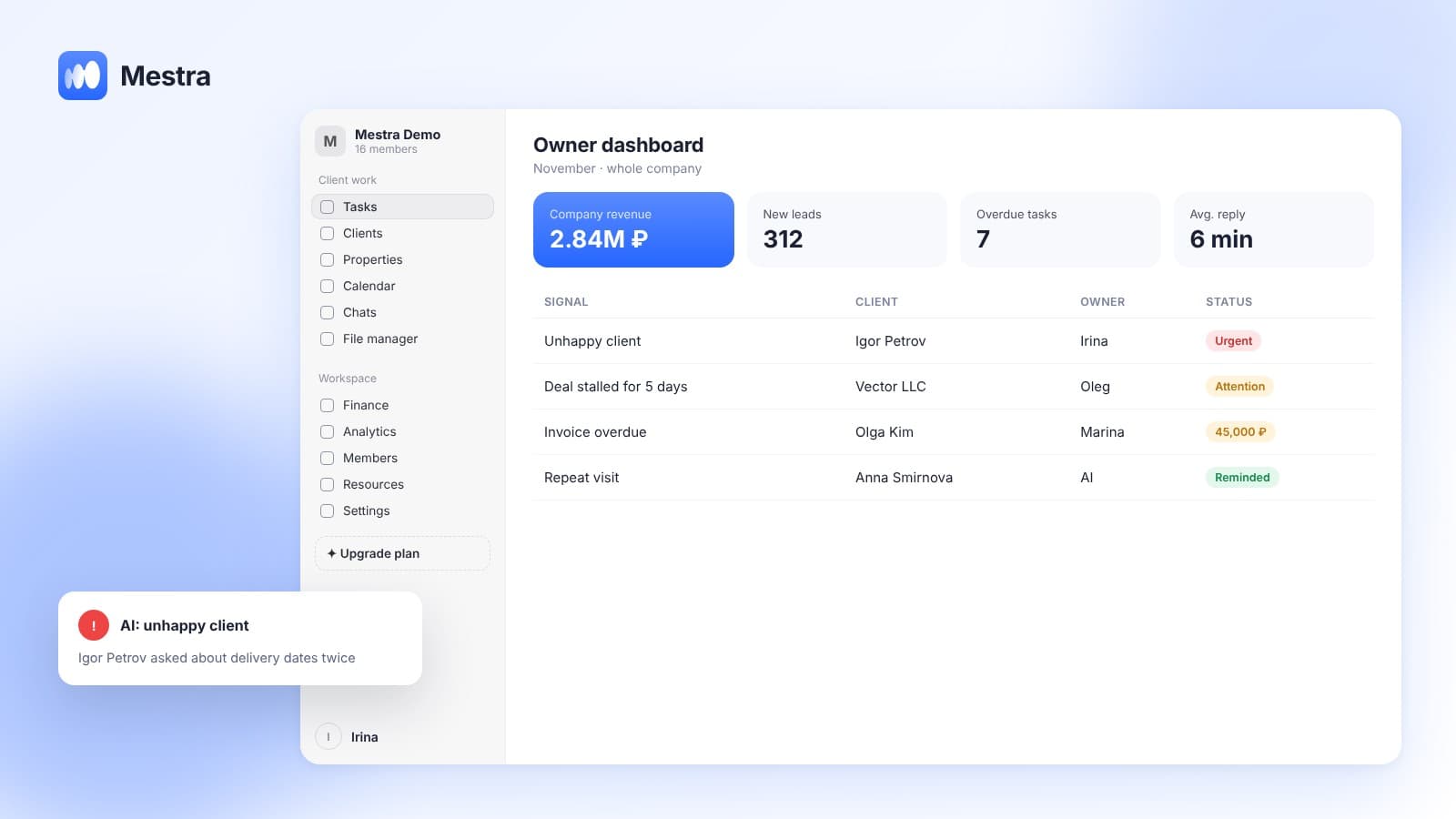
- Automatic assignment. AI distributes new tasks among assignees based on their workload and specialization.
Related reading: director job description.
Frequently asked questions
What is a RACI matrix in plain words?
A table that shows, for each task, who does it (R), who answers for the result (A), who is consulted (C) and who is informed (I).
Can a task have several owners?
There can be several doers (R), but only one person accountable for the result (A). Otherwise responsibility gets blurred.
How is Responsible different from Accountable?
Responsible does the work; Accountable answers for the work being done correctly and on time, and makes the final decision. Often it is the same person, but not always.
How often should I update the responsibility matrix?
When a process, the team structure or roles change. It's convenient to review it once a quarter along with the procedures.
At what team size do you need a responsibility matrix?
Especially when the company has more than 7–10 people and tasks start passing through several people. Even a simple table for one process removes a lot of confusion.
Summary
The RACI responsibility matrix shows who performs, who is accountable, who is consulted and who is informed for each task. The main rule is one owner per task. And to make the matrix work every day, move responsibility from the table into the tasks and process stages themselves.
In Mestra, every task and stage has an assignee and a deadline, processes launch from templates and the history shows who did what. Try Mestra free for 15 days at mestra.chat.