Delegating Tasks to Employees: Why Owners Are Afraid to Let Go and How to Do It Without Losses
Management4 min read
Delegating tasks to employees in practice: what to delegate and what not to, the delegation process step by step, and how to see results without asking every day.

Delegating a task means handing an employee responsibility for the result, together with a deadline and authority. The owner hands over the outcome rather than the action, and stops being the bottleneck every decision has to pass through.
Almost every owner knows they should delegate more. And almost every one finds a reason not to: "it's quicker to do it myself", "explaining takes longer", "I'll have to redo it anyway". Behind these reasons there's usually one fear — not knowing what's happening with the task once it's been handed over.
What to delegate and what not to
| Delegate | Keep for yourself |
|---|---|
| Repetitive tasks with a clear result | Strategic decisions and the company's direction |
| Client work that follows a standard process | Hiring and firing key people |
| Preparing reports and documents | Resolving conflicts between managers |
| Tasks where the employee is stronger than you | Decisions on major investments |
A good rule of thumb: if an employee will do a task at least 80% as well as you, it should be delegated.
The delegation process in one minute
- Define the result. Not "handle the client" but "by Friday, the client has signed the contract or declined with a reason".
- Set a deadline and an owner. One person, one date.
- Hand over authority. What the employee can decide alone and what needs approval.
- Agree checkpoints. Stages after which you can see progress.
- Don't take the task back at the first difficulty — help, but leave the responsibility where it is.
Why delegation breaks down
Most often, at the fourth step. The owner handed over a task and can't see what's happening with it. They start asking: "How's it going?", "What's happening with the client?", "Are we on time?". The employee feels distrusted, the owner wastes time, and eventually decides it's easier to do it themselves.
The problem isn't people but visibility. If the state of the task is visible in the system, the questions aren't needed.
How to see results without asking
- Each delegated task is broken into stages with names and deadlines.
- A specific person is responsible for each stage.
- The board shows which stage each task is at.
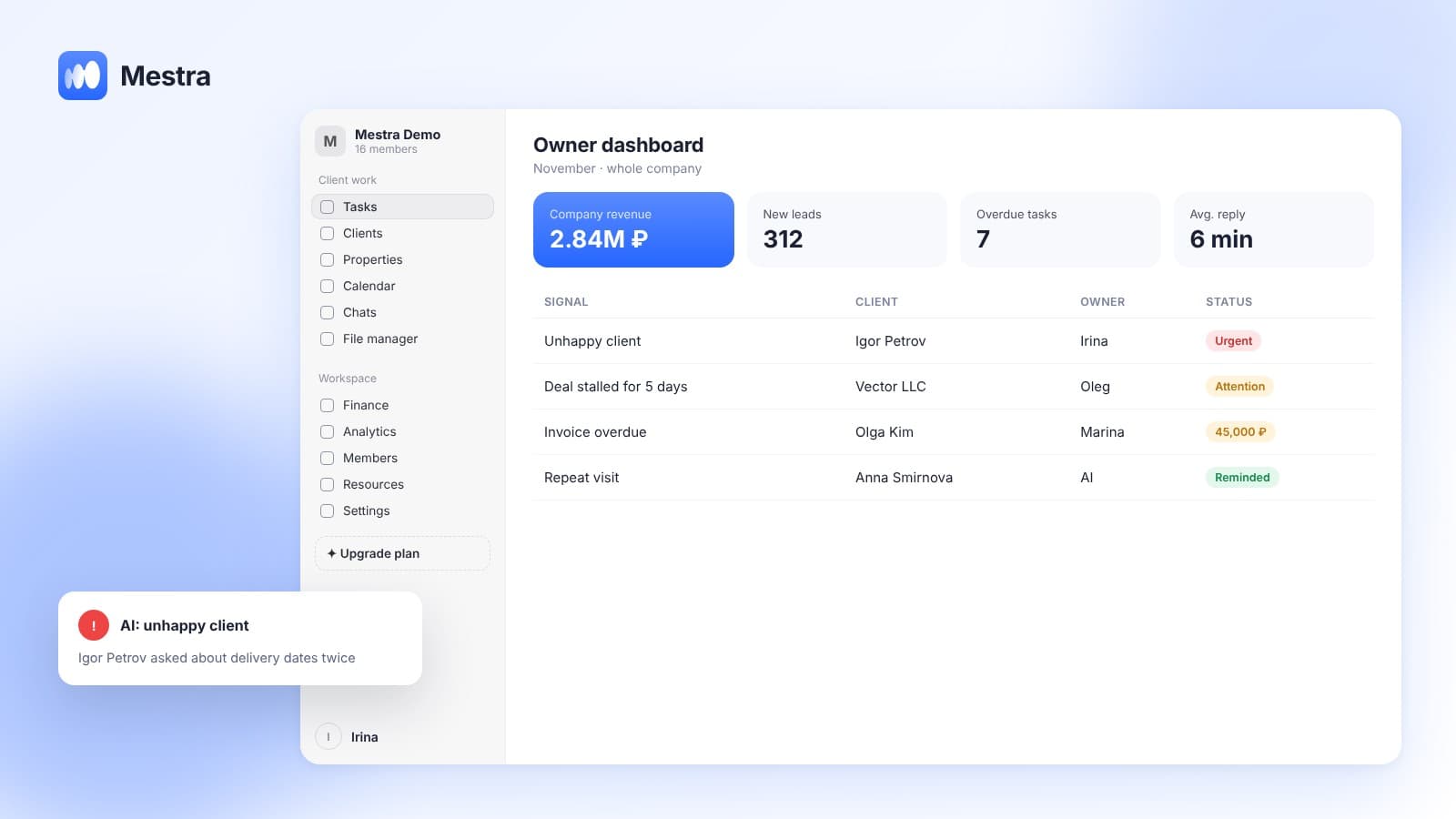
- If a task is overdue or isn't moving, the owner gets a signal.
- If a stage was done badly, it can be sent back with a comment.
An example in numbers
One-minute calculation:
- The owner of a 15-person company answers an average of 40 questions from employees a day.
- Each question takes about 3 minutes including the switch of attention: 120 minutes.
- Half of the questions are "how's the task going?" and "what do I do next?": 60 minutes a day.
- Over a month of 22 working days, that's 22 hours on status updates alone.
- When statuses are visible on the board and signals arrive by themselves, those hours go back to the owner.
How it works in Mestra
In Mestra, a task can be a full process: client, service, stages, an overall deadline, stage deadlines and an owner for each stage. Processes are visible on a kanban board, stages can be moved back, and the owner gets a signal when something is overdue or stalled. Permissions are set by role: everyone sees their part of the work. The owner can set a task and check its status by writing to the AI in the Telegram bot.
How the management system works as a whole — in our article business management system. About the board and stages — in kanban and tasks in a CRM.

FAQ
What is task delegation?
Handing an employee responsibility for a result together with a deadline and the authority to make decisions.
Which tasks shouldn't be delegated?
Strategic decisions, hiring key people, major investments and conflicts between managers.
How do you track delegated tasks?
Through stages with deadlines and owners and overdue signals — without daily questions.
Why are owners afraid to delegate?
Most often because they fear not seeing what's happening with the task. Visibility in the system removes that fear.
Bottom line
Delegation starts not with trust but with visibility: when the owner can see the state of tasks, they don't need to keep them to themselves. Mestra shows every process on one board — try it free for 15 days, no card required.