Unit Economics in Simple Terms: What a Client Costs and What They Bring In — With an Example
Finance3 min read
Unit economics in simple terms: client acquisition cost, lifetime value, margin per sale, and when it makes sense to scale up advertising.

Advertising brings in clients. But whether it pays to attract them depends on how much each of them will bring over time.
Unit economics answers this question before you double your budget.
One-minute calculation
- Calculate the profit from one purchase after all costs.
- Multiply by the client's average number of purchases per year.
- Calculate client acquisition cost.
- If value is 3 or more times the cost, advertising can be increased.
The two key numbers
- Client acquisition cost (CAC) — how much advertising goes into one new buyer. See client acquisition cost.
- Client lifetime value (LTV) — how much profit a client brings over the relationship.
LTV = profit per purchase × number of purchases over the relationship
Example: a service salon
| Metric | Value |
|---|---|
| Average bill | 3,000 ₽ |
| Profit per visit after all costs | 1,200 ₽ |
| Visits per year | 6 |
| Client value per year | 7,200 ₽ |
| Acquisition cost | 1,800 ₽ |
| LTV / CAC ratio | 4 |
A ratio of 4 means advertising can be increased. If the client came only once, their value would be 1,200 ₽ — less than the acquisition cost.
A unit economics table: how to calculate
A five-row table is enough to calculate unit economics: average bill, profit per purchase after all costs, number of purchases over the period, client value and acquisition cost. Product unit economics are calculated the same way, using one unit of the product instead of a client.
How to improve unit economics
- Repeat sales. Reminders and programmes for regular clients — see how to win back a client.
- Profit per purchase. Lower cost — see full cost.
- Acquisition cost. Replying to leads quickly raises conversion without a bigger budget.

The concepts of CAC and LTV come from venture analysis, but they work for any business with repeat sales — from salons and clinics to schools and service companies.
How it works in Mestra
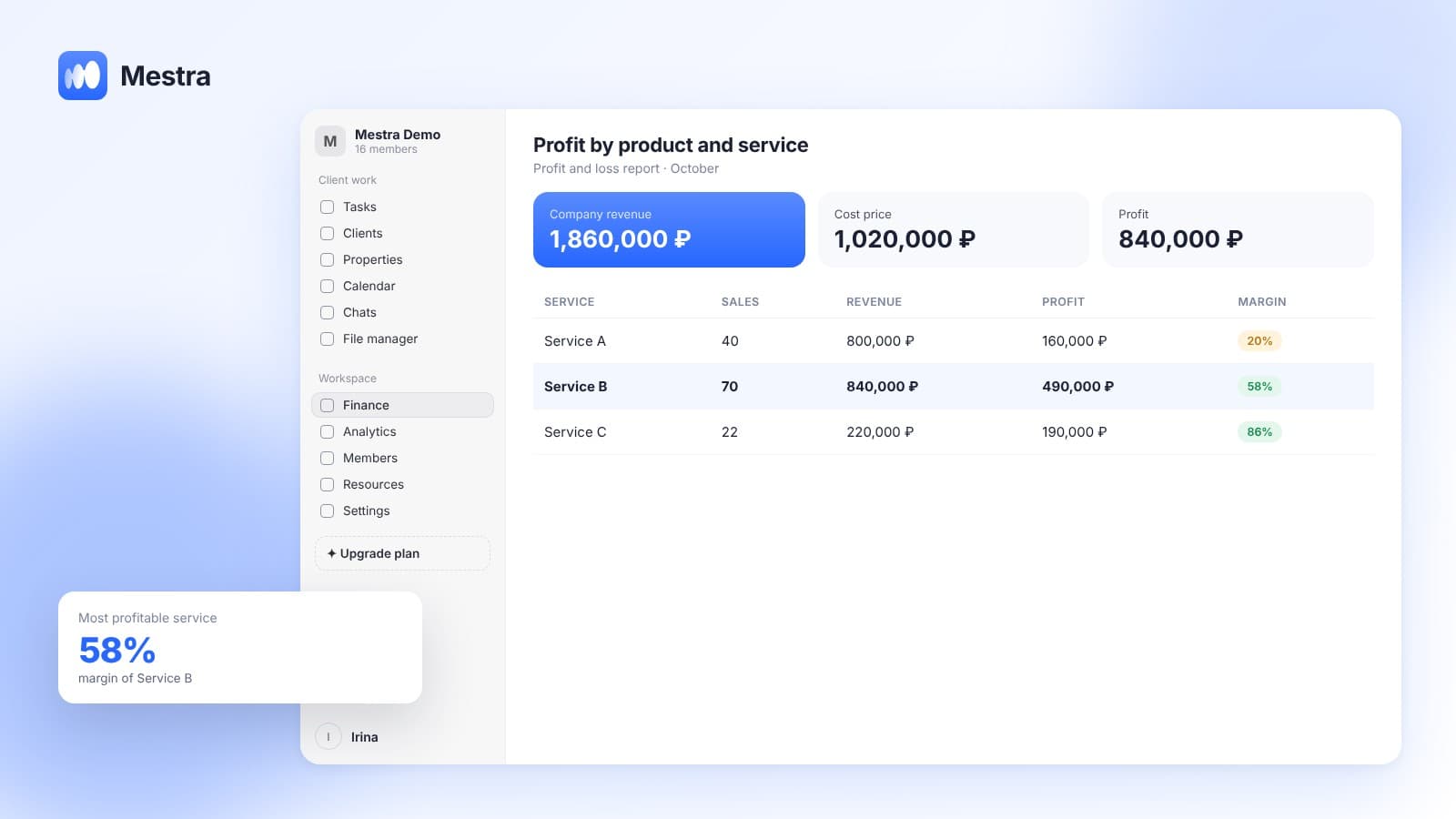
- Profit on every product and service after cost and sale expenses.
- Client history in the card: all purchases, invoices and conversations, plus the source they came from.
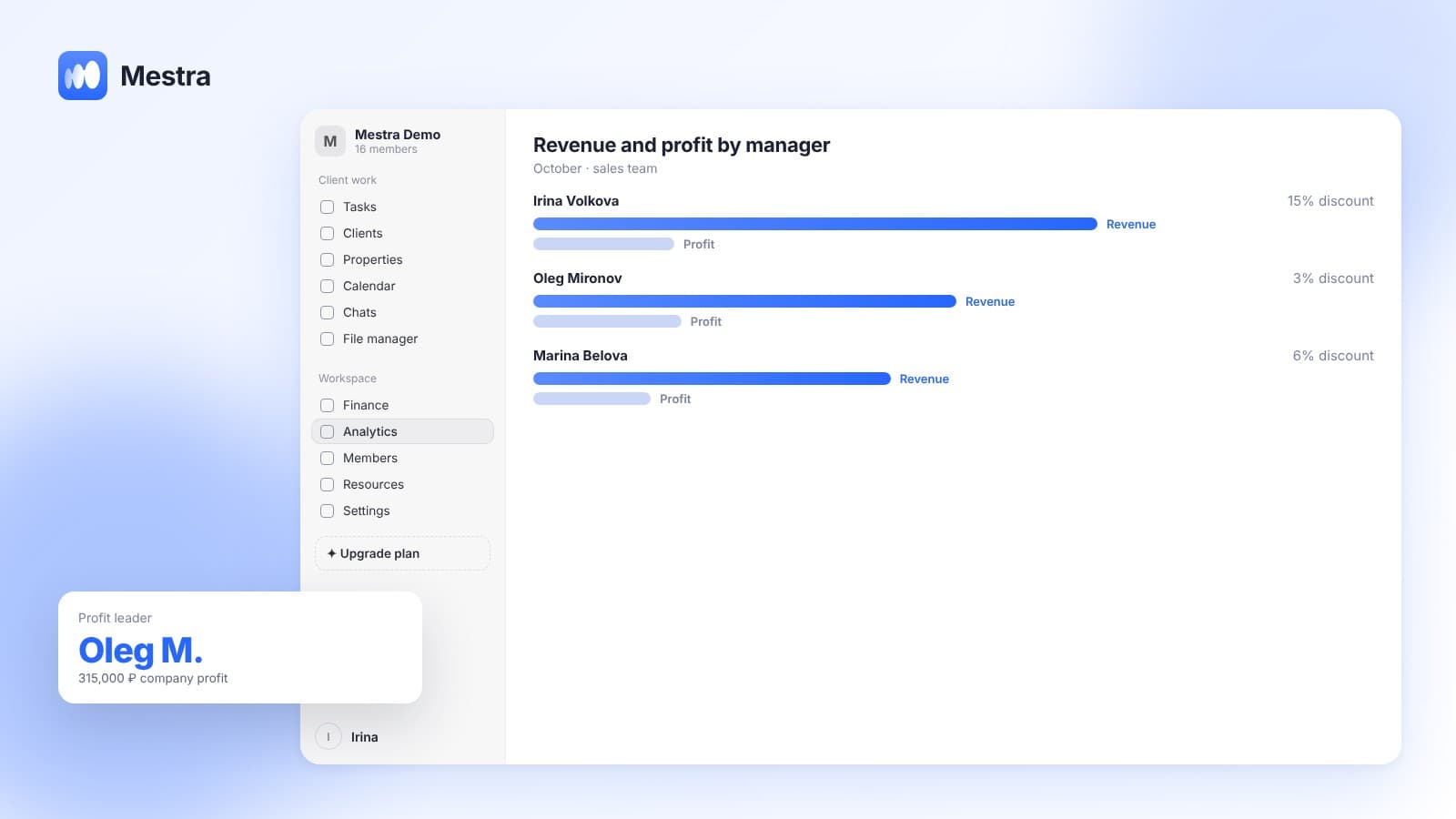
- Analytics by employee, channel and client source: enquiries, conversion, revenue, response speed.
- Mailings to your base — repeat sales to regular clients.
FAQ
What LTV-to-CAC ratio is considered good?
3 and above is a healthy model. 1–3 is workable, but scaling advertising is risky. Below 1, every new client makes a loss.
Does unit economics work for one-off sales?
Yes. Then the client's value equals the profit from one purchase, and it's compared with the acquisition cost.
What should you improve first?
Repeat sales: they're cheaper than new ones and immediately increase client value.
Bottom line
Unit economics shows whether to scale advertising or first fix your margins and repeat sales.
Calculate it for each channel. In Mestra, cost, client history and channel analytics are gathered in one system.