A deal management standard: how to get all your managers selling by the same rules
Sales7 min read
Deal management standard: stages and transition criteria, mandatory actions, time limits per stage, examples for three industries and how to lock it into a CRM.

A deal management standard is a document and a system configuration that describe the stages a deal passes through, what a manager does at each stage and what criterion moves the deal forward. Without one, every manager sells their own way, and the funnel shows not reality but the team's mood.
The standard in a minute
| Element | Example |
|---|---|
| Stages | Inquiry → Qualification → Proposal → Invoice → Payment → Fulfillment |
| Transition criterion | "Proposal" — the client has been sent a commercial proposal or a selection |
| Mandatory actions | Fill in the card, set a next step |
| Time limit per stage | No more than 3 days without action |
| Closing | "Won" with payment or "Lost" with a reason |
Why you need a standard
- Consistent quality. The client gets the same level of service from any manager.
- Faster onboarding. A newcomer knows what to do at every step.
- An honest funnel. A stage reflects fact, not hope.
- You can see where things get stuck. The head of sales sees deals that sit longer than the norm.
- You can improve. The conversion of each stage is measured.
What a standard consists of
1. Stages
5–8 stages that reflect the client's real path. More and managers get confused; fewer and it's unclear where clients are lost.
2. Transition criteria
| Stage | Criterion for moving to the next |
|---|---|
| Inquiry | The manager has contacted the client |
| Qualification | The task, budget and timing are known |
| Proposal | The client has received a commercial proposal or a selection of options |
| Invoice | The client has agreed, the invoice is issued |
| Payment | The money has arrived |
| Fulfillment | The work is delivered, the client has confirmed |
3. Mandatory actions
- first reply within 15 minutes during working hours;
- client card filled in before the "Proposal" stage;
- after every contact, a next step with a date;
- when the client declines, a reason and a comment.
4. Time limits per stage
Set a normal duration for each stage. A deal that sits longer is a signal for the manager. More in the article on time at a deal stage.
5. Closing the deal
A won deal is closed with payment. A lost one is closed with a reason. A deal cannot be closed without a reason. More in the article on reasons clients decline.
Example standards for different industries
Real estate agency
| Stage | What the agent does | Norm |
|---|---|---|
| New lead | Reply, clarify the request | 15 minutes |
| Qualification | Budget, district, mortgage | 1 day |
| Viewing | Selection of properties, arranging a viewing | 3 days |
| Offer | Negotiation, agreeing the price | 5 days |
| Contract | Deposit, documents | 7 days |
| Mortgage or payment | Support at the bank | 14 days |
| Handover | Keys, acceptance certificate | 3 days |
Renovation company
| Stage | What the manager does | Norm |
|---|---|---|
| Inquiry | Reply, book a measurement visit | 1 hour |
| Measurement | Site visit, photos, wishes | 3 days |
| Estimate | Calculation, agreement | 5 days |
| Contract | Signing, prepayment | 3 days |
| Works | Monitoring the stages | As planned |
| Handover | Acceptance certificate, final payment | 2 days |
Courses and education
| Stage | What the manager does | Norm |
|---|---|---|
| Inquiry | Reply, clarify the goal | 15 minutes |
| Consultation | Choosing a program | 1 day |
| Proposal | Program, price, installments | 1 day |
| Payment | Invoice, payment link | 2 days |
| Start | Access, meeting the mentor | 1 day |
How to roll out the standard
- Describe the current client path together with your best managers.
- Approve the stages and transition criteria.
- Set up the stages in the system.
- Save typical steps and checklists as templates.
- Train the team on real deals.
- After a month, check whether deadlines and criteria are being met.
A standard for communicating with clients
Besides stages, the standard should include communication rules — especially if clients write in messengers:
| Rule | Example |
|---|---|
| Form of address | By name, formal "you" unless the client suggests otherwise |
| First reply | To the point, with a question that moves the conversation forward |
| Price | Only after clarifying the task, with options |
| Every message | Ends with a next step |
| Follow-up contact | If the client is silent for 1–2 days after a proposal |
| Tone | Friendly, without bureaucratic language or pressure |
Communication rules are checked against correspondence. For how to do this without reading hundreds of chats, see the article on monitoring managers.
Common mistakes
- Stages are manager actions, not the client's path. "Called" is not a stage.
- No transition criteria. Deals are moved "just in case".
- A standard on paper. The stages in the system are different.
- No time norms. Stuck deals are not visible.
- The standard is never reviewed. The market and the product change; the standard doesn't.

How it works in Mestra
- Your own stages for your industry. Funnel stages are editable; each of the 23 industries has a ready-made structure.
- Process templates. Stages with assignees, deadlines and checklists are launched from a template.
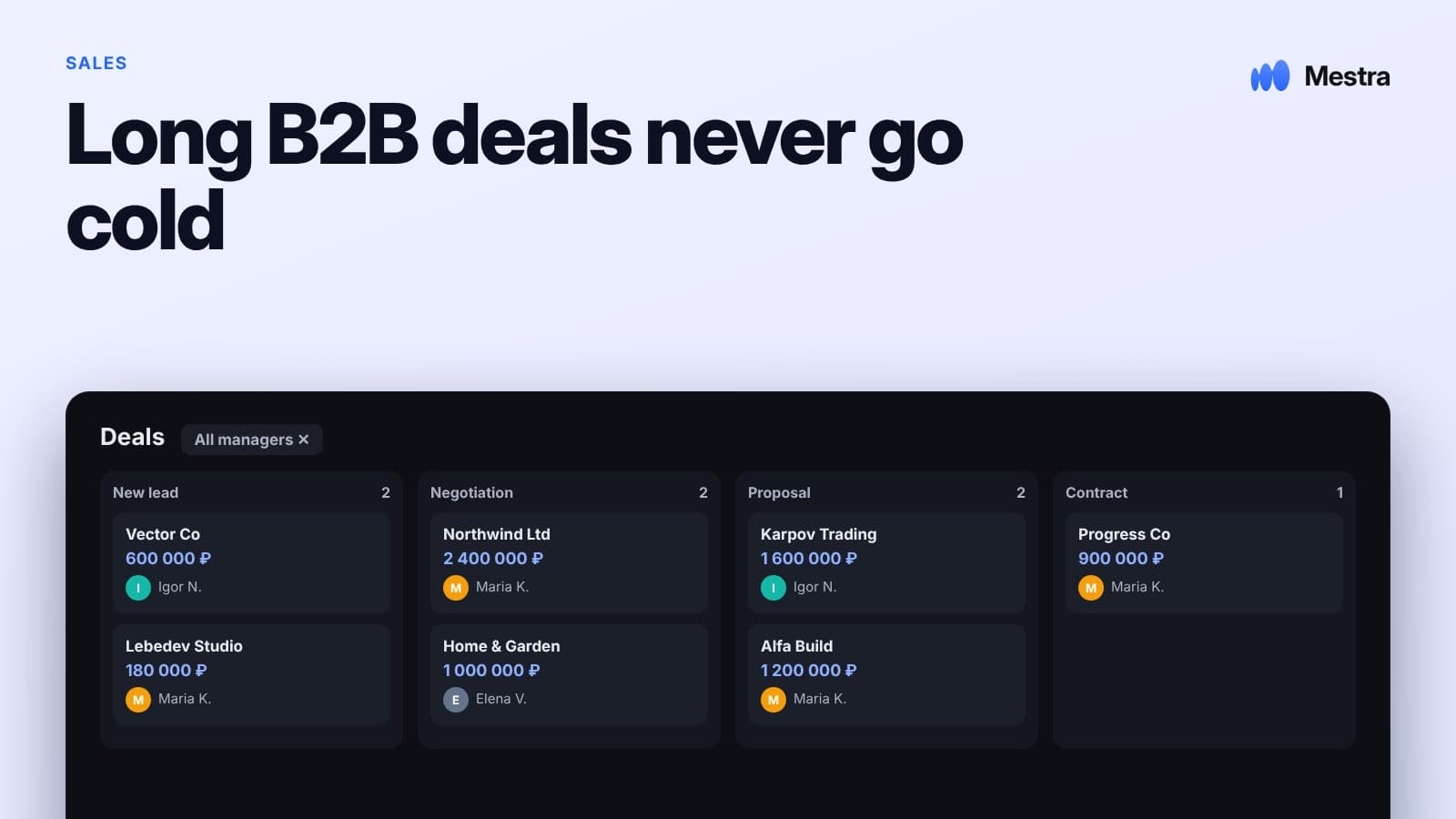
- Kanban, list and timeline. Deals are visible by stage and over time.
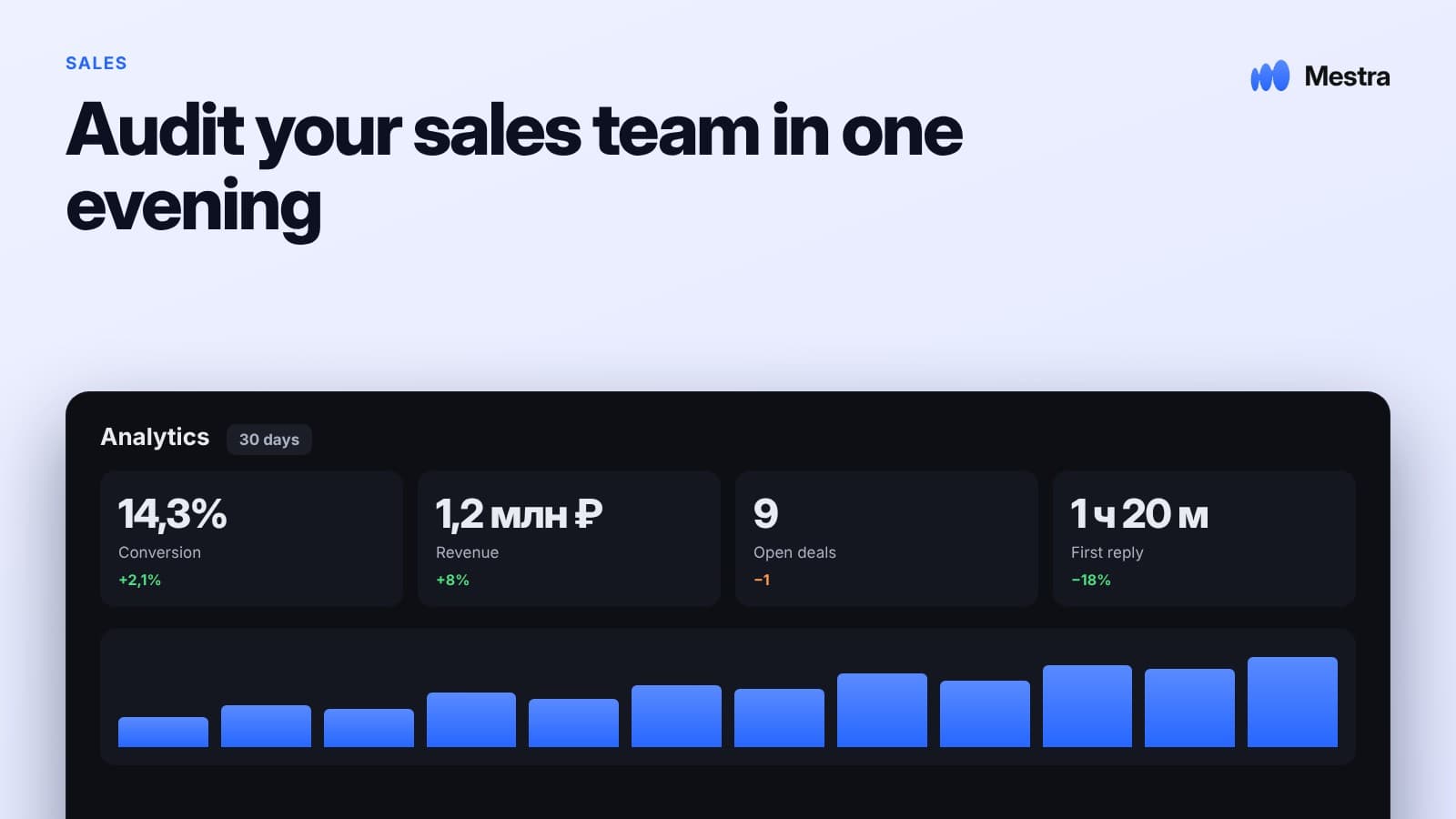
- Stage funnel. Analytics shows how many deals are at each stage; AI reports on stuck ones.
- Next step from the conversation. AI sets a task itself based on what was agreed with the client.
- Loss reason. When closing a lost deal, a reason and a comment are chosen.
- Quality check. AI flags weak spots in managers' replies.
Frequently asked questions
What is a deal management standard?
A description of the deal stages, transition criteria, the manager's mandatory actions and time limits for each stage.
How many stages should a deal have?
Usually 5–8, reflecting the client's real path from inquiry to payment and fulfillment.
What is a stage transition criterion?
An objective event after which the deal can be moved forward: for example, the client received a commercial proposal or the payment arrived.
How do I get managers to follow the standard?
Lock it into the system: stages, templates with checklists, a mandatory loss reason and control of time at each stage.
How often should I review the standard?
Every six months, or when the product, prices or sales channels change.
Summary
A deal management standard makes sales predictable: stages with transition criteria, mandatory actions, time norms and closing with a reason. It works when it is locked into the system, not just written in a document.
In Mestra, stages are set up for your industry, processes are launched from templates, and the stage funnel and loss reasons are visible in analytics. Try Mestra free for 15 days at mestra.chat.