Time in deal stage: how to find the stage where sales get stuck and go cold
Sales6 min read
Time in deal stage: what it shows, how to calculate it, benchmarks for different industries, how to find stuck deals and how to shorten your sales cycle.

Time in deal stage is the average number of days a deal spends in each funnel stage before moving on or closing. Conversion shows how many clients drop off. Time in stage shows where they get "stuck" and go cold.
Time in stage in a minute
| Question | Answer |
|---|---|
| What is it? | The average time a deal spends in each stage |
| What does it show? | Bottlenecks and sales speed |
| Deal cycle | The sum of time across all stages |
| How to use it? | Benchmarks per stage and a list of deals that exceed them |
| How often to look? | Weekly for stuck deals, monthly for averages |
Why time matters more than it seems
A client who received an offer and heard nothing from the company for a week goes cold. They keep searching, talk to competitors, put the decision off. The longer a deal stands still, the lower the chance of closing it.
| Time after the offer with no contact | What usually happens |
|---|---|
| 1–2 days | The client is thinking, comparing |
| 3–7 days | The client is talking to other companies |
| More than 2 weeks | High probability that the decision has gone against you |
How to calculate it
- For each deal, record the date it entered the stage and the date it left.
- The difference is the time in stage.
- The average across all deals in the period is the time in stage for the funnel.
- Separately, by each manager and by source.
Example
| Stage | Average time | Benchmark | Conclusion |
|---|---|---|---|
| New request | 0.2 days | up to 1 hour | First reply is too slow |
| Consultation | 1.5 days | 2 days | Normal |
| Offer | 6 days | 3 days | Bottleneck |
| Approval | 3 days | 4 days | Normal |
| Invoice | 4 days | 2 days | Slow payments |
The main problem in this example is the "Offer" stage: deals sit there twice as long as the benchmark. Most likely, managers don't go back to the client after sending the proposal.
Benchmarks for different industries
| Industry | Typical cycle | Where the bottleneck usually is |
|---|---|---|
| Beauty salon, service booking | Hours | First reply |
| Courses and training | 2–10 days | After the consultation |
| Renovation | 2–6 weeks | Estimate and approval |
| Real estate | 1–3 months | Viewings and mortgage |
| B2B supply | 1–6 months | Approval and contract |
These benchmarks are indicative — it is better to set them from your own history. More about long sales in the article on long B2B deals.
What to do about bottlenecks
| Bottleneck | Possible causes | Solutions |
|---|---|---|
| First reply | No owner, overload | Workload-based distribution, draft replies |
| Offer | No follow-up contact | A call task 1–2 days after the proposal |
| Approval | Not all participants are involved | Find out who makes the decision |
| Invoice | Inconvenient payment, no reminders | Send the invoice in the chat, track payment |
| Fulfillment | Assignees are overloaded | Timeline and redistribution |
Weekly review of stuck deals
Once a week the manager opens the list of deals that exceeded the benchmark and asks three questions about each:
- What is the next step, and when?
- What is stopping the client from deciding?
- Does the client need help from the manager?
Deals where the client has disappeared for good are closed with a reason for refusal — this cleans up the funnel. More in the article on reasons clients refuse.
How to shorten the cycle: an example
A course-selling company found that deals sit for 6 days on average after the program and price are sent. What they changed:
| Change | Effect |
|---|---|
| A "get in touch" task 24 hours after sending the program | Clients got answers to their questions right away, not a week later |
| A short video about the course along with the program | Fewer follow-up questions |
| A payment link in the same message as the price | Fewer steps to payment |
After two months, the average time in stage was roughly halved, and the share of paid deals grew. The figures are hypothetical, but simple changes like these usually produce a noticeable result.
Common mistakes
- Looking only at conversion. Funnel speed stays invisible.
- No benchmarks. It's unclear what time is normal.
- Dead deals aren't closed. The average gets distorted.
- Stages are moved retroactively. Time data loses its meaning.
- No breakdown by manager. You can't see whose deals sit longer.

How it works in Mestra
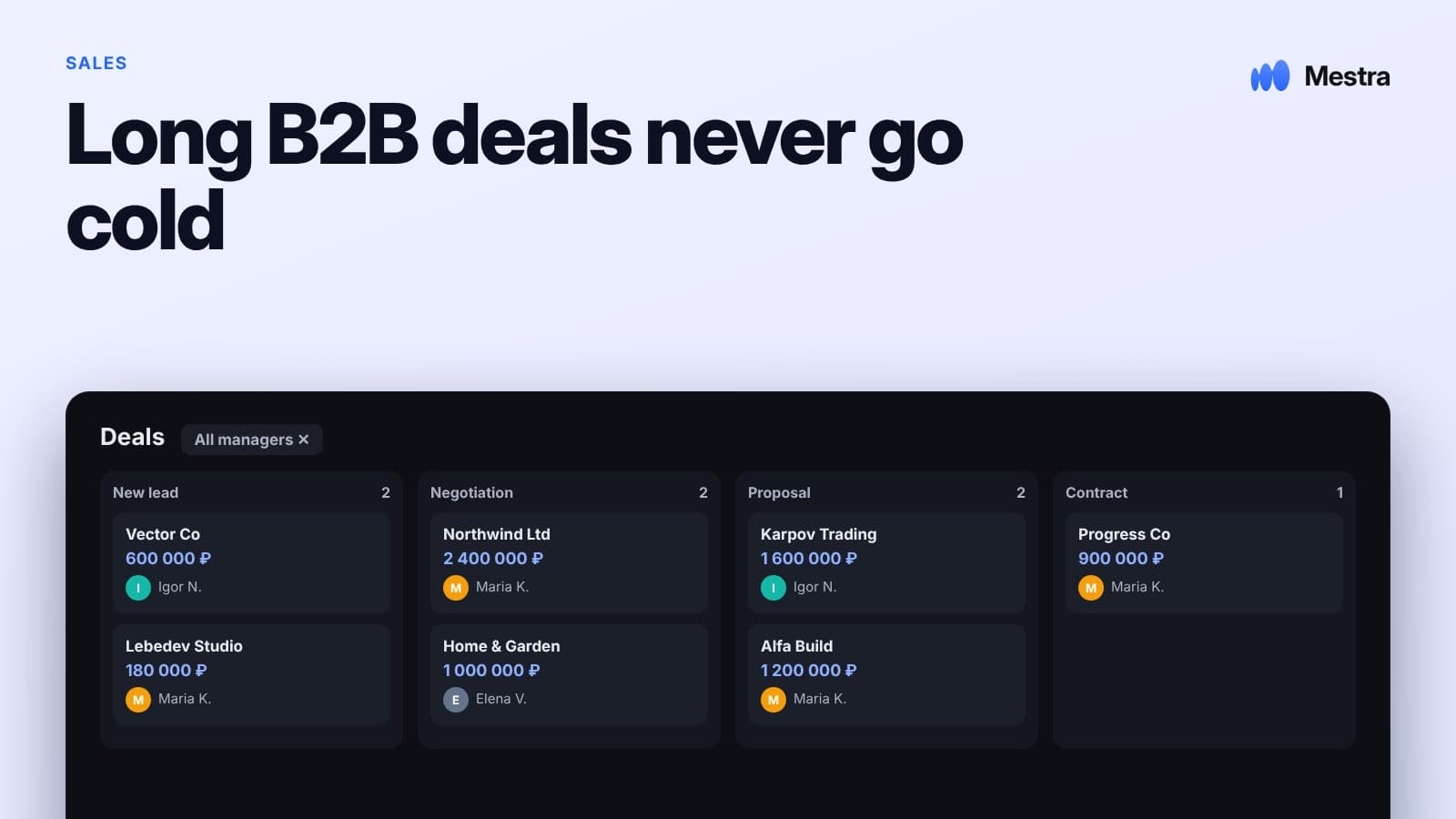
- A funnel of task stages. Analytics shows how many deals are in each stage and how they move.
- Stuck deals. AI flags deals and tasks that have gone too long without movement.
- Stuck and overdue. AI notifies you about deals and tasks that are standing still.
- Next step from the conversation. AI turns an agreement with the client into a task with a date.
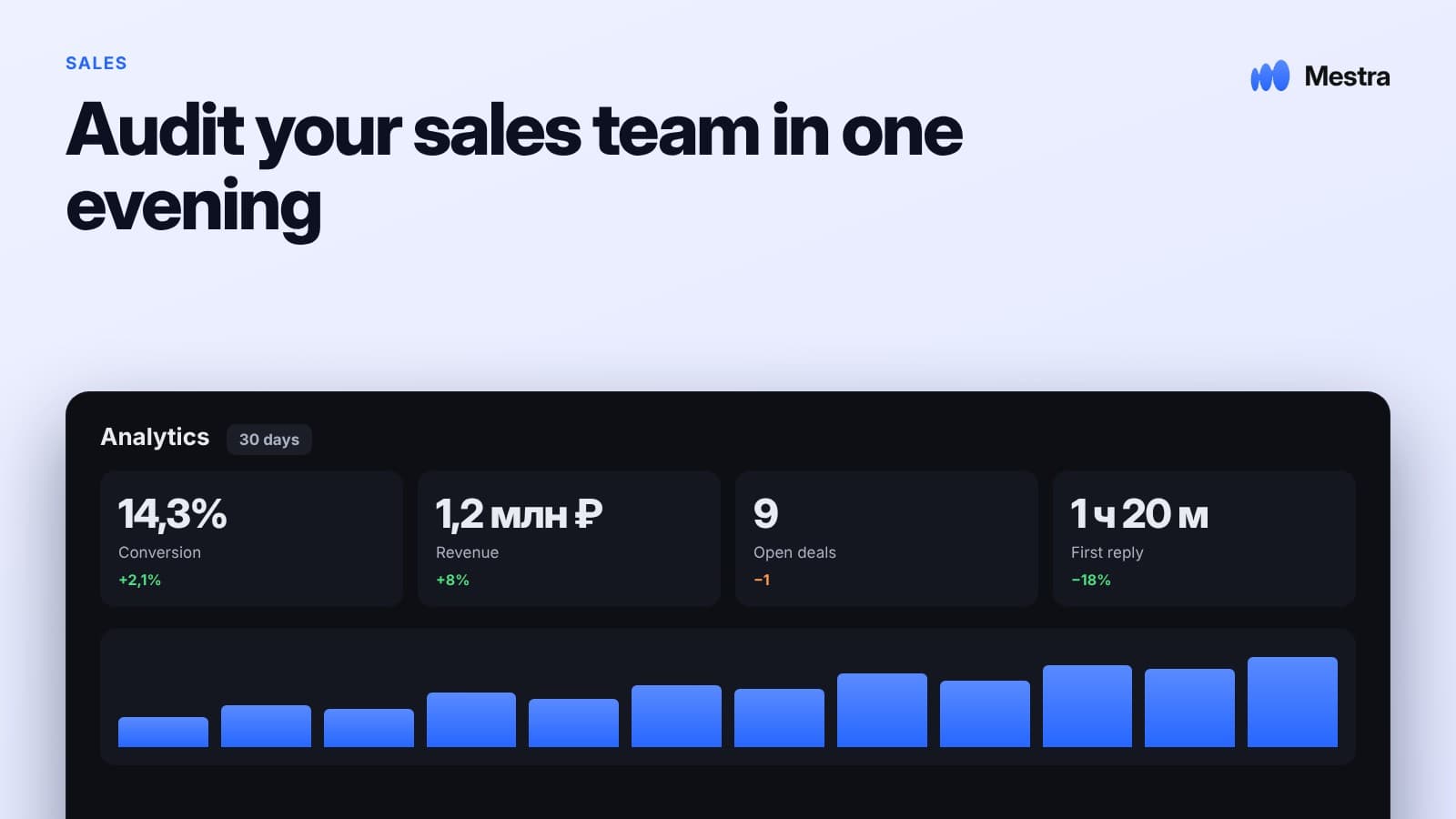
- Employee conversion. You see how many deals each person has won relative to those assigned.
- Custom stages. Funnel stages are edited to fit the company's industry.
Frequently asked questions
What is time in deal stage?
The average number of days a deal spends in a particular funnel stage before moving on or closing.
How do I find a bottleneck in the funnel?
Compare the average time in each stage with the benchmark: the stage where deals sit noticeably longer is the bottleneck.
What is a deal cycle?
The total time from the first request to payment — the sum of the time in all stages.
How can I shorten the deal cycle?
Speed up the first reply, set a next step after every contact, involve all decision participants and simplify payment.
How often should I look at time in stage?
Stuck deals weekly, average values per stage monthly.
Summary
Time in stage shows where sales get stuck and clients go cold. Stage benchmarks, a weekly review of stuck deals and a next step after every contact shorten the deal cycle and raise conversion.
In Mestra, the stage funnel and employee conversion are visible in analytics, and AI notifies you about stuck deals and creates tasks for the next step. Try Mestra free for 15 days at mestra.chat.