How to Close a Client Without Pressure: What to Do When a Deal Stalls After a Meeting or Viewing
Sales5 min read
How to close a client without pressure: why deals stall after a meeting or viewing, 4 signs of a stalled deal, 5 steps, a follow-up schedule and ready messages.

"Closing a client" doesn't mean pressuring them — it means not letting the deal stall. Most often a client is lost not at the first message but after a meeting or viewing: the conversation looks alive, but there's no next step.
The client is thinking, the manager is waiting, and the agreement about the next contact isn't recorded anywhere. The fix is simple: every deal should always have a next step with a date, and every message to the client should give a new reason and end with a question.
Why deals stall after a viewing
After a meeting, both sides feel that "everything's going fine":
- the client said "I'll think about it" — the manager politely waits;
- the manager sent options — the client promised to look;
- they agreed to "speak during the week" — without a day or time.
Two weeks later, the deal is still "in progress", even though the client bought from a competitor long ago. Almost nobody counts these losses: formally the deal wasn't lost, it quietly died.
4 signs of a stalled deal
| Sign | What it means |
|---|---|
| No task with a next step | Nobody knows what to do or when |
| Last contact more than a week ago | The client is cooling off |
| The stage isn't changing | The deal has been at "viewing done" for three weeks |
| The last message is from the manager and has no question | The client has nothing to reply to |
How to close a client: 5 steps
1. Agree the next step right at the meeting. Not "we'll talk", but "let's speak on Thursday at 18:00 — does that suit you?"
2. Send a short message the same day.
Thanks for coming! What did you like, and what put you off? If this option isn't right, I'll find others.
3. After 2–3 days — a new reason, not "so, have you decided?"
There's another option in the same area, a bit cheaper. Shall I send it?
4. Find out the real reason for the pause.
Could you tell me what matters most for making a decision right now: price, timing or something else?
How to respond to "too expensive" and "I'll think about it" — in our article handling objections.
5. Offer a polite way out.
If your plans have changed, just write "no longer relevant" — I won't bother you again.
Such a message often revives the conversation: it's easier for someone to answer honestly than to stay silent. More templates in our article sales scripts for messengers.
A follow-up schedule after a meeting
| When | What to send |
|---|---|
| The same day | Thanks and a question: "what did you like, what put you off" |
| After 2–3 days | A new reason: an option, an answer to a question, a calculation |
| After a week | A question about the reason for the pause |
| After 2 weeks | A polite way out |
| After 1–3 months | A new offer — now as winning the client back |
Mistakes that make a deal stall for good
- The message "So, have you decided?". It applies pressure and gives the client no reason to reply.
- Repeating the same offer. Every touchpoint should bring something new: a photo, a calculation, an option.
- Waiting for the client to write first. Without a task with a date, the manager remembers the deal too late.
- Offering a discount instead of clarifying. Often it isn't the price stopping the client but an unanswered question.
How to stop losing stalled deals systematically
- The rule: every deal has a task with a next action and a date.
- Once a week, look at deals without tasks or with overdue tasks.
- Watch time at each stage: where deals "hang" longer than usual is where money is lost. More in our article the sales funnel.
- Close every lost deal with a reason.
How it works in Mestra
Mestra is our product. Stalled deals are visible straight away:
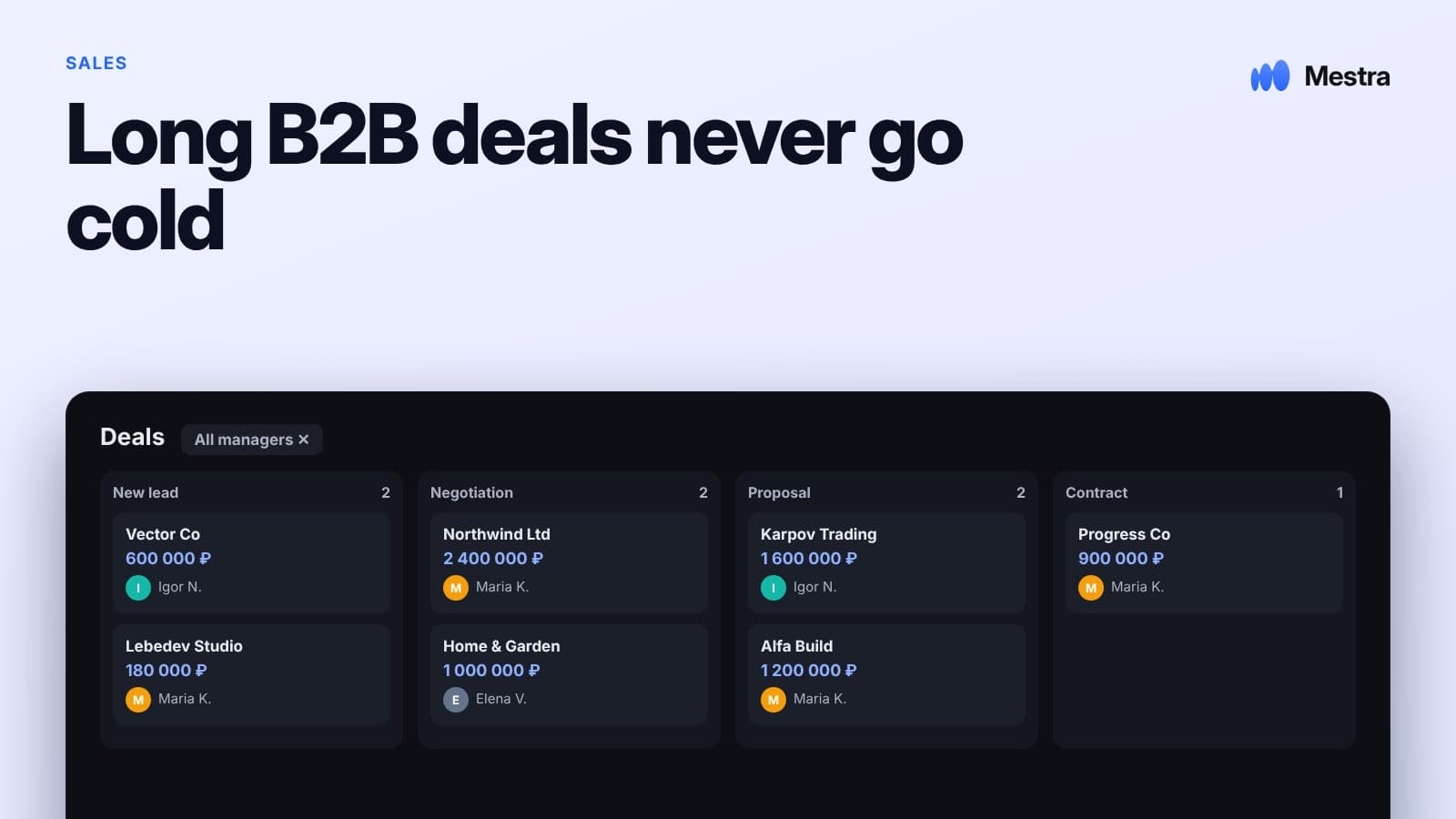
- The stage pipeline shows how many deals are at each stage and how long they stay there on average.
- Tasks with deadlines: "write 2 days after the viewing" won't be forgotten, even if the manager changes.
- The AI assistant suggests setting a task during the conversation and replies to the client if they write at night.
- A reason for refusal is required when closing a deal as lost.
- The full conversation history is in the card — a new manager picks up from the right place.

FAQ
How do you close a client who isn't replying?
2–3 short messages with a specific reason, a few days apart. The last one offers a polite way out.
How do you close a client who says "I'll think about it"?
Find out exactly what they want to think over, and agree a specific date for the next contact.
Won't it come across as pushy?
No, if each message gives the client something useful: a new option, an answer to a question, a convenient time.
How long should you wait before writing after a viewing?
The first message the same day, the next one after 2–3 days.
Bottom line
Closing a client means not letting the deal quietly die.
A next step with a date after every meeting, short messages with a reason and a regular review of stalled deals bring back clients you otherwise wouldn't even have noticed. Try Mestra free for 15 days.