Working with suppliers: how to choose, negotiate and monitor so you don't let your own clients down
Finance7 min read
Working with suppliers: selection criteria, what to put in the contract, how to manage orders, control deadlines and payments, evaluate and reduce dependence.

Working with suppliers means selecting, agreeing terms with, ordering from, monitoring and evaluating the companies from which you buy goods, materials or services for your business. A supplier's delay becomes a delay for your client, and that means a complaint, a discount or a lost deal.
Working with suppliers in a minute
| Stage | What we do |
|---|---|
| Selection | Compare on price, deadlines, quality, terms |
| Contract | Fix deadlines, liability, payment |
| Order | Place the order with an owner and a deadline |
| Control | Track deadlines and quality |
| Payment | Pay on schedule, record in expenses |
| Evaluation | Once a quarter, based on facts |
| Backup | A reserve supplier for critical items |
How to choose a supplier
| Criterion | What to check |
|---|---|
| Price | Including delivery and minimum order |
| Deadlines | Real ones, not promised ones: ask other clients |
| Quality | Samples, a trial order |
| Payment terms | Prepayment, deferred payment, volume discounts |
| Reliability | Years on the market, reviews, financial standing |
| Communication | How fast they reply, whether there is a dedicated manager |
| Documents | Whether they can quickly provide closing documents |
The lowest price is rarely the most profitable: a failed delivery costs more than the price difference.
Comparison example
| Supplier A | Supplier B | Supplier C | |
|---|---|---|---|
| Price per unit | 1,000 ₽ | 1,080 ₽ | 950 ₽ |
| Delivery time | 5 days | 3 days | 10 days |
| Payment | 100% prepayment | 14-day deferral | 50% prepayment |
| Trial order | No issues | No issues | 2 defective out of 20 |
| Response to a request | 1 day | 2 hours | 3 days |
Supplier B is 8% more expensive, but offers deferred payment, delivers faster and replies faster. For many companies this is the best choice.
What to put in the contract
- Subject and specification. What exactly is supplied, characteristics, tolerances.
- Deadlines. Delivery time from the moment of order or payment.
- Payment terms. Prepayment, deferral, procedure.
- Acceptance. How quality and quantity are checked.
- Claims. Deadlines and procedure for returns and replacements.
- Liability. What happens if deadlines are missed.
- Contacts. Who is responsible on both sides.
It is better to have a lawyer review the contract, especially for large and long-term supplies.
How to manage orders
A typical situation: a manager agreed terms with a supplier in a personal messenger, then fell ill — and nobody knows when the goods will arrive or what was promised.
| What not to do | What to do |
|---|---|
| Order in a personal messenger | Correspondence in the company's work account |
| Agreement kept in someone's head | A task with an owner, delivery deadline and amount |
| "I'll call and find out" | A checkpoint 1–2 days before the deadline |
| Supplier invoice in the manager's email | Invoice in the shared system, expense recorded |
If an order to a supplier is tied to a specific client's order, it is worth linking the tasks: then you can see which client will be affected by a delay.
Delivery control
- Checkpoints. 1–2 days before the deadline, confirm shipment.
- Acceptance. Check quantity and quality immediately on receipt.
- Recording deviations. Every delay or defect is a dated record.
- Informing the client. If a delivery is delayed, the client hears it from you in advance, not on the day they expect their order. For how to handle unhappy clients, see the article on client complaints.
Paying suppliers
Supplier payments are one of the largest expense items. It is important to:
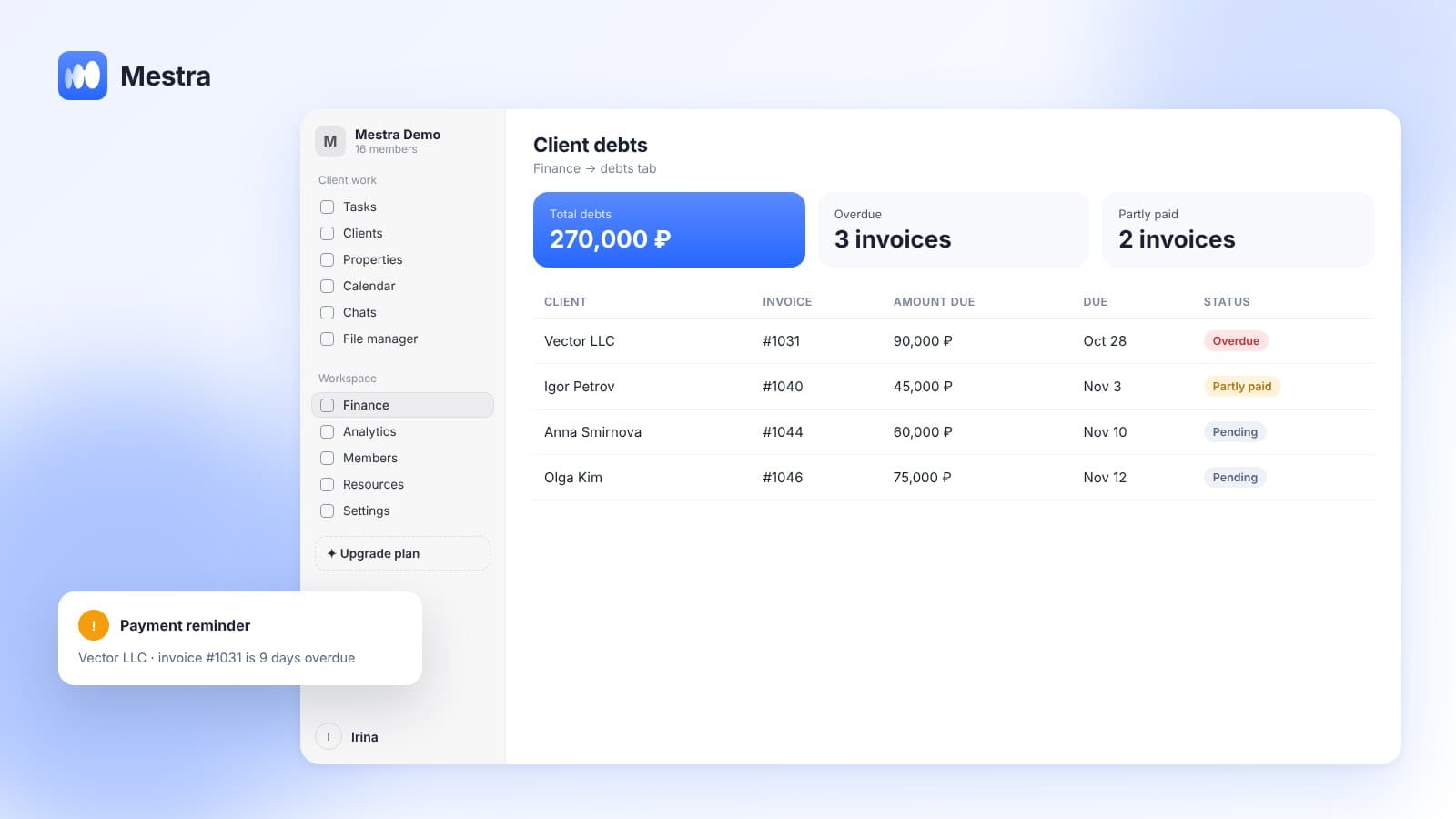
- include them in the payment calendar so you don't hit a cash gap;
- spread large payments across different weeks;
- use deferred payment if it is available;
- assign them to the right expense category so you can see the cost of goods.
More in the article on the payment calendar.
Evaluating suppliers
Once a quarter, evaluate key suppliers based on facts:
| Criterion | How to calculate | Weight |
|---|---|---|
| Meeting deadlines | Share of on-time deliveries | 30% |
| Quality | Share of defects and returns | 30% |
| Price | Comparison with the market | 20% |
| Communication | Reply speed, problem solving | 10% |
| Payment terms | Deferral, flexibility | 10% |
A supplier scoring below the threshold is a reason for a conversation or a search for a replacement.
How to reduce dependence on a supplier
- for critical items, at least two proven suppliers;
- small regular orders with the backup supplier so the relationship doesn't go cold;
- a stock of critical materials in the warehouse;
- a contract with liability for missed deadlines.
How to negotiate better terms
- Volume. A discount for volume or regularity.
- Contract term. A long-term contract in exchange for a better price.
- Payment discipline. Paying on time is an argument for deferred payment.
- Alternatives. Real offers from other suppliers.
- Honesty. Explain what matters to you: price, deadlines or deferral.
Common mistakes
- Choosing on price alone. Missed deadlines cost more than the savings.
- No contract, or a formal one. Nothing to back up a claim.
- Orders in personal messengers. The history leaves with the employee.
- No deadline control. You learn about a delay from an unhappy client.
- One supplier for a critical item. Any failure on their side stops your work.
- No evaluation. Supplier decisions are made out of habit.

How it works in Mestra
In Mestra, work with suppliers is handled in the same system as work with clients:
- Correspondence in work accounts. Messengers are connected to the shared system, so correspondence with a supplier stays in the company.
- A supplier order is a task. With an owner, a deadline, an acceptance checklist and the invoice and contract files.
- Products and warehouses. A product catalog and stock by warehouse — you can see what is where.
- Expenses and company accounts. Payments to suppliers are recorded by expense category and company account, in different currencies.
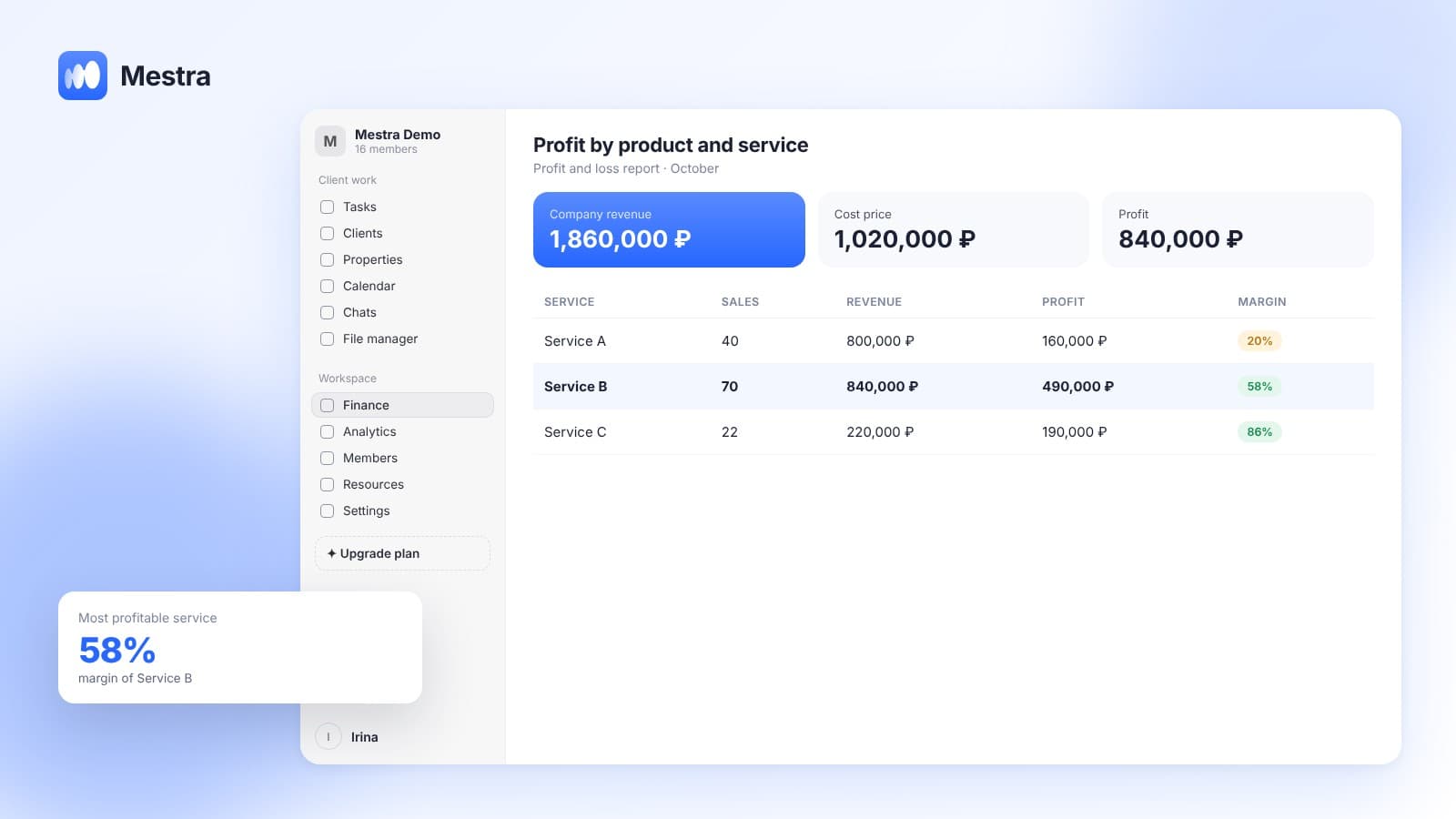
- Profit and loss statement. You can see how supplier costs affect profit.
- Tags and files. Suppliers can be marked with tags, and contracts and specifications stored in the file manager.
- Calendar and timeline. Delivery deadlines are visible alongside client tasks.
Frequently asked questions
How do I choose a reliable supplier?
Compare several on price including delivery, real deadlines, trial order quality, payment terms, reply speed and reviews from other clients.
What must be included in a supplier contract?
The specification, deadlines, payment terms, acceptance procedure, claims procedure and liability for missed deadlines.
How do I control delivery deadlines?
Make every order a task with an owner and a deadline, set a checkpoint 1–2 days before the deadline and record all deviations.
How do I evaluate suppliers?
Once a quarter, by meeting deadlines, quality, price, communication and payment terms, with weights based on what matters for your business.
How many suppliers do I need per item?
For critical items, at least two, so one supplier's failure doesn't stop your work.
Summary
Good supplier management means choosing on more than price, a clear contract, orders with owners and deadlines, delivery control, payment tracking and regular evaluation. Then a supplier's delays don't turn into your clients' problems.
In Mestra, supplier correspondence, order tasks, products and warehouses, expenses and the profit and loss statement are brought together in one system. Try Mestra free for 15 days at mestra.chat.