Company Business Processes: How to Describe Them, Find the Losses and Optimise Them
Processes4 min read
Company business processes in simple terms: how to describe a process from enquiry to payment, find where clients and time are lost, and optimise it yourself.

A company's business processes are the repeating chains of actions that every client, order or task goes through: from the first enquiry to payment. While a process exists only in employees' heads, it can't be improved — first you have to see it.
Many companies have processes, but nobody has ever described them. Each manager works in their own way, newcomers are taught on a "watch how I do it" basis, and the owner learns about a problem once the client has already left. Describing the process is the first step to making it work equally well for everyone.
A company's main business processes
| Process | Start | Result |
|---|---|---|
| Sales | A client's enquiry | Payment |
| Delivering a service | Payment or booking | Service delivered, client satisfied |
| Winning the client back | Service completed | A repeat purchase |
| Handling payments | Invoice issued | Money in the account |
| Purchasing | Stock level | Goods received |
Describing a business process in one minute
- Name the start and the result of the process.
- List the stages in between in the order they really happen, not how they should.
- For each stage, note the owner and the normal time it takes.
- Mark the places where the client or task waits.
- Mark the actions that repeat the same way every time.
A sheet of paper and an honest conversation with the team are enough. Diagrams in formal notations are needed later, if at all.
Where to look for losses
| Type of loss | What it looks like | What to do |
|---|---|---|
| Waiting | A request waits for someone to pick it up | Automatic routing |
| Manual repetition | Identical messages and retyping data | Rules and AI |
| Lost information | An agreement stayed in a chat | Tasks from conversations |
| Rework | A stage was done badly, and it surfaces at the end | Checks at the stage |
| Invisibility | Nobody knows where a case is stuck | A board and stall signals |
Optimising a company's business processes: the order of steps
- First, remove what's unnecessary. Stages that add nothing for the client are deleted, not automated.
- Then simplify. Merge stages that one person does in a row.
- Then automate repetition. Hand anything done the same way to the system.
- Add visibility. Every stage on the board, every delay a signal to the owner.
- Review once a quarter. The process changes as the company does.
An example in numbers
One-minute calculation:
- In an agency, the path from enquiry to first viewing takes an average of 3 days.
- Describing the process shows that the request waits 1 day to be routed, and the agent spends another day searching for suitable listings.
- Automatic routing cuts the wait to minutes, and system-based matching cuts the search to one day of work with the client.
- The path to a viewing shrinks from three days to one.
- The client sees the first options before competitors do — and more often stays with you.
How it works in Mestra
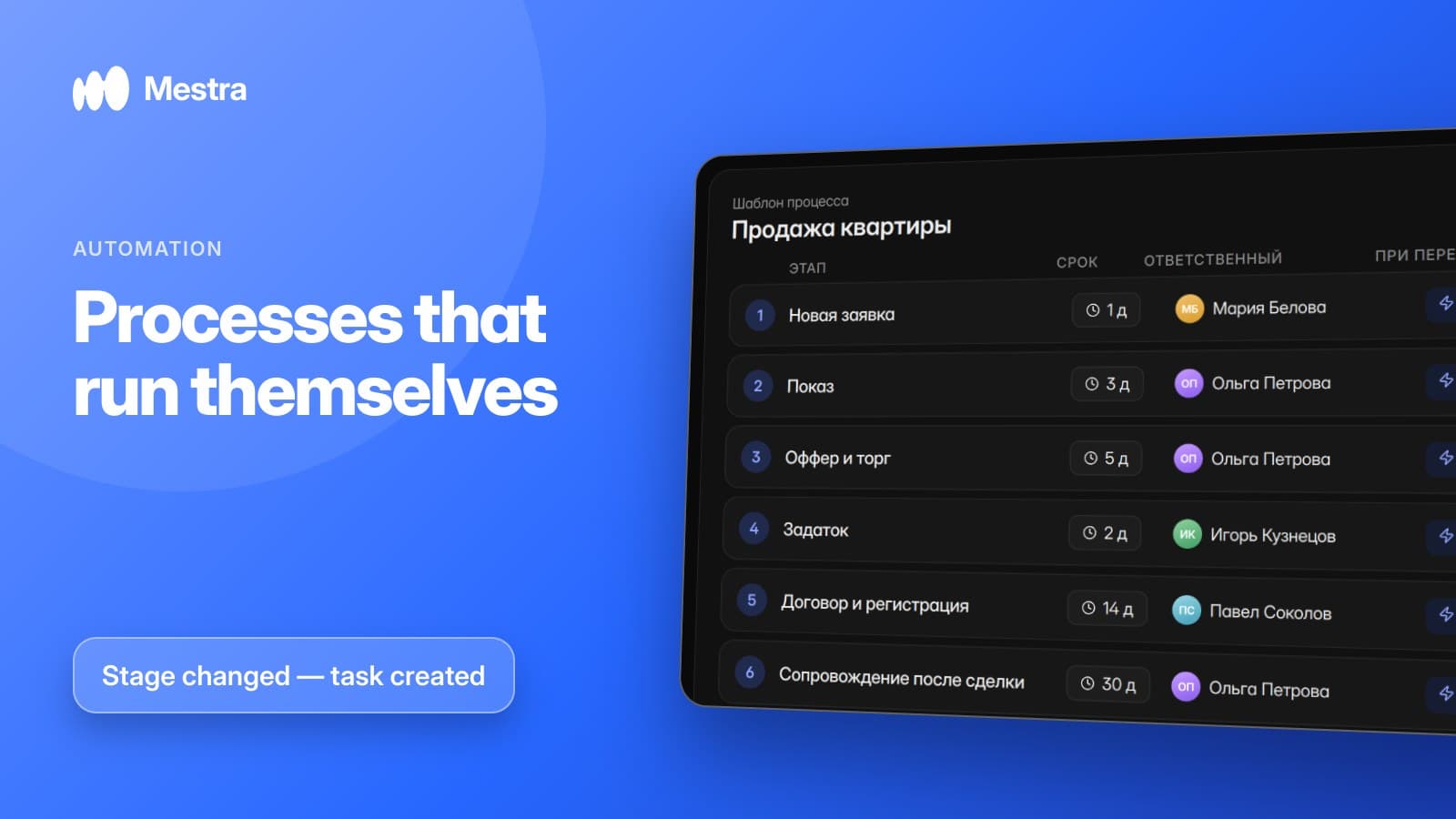
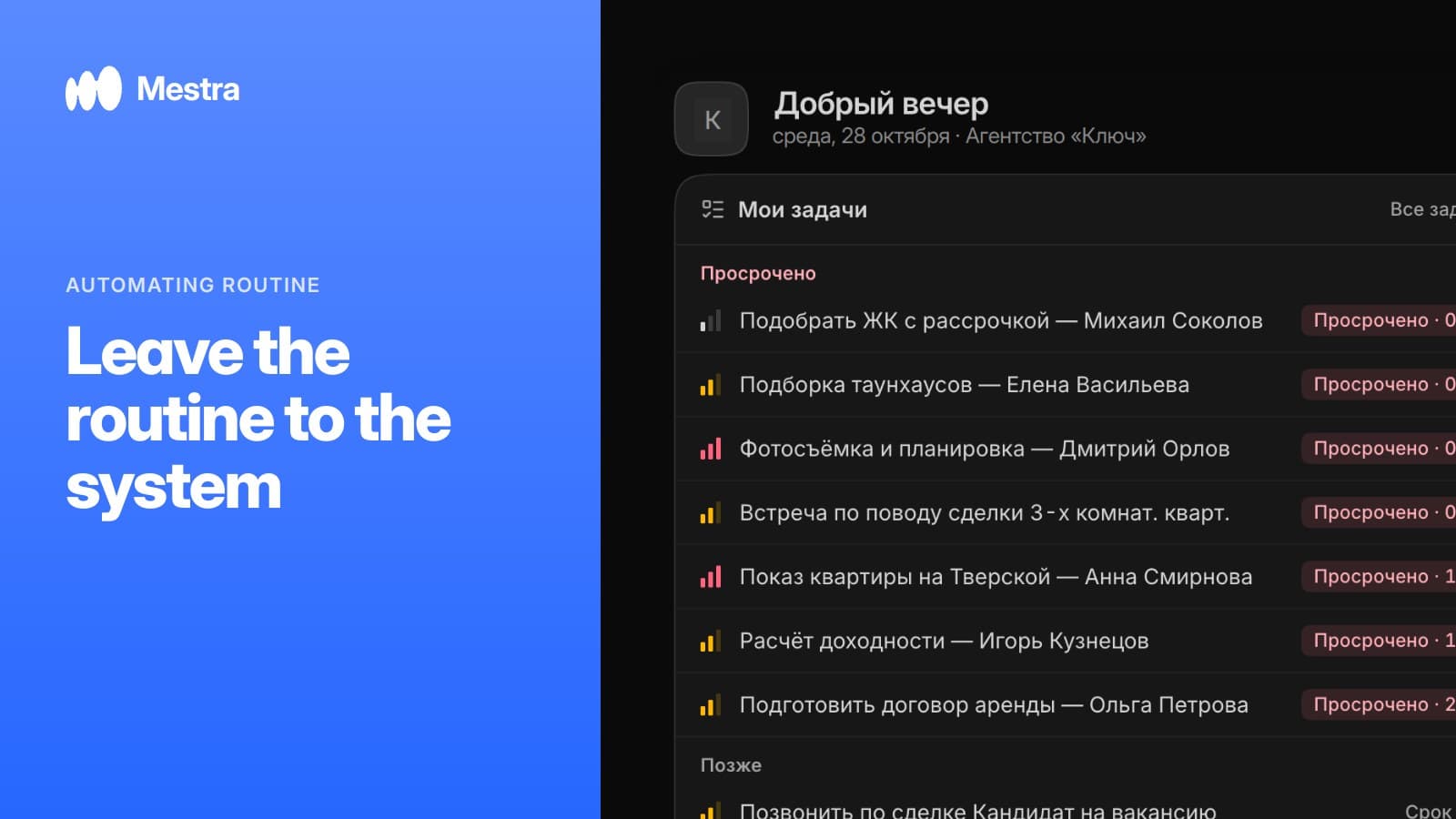
In Mestra, processes are set up as stages: you create process templates for your industry yourself and specify owners and deadlines. Processes are visible on a kanban board, stages can be sent back for rework, and the owner gets a signal when something stalls. Actions are linked to stages — a message to the client, a task, a change of owner — and AI launches processes from templates and creates tasks from conversations.
How to automate what you found while describing the process — in our article business process automation. How to set up sales stages — in the sales funnel.

FAQ
What are a company's business processes?
Repeating chains of actions that lead to a result: a sale, delivering a service, receiving payment, purchasing.
How do you describe a business process?
Name the start and the result, list the stages in their real order, specify owners and deadlines, and mark waiting and repetition.
Where should you start optimising business processes?
By removing unnecessary stages, then simplifying, and only then automating repetitive actions.
Do you need a consultant to describe processes?
For most companies, no. The team knows the process better than a consultant; what matters is describing it honestly.
Bottom line
A process you can see is a process you can improve. Mestra turns a process description into working stages with owners, deadlines and automation — try it free for 15 days, no card required.