An Agent's Fee Under an Agency Agreement: How to Calculate It, Account for It and Not Confuse It With Revenue
Finance4 min read
An agent's fee under an agency agreement: how to calculate a percentage or fixed fee, why the principal's money isn't the agent's revenue, and VAT.

An agent's fee is the amount the principal pays the agent for work under an agency agreement: a percentage of the transaction or a fixed payment. For the agent, revenue is only this fee; the principal's money passing through its account remains someone else's and is passed on.
Agency arrangements are common in real estate, travel, advertising, marketplaces and recruitment. Below: how to calculate the fee and avoid overstating revenue many times over.
One-minute calculation
- Find the base in the contract: transaction amount, sales amount or fixed fee.
- Multiply the base by the fee percentage.
- If the agent is a VAT payer, extract the tax from the fee or add it on top.
- Deduct the fee from the principal's money, if the contract allows.
- Transfer the rest to the principal and close the deal with the agent's report.
The agency agreement: roles
| Role | Who it is | What they receive |
|---|---|---|
| Principal | Owner of the goods or service | Money from the buyer minus the fee |
| Agent | Intermediary | The fee |
| Buyer | Client | The goods or service |
If the contract doesn't specify the fee, it's determined by the price usually charged for similar services in comparable circumstances (Article 1006 of the Civil Code, referring to Article 424).
Example 1: a travel agency
A tour costs 180,000 ₽, and the agency's fee is 10%. The client pays the agency 180,000 ₽, the agency keeps 18,000 ₽ and transfers 162,000 ₽ to the tour operator.
- The agency's turnover on the deal: 180,000 ₽.
- The agency's revenue: 18,000 ₽ (incl. VAT, if the agency pays it).
Example 2: a real estate agency
The commission for selling an apartment for 28,900,000 ₽ is 3%, or 867,000 ₽ incl. VAT. The agency's revenue excluding VAT: 867,000 ÷ 1.22 = 710,656 ₽. Agents' shares are calculated from this: listing agent 50%, buyer's agent 20%, partner agency 10%, agency 20%.
Why separating pass-through money matters
An agency with a monthly turnover of 10 million ₽ and a 10% fee actually earns 1 million ₽. If budget, bonuses and hiring are planned on 10 million, within a quarter there won't be enough money in the account to pay principals.
Common mistakes
- Treating all incoming payments as the agent's revenue.
- Charging VAT on the whole transaction amount instead of the fee.
- Not tracking how much of the principal's money hasn't been transferred yet.
- Paying staff a percentage of turnover rather than of the fee.
Related reading: revenue vs turnover, realtor commission, CRM for travel agencies, sales commission, agency pass-through payments, agency agreement: sample.
How it works in Mestra

Third-party pass-through money is separated from revenue
Mestra is a CRM system: clients, messengers and marketplaces, tasks, finance, analytics and an AI operator in one window.
- Amount type on the invoice line. Pass-through, commission, income, advance or conditional.
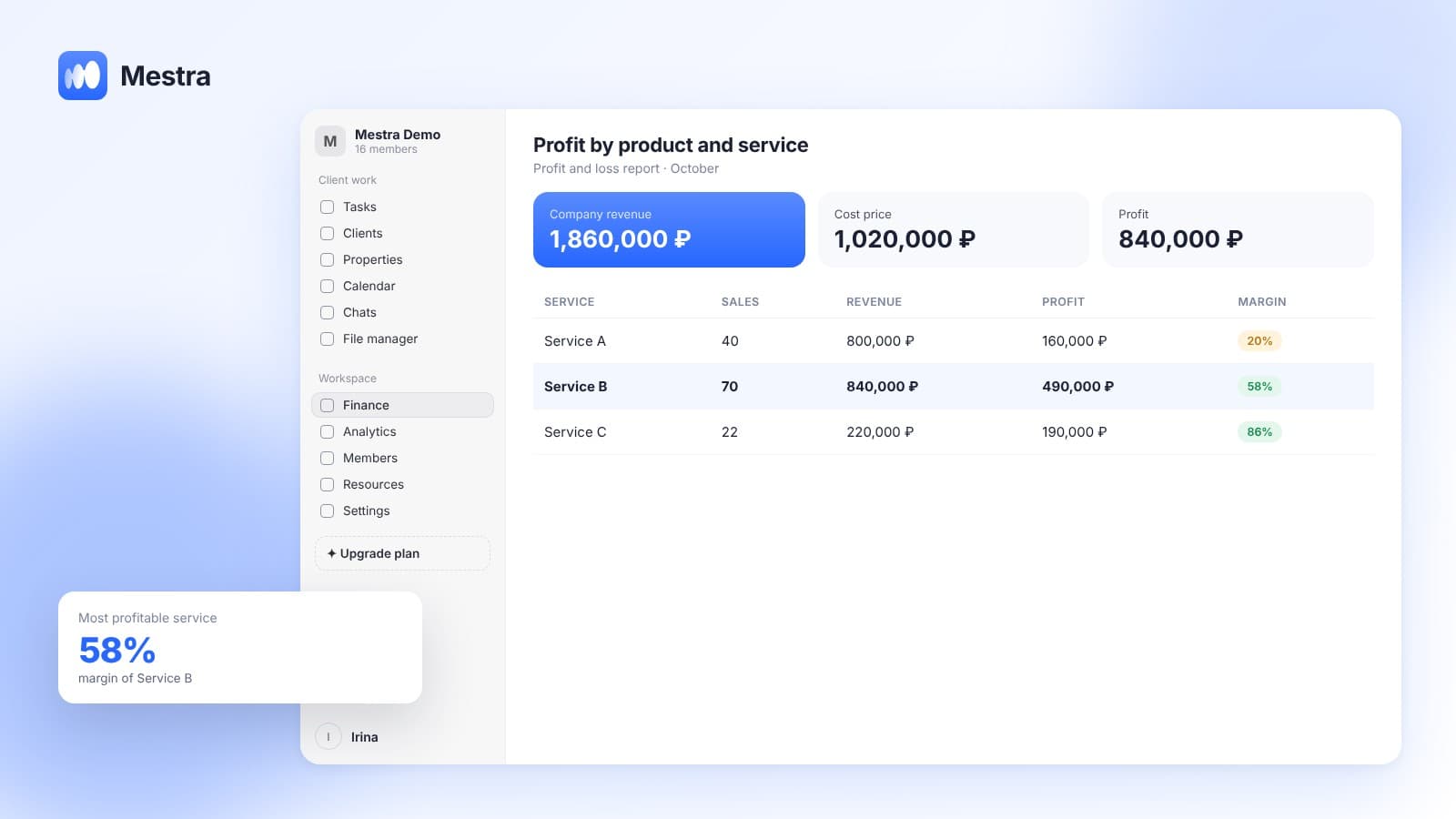
- Revenue without pass-through money and VAT. The profit and loss report separates turnover and revenue.
- VAT by line. Tax is charged only where it applies.
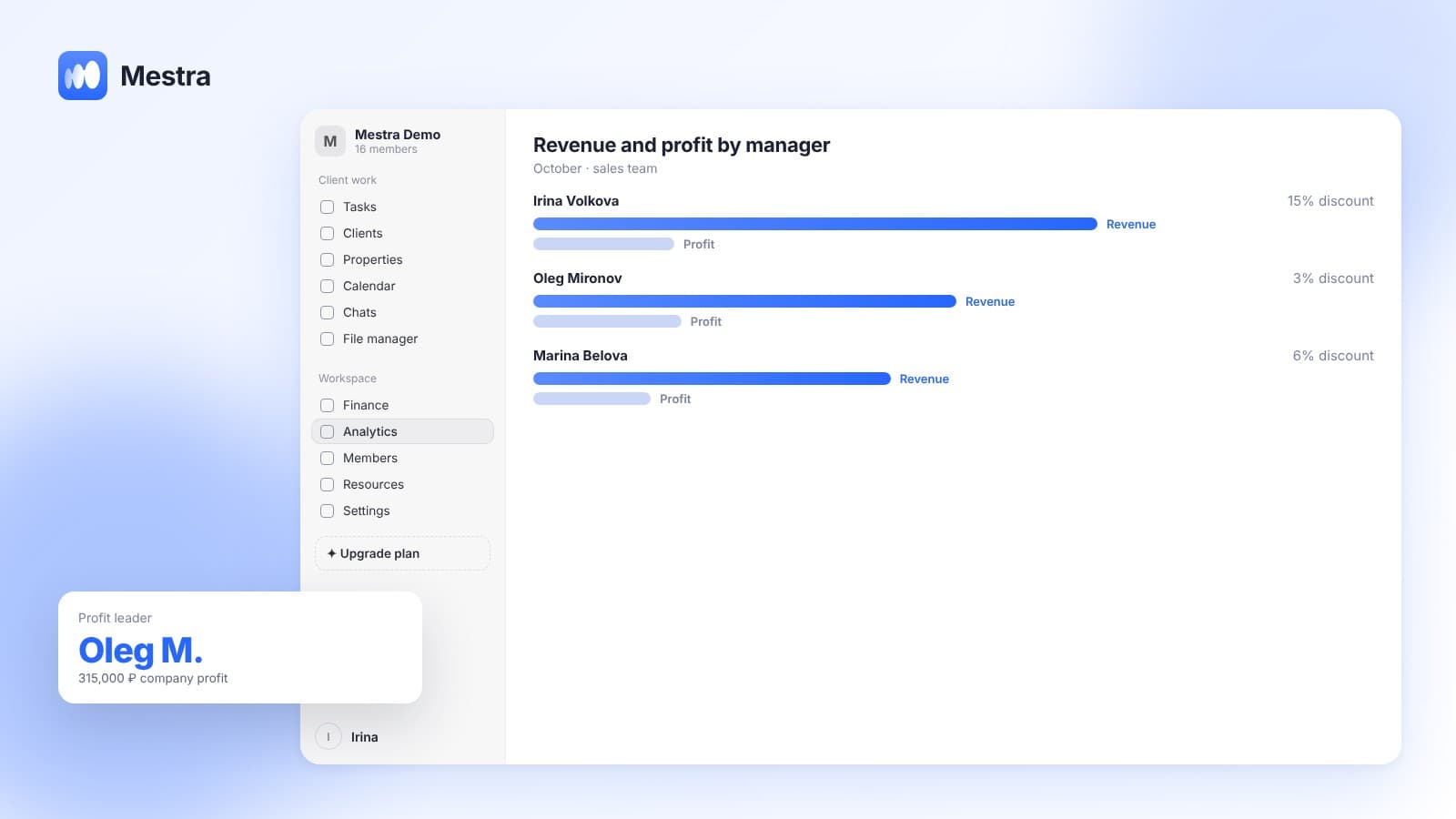
- Deal participants' shares. Agents' commission is calculated on your revenue by rule: percentage, fixed amount, per session or per hour.
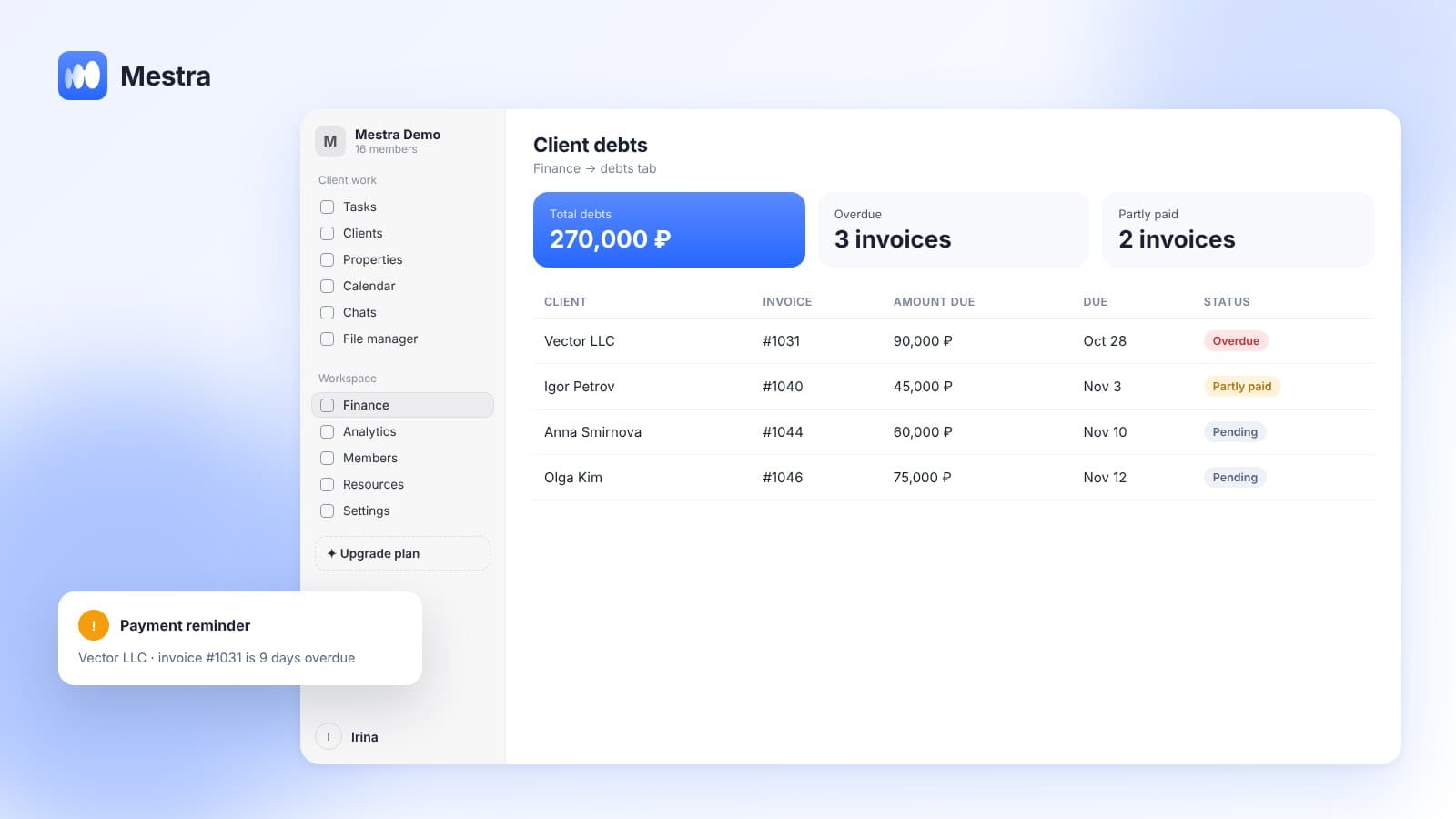
- Debts both ways. The Debts tab shows who owes you and whom you owe.
- Invoice preview. Internal amounts — shares and profit — don't appear on the printed form.
FAQ
How is an agency agreement different from a commission agreement?
A commission agent acts only in its own name; an agent can act in its own name or the principal's. An agency agreement is broader.
Is the agent's fee part of its revenue?
Yes, the fee is precisely the agent's revenue. The principal's money is not.
Can the agent deduct its fee from the money received?
Yes, if the contract provides for it.
On what amount does the agent pay VAT?
On the amount of its fee, if the agent is a VAT payer.
Bottom line
An agent's fee is its only revenue on an agency transaction; the principal's money remains pass-through. Calculate the fee under the contract, charge VAT only on it and pay staff from the fee. In Mestra, pass-through money and commission are separated on the invoice and in the report — try it free for 15 days.