Working Time Timesheet: Forms T-12 and T-13, Codes and Filling Rules
Team5 min read
How to keep a working time timesheet in Russia: the duty under Article 91 of the Labour Code, forms T-12 and T-13 or your own, letter codes, overtime and typical mistakes.

A working time timesheet is a daily record of how many hours an employee worked and why they were absent, if they were. Every employer must keep these records, and chooses the form itself: a ready-made T-12 or T-13 or its own, set out in the accounting policy.
Example: a four-person furniture showroom
Four people work at the Dub i Lyon showroom: Anna, Olga, Dmitry and Alina. Anna works a five-day week, Olga at weekends, Dmitry evening shifts, and Alina went on leave in November. The administrator records hours every evening, and at the end of the month the director signs the timesheet and passes it to the accountant. Let's use this example to see what to record and how.
Which form to choose
| Option | When it's convenient |
|---|---|
| T-12 | Filled in by hand; combines hours tracking and payroll |
| T-13 | Hours come from software or an access control system |
| Your own form | Approved in the accounting policy and containing the required primary-document details |
Dub i Lyon keeps the timesheet in a spreadsheet modelled on T-13 — it's easier to pass data to the accountant.
The codes you'll need most often
| Letters | Digits | Meaning |
|---|---|---|
| Я (Ya) | 01 | Working day, daytime hours |
| Н (N) | 02 | Hours from 22:00 to 6:00 |
| РВ (RV) | 03 | Working on a day off or holiday |
| С (S) | 04 | Overtime above the norm |
| К (K) | 06 | Business trip |
| ОТ (OT) | 09 | Paid annual leave |
| ДО (DO) | 16 | Unpaid leave |
| Б (B) | 19 | Sick leave |
| ОЖ (OZh) | 15 | Childcare leave until age three |
| ПР (PR) | 24 | Absence without good reason |
| В (V) | 26 | Day off or holiday per the schedule |
| НН (NN) | 30 | Absence, reason not yet known |
The cell holds the code and hours: for Anna "Я 8", for Dmitry on a late shift "Я 6" and "Н 2".
Six rules that save nerves
- Record on the same day rather than reconstructing from memory at month-end.
- Record actuals, not the plan: Dmitry left an hour early — the timesheet shows seven hours, not eight.
- Give the reason for absence — leave, sick leave, business trip.
- Use "НН" temporarily until the employee brings a supporting document, then correct it.
- Show overtime separately: it's paid at a higher rate.
- Sign at the end of the month — the person keeping the timesheet and the manager.
Overtime and night hours
Article 99 of the Labour Code limits overtime: no more than four hours over two consecutive days and no more than 120 hours a year per person. The first two hours are paid at least time and a half, the rest at least double, unless a contract or local regulation sets more. At the employee's request, extra rest can be given instead of money.
Work from 22:00 to 6:00 is paid with a premium of at least 20% of the hourly rate for each night hour.
One-minute calculation: Alina and unpaid leave
Alina's salary is 60,000 ₽, and November has 20 working days on her schedule. She worked 18 and took two days unpaid.
Accrual: 60,000 ÷ 20 × 18 = 54,000 ₽.
Without a timesheet, the accountant couldn't justify that amount to Alina or to inspectors.
Shift schedules
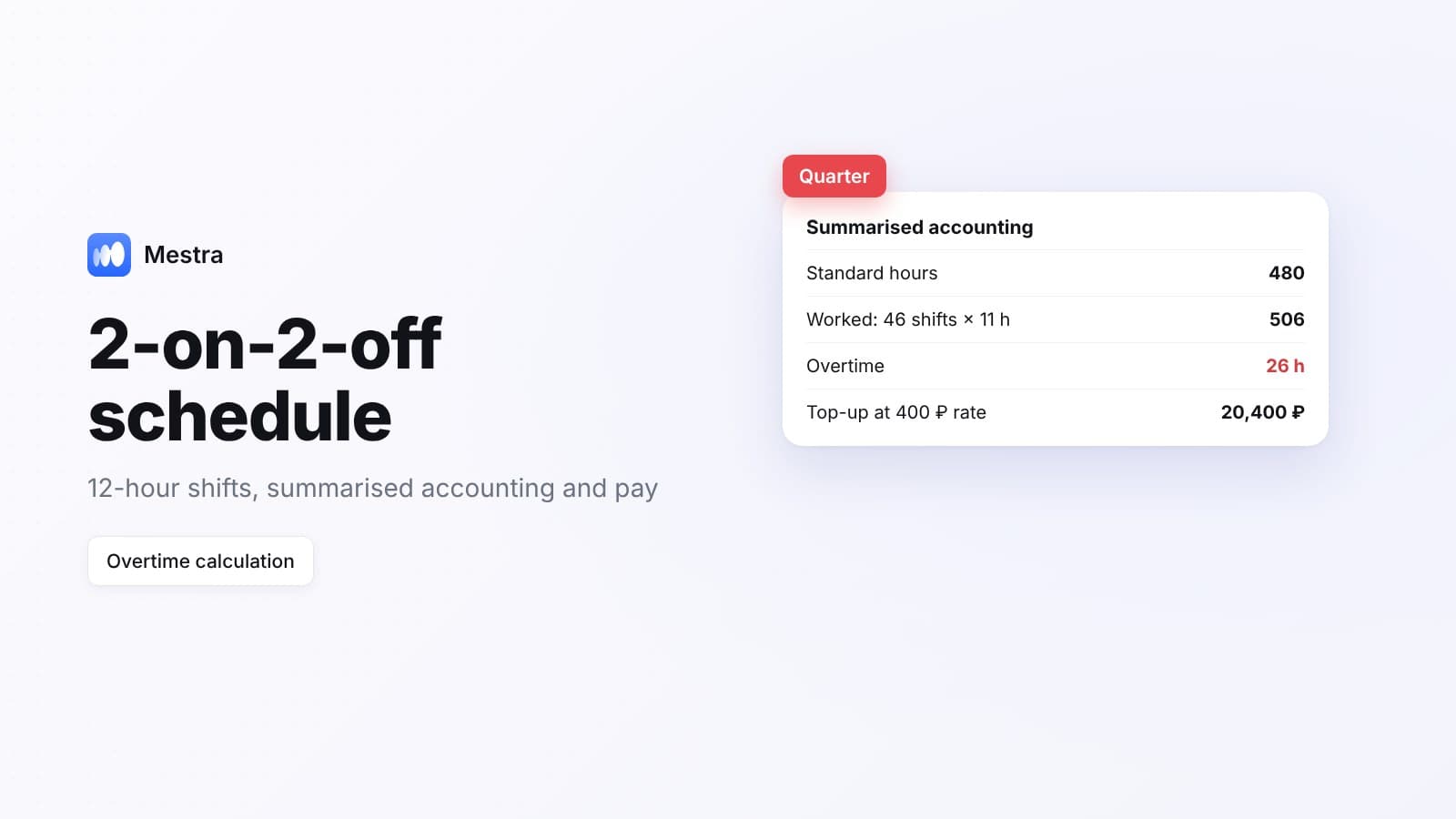
When employees work shifts with summarised accounting, the timesheet records the actual hours of each shift, and overtime is determined at the end of the whole reference period. Details in 2-on-2-off schedule.
Typical slip-ups
- Putting eight hours for everyone regardless of reality.
- Filling in the timesheet retroactively.
- Not recording overtime — and not paying for it.
- Mixing up "ДО" and "ОТ": the first is unpaid, the second paid.
- Keeping the only copy with one person.
How it works in Mestra
In Mestra each employee has a work schedule, and the team calendar shows shifts, meetings and bookings. The profile shows task history, time spent on tasks and workload. That's convenient for management control, while the timesheet for payroll itself is kept in HR or accounting software.

- Schedules in employee profiles.
- Team workload — a widget on the analytics dashboard.
- 1C integration on the Pro plan.
FAQ
Is a timesheet mandatory?
Every employer must record actual working time — this follows directly from Article 91 of the Labour Code. The employer chooses the form of the document.
Who fills it in?
Whoever is appointed by order: an administrator, a department head, an HR officer or an accountant.
How do I record work from home?
The same as in the office: the attendance code and the number of hours, unless the company has approved a separate code for remote work.
How long should timesheets be kept?
At least five years, and longer for hazardous or dangerous working conditions, according to the list of archive retention periods.
Bottom line
A timesheet is the mandatory record of actual hours on which pay, overtime and night premiums depend. Choose a form, appoint a person responsible, record actuals every day and sign the document at the end of the month. How to hire an employee properly from the start is covered in employment contract: template.
Mestra — 15 days free, no bank card required: set up staff schedules and see your team's workload.
Sources: Labour Code of the Russian Federation (Arts. 91, 96, 99, 152, 154), Goskomstat of Russia Resolution No. 1 of 05.01.2004, Government Decree No. 554 of 22.07.2008, Federal Law No. 402-FZ. This article is not legal advice.