Sole Trader Taxes in 2026: How Much You Pay Under Each Regime
Taxes and accounting7 min read
What taxes a Russian sole trader pays in 2026: NPD, USN, patent, AUSN and the general regime, rates and limits, VAT on USN above 20M ₽, 57,390 ₽ fixed contributions.

A sole trader's tax load in 2026 depends on three decisions: which regime is chosen, whether there are employees, and how much money passes through the account in a year. The simplified system suits most people, and those earning over 20M ₽ now also have VAT on top.
Three sole traders, three different tax bills
Rather than retell the Tax Code, let's look at three fictional people.
- Marina does manicures at home in Kazan, works alone and takes in about 1.8M ₽ a year.
- Artyom runs a car parts shop: revenue 30M ₽, purchases eat 75% of revenue, two sales assistants on staff.
- Ksenia's studio designs interiors: 9M ₽ a year, four designers, almost no purchasing.
Each has their own optimal regime. Here's why.
Which regimes are available
| Regime | What's charged | Revenue ceiling | Employees | Usually best for |
|---|---|---|---|---|
| Self-employment (NPD) | 4% of payments from individuals, 6% from companies | 2.4M ₽ | Not allowed | Marina at the start, if she sells only her own services |
| USN "income" | 6%, lower in some regions | 490.5M ₽ | Up to 130 | Ksenia's studio: few expenses |
| USN "income minus expenses" | 15%, lower in some regions | 490.5M ₽ | Up to 130 | Artyom: large purchases backed by documents |
| Patent | 6% of the income the state deems possible for the activity | 20M ₽ | Up to 15 | Narrow lines of work with a steady client flow |
| AUSN | 8% "income" or 20% "income minus expenses" | 60M ₽ | Up to 5 | Those who want no reporting at all, if the regime applies in their region |
| General regime | Personal income tax on a 13–22% scale and 22% VAT | No limit | No limit | When large clients need input VAT |
You can combine, for example, USN and a patent. Self-employment can't be combined with anything.
One-minute calculation: Marina on USN "income"
Say Marina registered as a sole trader and received 1.8M ₽ over the year.
| What we calculate | Amount |
|---|---|
| 6% of 1,800,000 ₽ | 108,000 ₽ |
| Mandatory insurance contribution | 57,390 ₽ |
| Plus 1% of revenue above 300,000 ₽ | 15,000 ₽ |
| Tax after deducting these two amounts | 108,000 − 72,390 = 35,610 ₽ |
| Total paid for the year | 108,000 ₽ |
The conclusion surprises many: for a solo trader without employees on "income", the whole set of payments equals 6% of revenue — the insurance amounts simply "eat" part of the tax. If Marina had stayed self-employed and worked only with private clients, she'd pay 4%, or 72,000 ₽, but then her ceiling is 2.4M ₽ and no helpers.
One-minute calculation: Artyom chooses the tax base
Revenue 30M ₽, documented expenses 22.5M ₽.
- On "income": 30,000,000 × 6% = 1,800,000 ₽.
- On "income minus expenses": (30,000,000 − 22,500,000) × 15% = 1,125,000 ₽.
The difference is almost 700,000 ₽ in favour of the second option. The rule of thumb is simple: when expenses are consistently above 60–65% of revenue and each has a document, "income minus expenses" almost always wins. There's also a floor: even at a loss you pay at least 1% of revenue.
But Artyom's revenue is above 20M ₽ — so this year he also pays VAT.
VAT: who it affects on USN
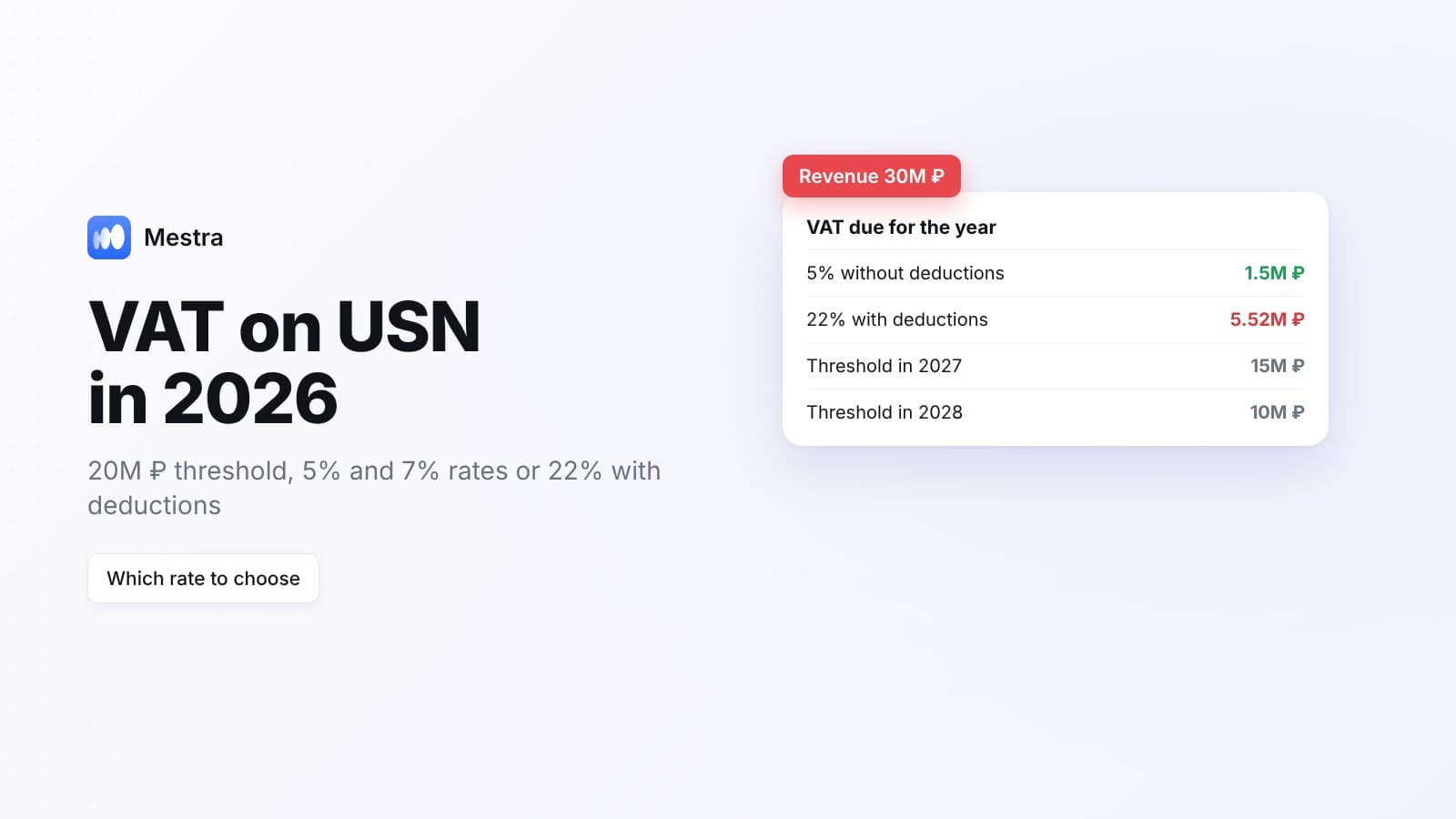
The exemption remains if last year's revenue didn't exceed 20M ₽ and that mark hasn't been passed in the current year either. Once the threshold is exceeded, the tax applies from the first day of the following month.
| Annual revenue | What to choose |
|---|---|
| Up to 20M ₽ | No VAT |
| 20M to 272.5M ₽ | 5% without deductions or 22% with deductions |
| 272.5M to 490.5M ₽ | 7% without deductions or 22% with deductions |
The threshold will fall: 15M ₽ in 2027, 10M ₽ in 2028. How to choose the rate and what changes in your documents is covered in VAT on USN in 2026.
Ksenia's studio: what employees change
Ksenia has four designers. So, in addition to her own tax:
- personal income tax is withheld from every salary — it's the employee's money, Ksenia only transfers it;
- employer contributions are charged on top: 30% until a person's annual pay exceeds 2,979,000 ₽, and 15.1% after. From 2026 the reduced rate for small companies remains only for industries on the government list;
- the tax on "income" can be reduced by her own insurance amounts and contributions for employees, but by no more than half.
Payroll fund helps work out what one employee costs.
USN payment calendar
| What | When |
|---|---|
| Advance for Q1, the half-year and 9 months | No later than the 28th after the quarter ends |
| The sole trader's annual return | No later than 25 April of the following year |
| Tax for the year | No later than 28 April of the following year |
Everything is paid as a single sum into the unified tax account, and the tax service allocates the money to payments itself.
Where sole traders most often go wrong
- They don't notice revenue approaching 20M ₽ and miss the month VAT starts.
- They forget the 1% on revenue above 300,000 ₽ and get late-payment interest in July.
- They switch to "income minus expenses" without collecting receipts and delivery notes.
- They pay the full tax when they could have deducted the insurance amounts.
If contributions are your main headache, see the separate guide sole trader contributions in 2026.
How it works in Mestra
In Mestra's finance section, income and expenses are collected across all accounts, and the profit and loss report shows each month's result. It doesn't replace accounting software or the tax return, but it lets you see in advance how much money to set aside for the 28th.

- Transactions — "Income", "Expense", "Refund" and "Transfer" across accounts in rubles, dollars and euros.
- Profit and loss report by month.
- Client invoices with margin and VAT shown at the review step.
FAQ
Which regime is best for a sole trader with no employees?
For services with low expenses, USN "income" or a patent usually wins; for retail, "income minus expenses". At the start, with income up to 2.4M ₽, it's worth calculating self-employment too.
Does a USN payer pay VAT in 2026?
Only if revenue for 2025 or since the start of 2026 exceeded 20M ₽.
Can I skip the insurance part if I had no income?
No. The obligation is tied to the status, not to revenue. The exceptions are periods listed in Article 430 of the Tax Code: military service, caring for a child under one and a half, and a few others.
When can I switch to USN?
An existing sole trader — from 1 January, if they notify the tax service by 31 December. A new sole trader — within 30 days of registration.
Bottom line
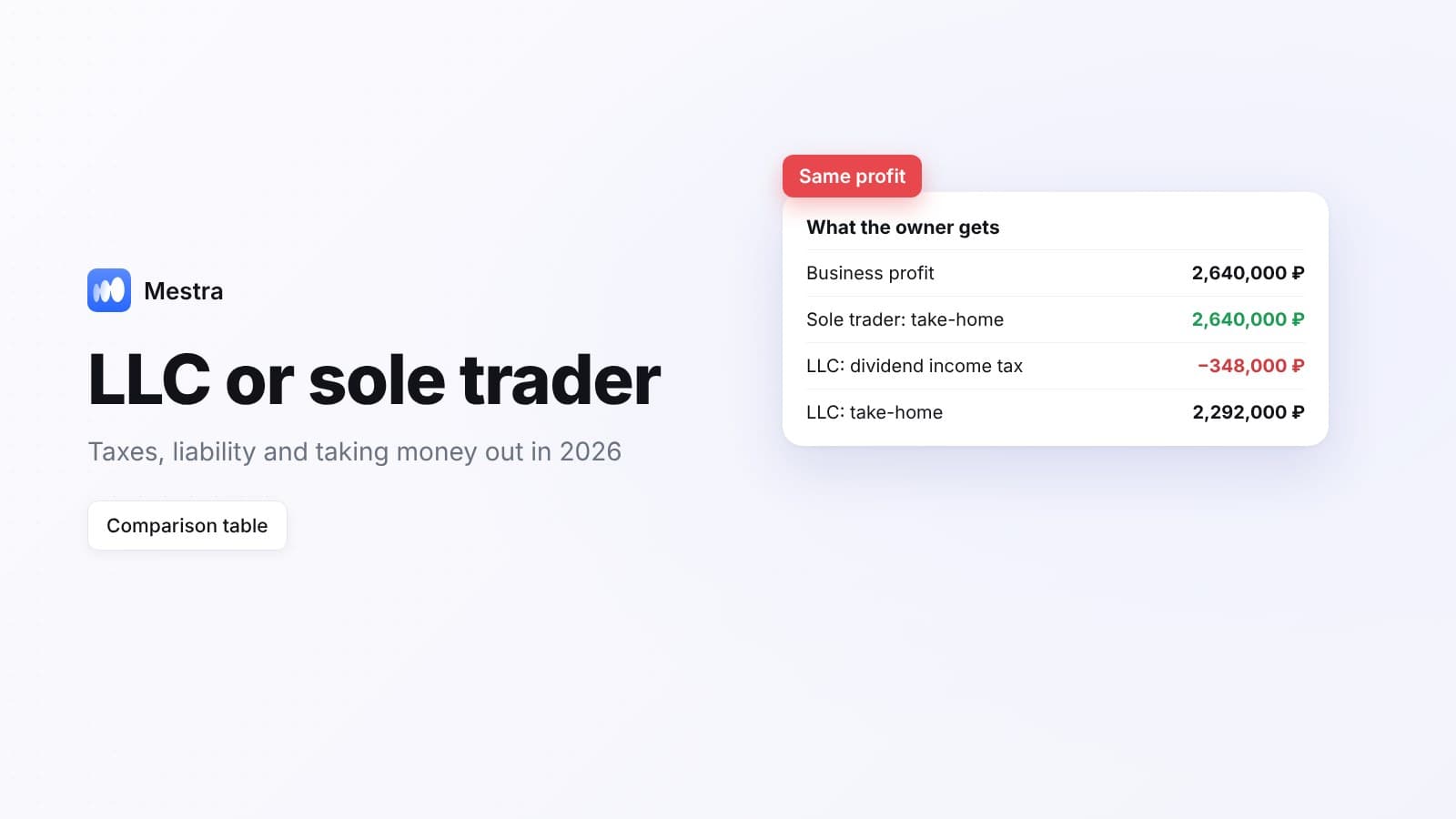
A sole trader's tax isn't a single rate but a combination of the regime, insurance contributions and, with revenue above 20M ₽, VAT. Calculate every option on your own numbers, as we did for Marina, Artyom and Ksenia, and keep an eye on revenue all year. If you haven't settled on a business form yet, start with LLC or sole trader.
Mestra — 15 days free, no bank card required: set up your accounts and see the profit and loss report for your first month.
Sources: Tax Code of the Russian Federation (Chs. 26.2, 26.5, Arts. 145, 164, 427, 430), Federal Tax Service of Russia, Federal Law No. 425-FZ. This article is not tax advice.