LLC or Sole Trader: Taxes, Liability and Taking Money Out Compared
Taxes and accounting6 min read
LLC or sole trader in Russia in 2026: liability, taxes and contributions, taking out profit, reporting, partners and selling. A comparison and a calculation.

A sole trader registration suits you if you run the business alone and want simple accounting and free access to the money. An LLC is chosen when there are partners, an investor or a future sale is planned, or for activities a sole trader can't carry out. Taxes under the same regime are similar, but the path money takes to the owner is different.
Sole trader versus LLC
| Criterion | Sole trader | LLC |
|---|---|---|
| Registration | Passport and application | Charter, decision, share capital from 10,000 ₽ |
| State fee | 0 ₽ online, 800 ₽ on paper | 0 ₽ online, 4,000 ₽ on paper |
| Liability for debts | All personal property | The company's property; the director if at fault |
| Owners | One person | From one to 50 members |
| Access to money | Immediate, no tax on withdrawal | Dividends or salary with taxes |
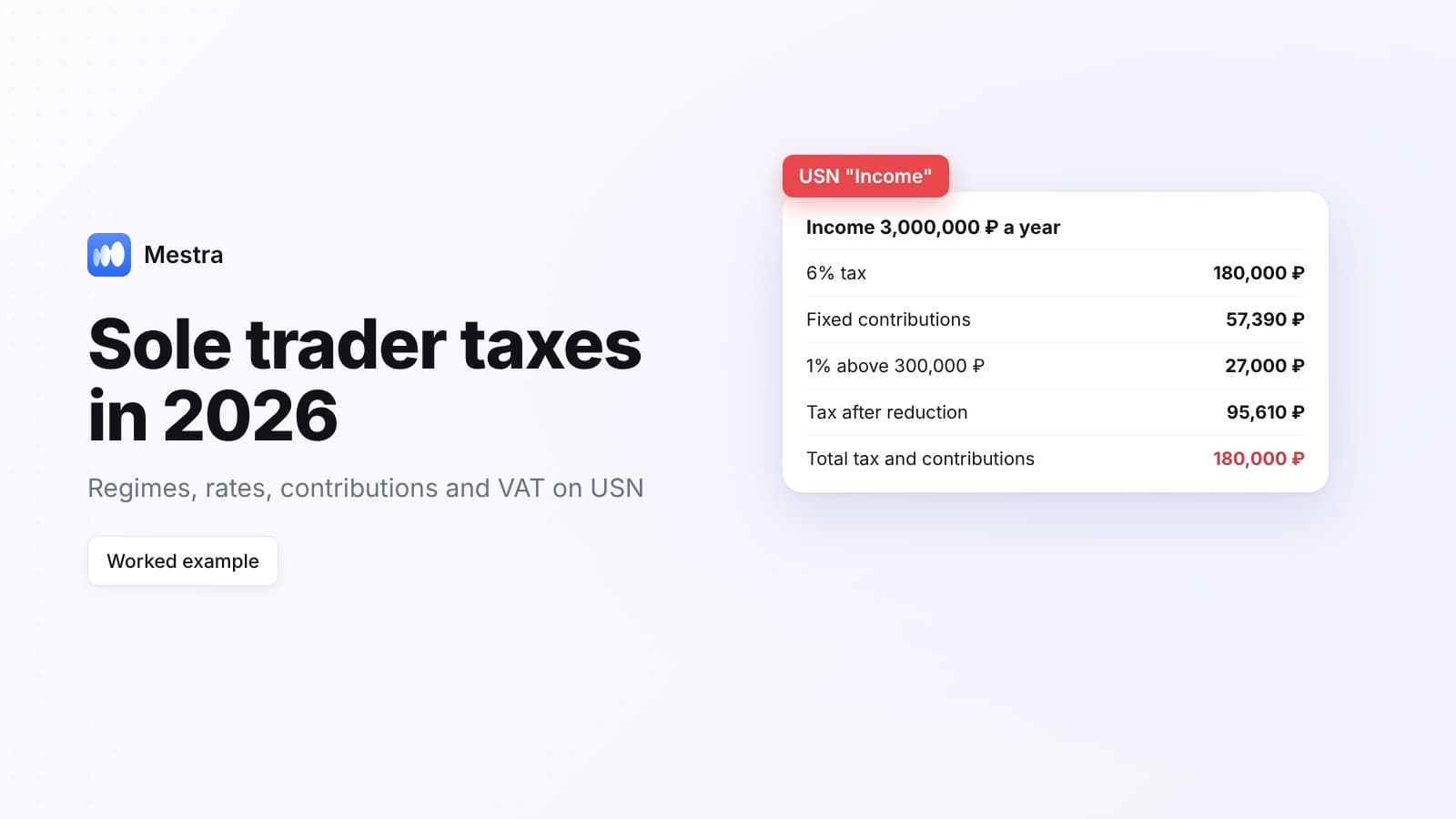
| Contributions for yourself | 57,390 ₽ + 1% above 300,000 ₽ | None, but contributions on the director's salary |
| Accounting | Not mandatory | Mandatory, annual financial statements |
| Fines | Usually lower | Usually higher |
| Selling the business | Only assets and rights | You can sell a share |
| Certain activities | Not available: e.g. retail sale of spirits | Available |
Liability: what an LLC really protects
A sole trader is liable for business debts with all their property, except what can't be seized — for example, their only home.
An LLC is liable with its own property. But the protection isn't absolute: in bankruptcy, the director and controlling members can be held vicariously liable if the debts arose from their actions — withdrawing money, failing to file for bankruptcy, deals that harmed the company. A company's tax debts can also be recovered from the director if fault is proven.
Taxes: what's different
Sole traders and LLCs have the same tax regimes: USN, the general regime, AUSN. The patent system and self-employment (NPD) are available only to sole traders and individuals.
The main difference is how money reaches the owner:
- A sole trader pays tax under their regime and contributions for themselves. The rest is their personal money.
- An LLC pays tax under its regime. For the owner to receive profit, dividends must be paid and personal income tax withheld: 13% on income up to 2.4M ₽ a year and 15% above. Or a salary is paid with income tax and 30% contributions.
One-minute calculation: what the owner takes home
USN "Income" 6%, revenue 6,000,000 ₽, business expenses 3,000,000 ₽, no employees.
| Sole trader | LLC | |
|---|---|---|
| USN tax 6% | 360,000 ₽ | 360,000 ₽ |
| Sole trader's own contributions (57,390 + 1% of 5,700,000) | 114,390 ₽, reduce the tax | — |
| Tax after reduction | 245,610 ₽ | 360,000 ₽ |
| Profit after tax and contributions | 2,640,000 ₽ | 2,640,000 ₽ |
| Dividend income tax: 13% up to 2.4M ₽ and 15% above | — | 348,000 ₽ |
| Owner's take-home | 2,640,000 ₽ | 2,292,000 ₽ |
In an LLC with no employees, the director is also formally supposed to receive a salary, with contributions on it — which widens the gap further. The figures are illustrative: an exact calculation depends on the regime and the structure of expenses.
When to choose a sole trader
- You work alone or with a small team.
- You need simple reporting and minimal accounting costs.
- Fast access to money matters.
- A patent or self-employment suits you at the start.
- The business doesn't involve large obligations and risks.
When to choose an LLC
- A business with partners — shares and rights are set in the charter and a corporate agreement.
- You plan to bring in an investor or sell the business.
- Large contracts, loans and obligations where separating personal property matters.
- An activity open only to organisations.
- Corporate clients insist on working with a legal entity.
How to register online
- Prepare the application in the tax service's online service or via a partner bank.
- Sign the documents with an electronic signature or confirm your identity through the bank.
- Choose a regime: the notice of switching to USN can be filed with the documents.
- Receive the EGRIP or EGRUL record sheet — registration takes up to three working days.
- Open a current account.
If you're registering to sell on marketplaces, see how to start selling on Wildberries.
How it works in Mestra
Mestra suits both sole traders and LLCs: the business details entered in settings are filled into invoices, and finance tracks income, expenses and the profit and loss report. For an LLC it's convenient to see the company's profit and payouts to owners separately.

- Business details — in the invoice wizard at the "Details" step.
- Multiple accounts — in rubles, dollars and euros.
- Profit and loss report — the basis for dividend decisions.
FAQ
Which is easier for a beginner — a sole trader or an LLC?
A sole trader: registration with a passport, no share capital and no mandatory accounting, and money is available straight away.
Can a sole trader be converted into an LLC?
Not directly. You register a new LLC, move contracts and assets to it, and close or keep the sole trader registration.
Can a sole trader hire employees?
Yes. Up to 130 people on USN, up to 15 on the patent system.
Is an LLC member liable with personal property?
As a rule, no — only up to the value of their share. The exception is vicarious liability of controlling persons in a bankruptcy caused by their fault.
Bottom line
A sole trader is a simple and cheap start for a single owner; an LLC is a tool for partners, investors and businesses with large obligations. Calculate how much money reaches you under the same regime and factor in future plans: a sale, partners, loans. An overview of sole trader taxes is in sole trader taxes in 2026.
Mestra — 15 days free, no bank card required: enter your business details and issue your first invoice as a sole trader or an LLC.
Sources: Civil Code of the Russian Federation (Arts. 23, 24, 87), Federal Law No. 14-FZ "On Limited Liability Companies", Tax Code of the Russian Federation (Arts. 224, 333.33, 333.35, 430), Federal Law No. 127-FZ. This article is not legal advice.