Key clients: how to find the ones who bring in most of your revenue, and keep them
Sales10 min read
How to work with key clients: ABC analysis of your client base, key client criteria, an account plan, a responsible manager and spotting churn risk in time.

Key clients are the clients who bring the company most of its revenue or profit and on whom the stability of the business depends. Working with them takes a different approach from the rest: personal attention, regular contact and risks spotted in advance.
In this article: ABC analysis of the client base · Not just revenue: XYZ and margin · How to work with key clients · Signs a key client may leave · How to grow group B clients · Quarterly meeting with a key client · How to reduce dependence on a few clients · Common mistakes · Worked example: what losing one key client costs · 30-day plan
Key clients in a minute
| Question | Answer |
|---|---|
| Who are they? | Clients who provide most of the revenue or profit |
| How do you find them? | ABC analysis over 6–12 months |
| How many are there usually? | About 20% of the base |
| What do they need? | A responsible manager, speed, attention, terms |
| Main risk? | Leaving quietly, without a complaint |
| How do you spot the risk? | Orders get less frequent, the contact person changed, a colder tone |
ABC analysis of the client base
ABC analysis divides clients into three groups by their contribution to revenue.
| Group | Share of revenue | Usual share of clients | Approach |
|---|---|---|---|
| A | 80% | 15–20% | Personal work, a responsible manager |
| B | 15% | 25–30% | Regular contact, growth into group A |
| C | 5% | 50–60% | Standard service, automation |
How to run an ABC analysis: 5 steps
- Export all clients with the total of their payments over 6–12 months.
- Sort by revenue, descending.
- Calculate each client's share of total revenue and the cumulative share.
- The clients who together make up the first 80% are group A, the next 15% are B, the rest are C.
- Sanity-check the result: a single large one-off order doesn't make a client a key client.
Example
| Client | Annual revenue | Share | Cumulative | Group |
|---|---|---|---|---|
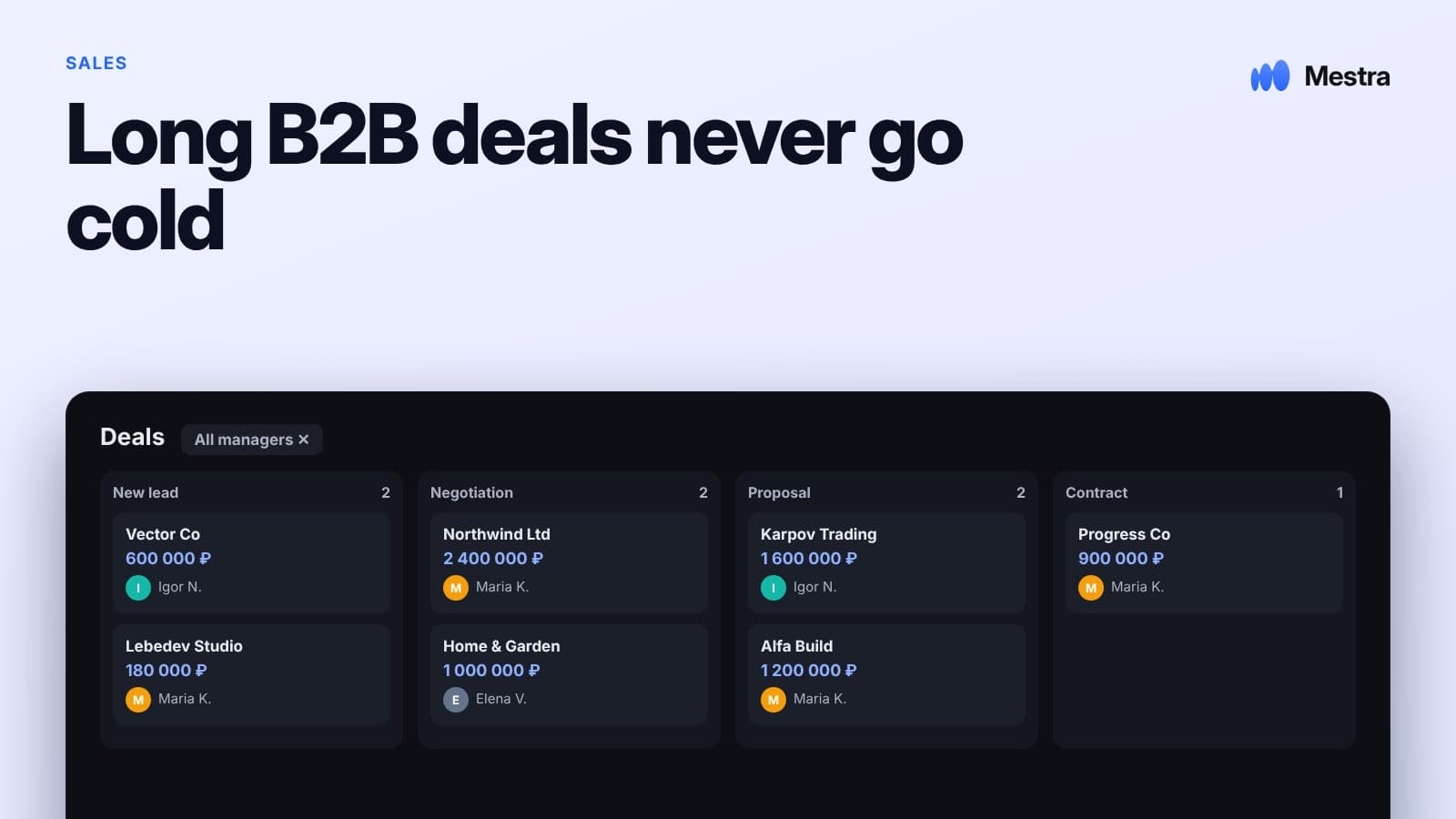
| Northwind LLC | 2,400,000 | 30% | 30% | A |
| Karpov (sole proprietor) | 1,600,000 | 20% | 50% | A |
| Alfa-Build LLC | 1,200,000 | 15% | 65% | A |
| Home & Garden LLC | 1,000,000 | 12.5% | 77.5% | A |
| Vector LLC | 600,000 | 7.5% | 85% | B |
| The other 40 clients | 1,200,000 | 15% | 100% | B/C |
Not just revenue: XYZ and margin
ABC analysis shows volume, but not the whole picture. Supplement it with:
| Criterion | What it shows |
|---|---|
| Regularity (XYZ) | Buys steadily or only now and then |
| Margin | How much the company really earns on the client |
| Potential | Whether the client could buy more |
| Payment discipline | Pays on time or with delays |
| Cost to serve | How much time and resources the client takes |
A client with high revenue but zero margin and constant payment delays is not necessarily a key client.
How to work with key clients
1. A responsible manager
Every key client has one owner who knows the whole history. The client shouldn't have to explain everything again to a new person every time.
2. A client card with the full history
All conversations, agreements, invoices and the contacts of everyone on the client's side — in one place. If the owner is on vacation, a colleague picks up without losses.
3. An account plan
| What | Example |
|---|---|
| Goal for the year | Increase purchase volume by 20%, connect a second branch |
| Regular contact | A call once a month, a meeting once a quarter |
| Additional offers | A service contract, new catalog items |
| Risks | A new buyer at the client, a competitor offering a discount |
4. Speed and priority
Messages from key clients get priority. A good practice is a separate tag that makes them visible in the general flow.
5. Regular satisfaction checks
Not only when something has happened. A short question once a quarter: "What should we do better?"
Signs a key client may leave
| Signal | Where you see it |
|---|---|
| Orders became less frequent or smaller | Payment history |
| The contact person changed | Conversation, a new person on the other end |
| The tone got colder, replies got shorter | Conversation |
| The client asks for documents to compare | Requests for proposals and price lists |
| Recurring complaints | Complaints, tasks |
| Payment delays | Invoices |
Key clients rarely leave with a complaint — more often they simply start ordering less. More in the article on client retention.
How to grow group B clients
Group B clients are the main reserve for growth. Many of them can become key clients:
- offer additional products and services for their needs;
- find out who else they buy from what they could be buying from you;
- offer terms for volume or regularity.
More in the article on upselling.
Quarterly meeting with a key client
Once a quarter, hold a conversation not about the current order but about the relationship as a whole.
| Block | Questions |
|---|---|
| Results | What worked this quarter, what problems there were |
| Satisfaction | What they like, what we should do better |
| Client's plans | What the client's goals are for the next six months |
| New opportunities | What else we can do for the client |
| Agreements | Next steps with dates |
Meeting notes and agreements go into the client card and tasks. Then the next meeting starts by checking what was promised.
How to reduce dependence on a few clients
If one client provides more than 25–30% of revenue, losing them would hit the business hard. What to do:
- Grow group B. Mid-size clients are the main reserve.
- Widen your acquisition channels. More new clients from different sources.
- Strengthen the relationship with the key client at several levels. Not one contact, but several.
- A fixed-term contract. A long-term contract lowers the risk of a sudden departure.
More on segments in the article on client segmentation.
Common mistakes
- Not knowing who your key clients are. The company doesn't notice its dependence on a few clients.
- Serving everyone the same. Key clients get the same service as one-off buyers.
- Contacting them only when there's a problem. The client hears from the company only when it's time to pay.
- A single contact at the client. That person leaves the client's company — the connection is lost.
- Too much dependence. One client provides 40% of revenue — that is a risk to the business.

Worked example: what losing one key client costs
A hypothetical example. Company revenue is 8,000,000 ₽ a year, margin is 25%. The client Northwind brings in 2,400,000 ₽ (30%).
| Indicator | Value |
|---|---|
| Revenue from the client per year | 2,400,000 ₽ |
| Profit from the client (25% margin) | 600,000 ₽ |
| Average new client: annual revenue | 120,000 ₽ |
| Average new client: profit (25%) | 30,000 ₽ |
| How many new clients to make up the profit | 600,000 ÷ 30,000 = 20 |
Twenty new clients means months of searching, advertising and negotiating. Keeping one key client takes one regular conversation a month and attention to signs of leaving. So in practice a company's resources should be distributed not equally but in favor of group A.
This conclusion is consistent with a well-known observation by Frederick Reichheld of Bain & Company: a 5% increase in client retention can raise profit by 25–95%, depending on the industry. The exact figure is different for every company, but the direction is the same: retention is cheaper than acquisition.
30-day plan
| Week | What to do |
|---|---|
| 1 | Export clients and payments for 12 months, run an ABC analysis, identify group A |
| 2 | Assign an owner to every group A client, add a "key" tag |
| 3 | Draw up a yearly plan for each: goal, contact rhythm, risks |
| 4 | Hold the first quarterly meetings, set up reminders for silence longer than 30 days |
In a month you'll have not just a list but a system: who is responsible, when the next contact is and which signal counts as alarming.
How it works in Mestra
In Mestra, key clients are visible and under control:
- Payment history. The client card shows all invoices and payments; you can see how much the client has brought in and how order frequency is changing.
- Tags and segments. You can mark key clients with a tag and filter for them in the Clients list.
- Client owner. The client and their chats are assigned to a specific rep; during vacation they are passed to a colleague with the history.
- Client connections. Everyone on the client's side is linked to the card — the connection isn't lost when the contact person changes.
- AI notices dissatisfaction. Signs of dissatisfaction in conversations are flagged and visible to the manager.
- Picking additional offers. AI selects suitable products and services from the catalog for the client's request.
Frequently asked questions
How do I identify key clients?
Run an ABC analysis by revenue over 6–12 months and supplement it with margin, purchase regularity and growth potential.
How many key clients should there be?
Usually about 20% of the base, bringing in 60–80% of revenue. If fewer than five clients provide more than half of revenue, that is a dependence risk.
How is working with key clients different from regular work?
By a responsible manager, an account plan, regular contact, priority in replies and early tracking of the risks of leaving.
How often should I run an ABC analysis?
Once a quarter or every six months: clients move between groups, and the approach to them should change.
How can I tell a key client is about to leave?
By falling order frequency and volume, a change of contact person, a cold tone in conversations, payment delays and requests for documents to compare.
Summary
Key clients are the foundation of stable revenue. ABC analysis helps find them, and a responsible manager, the full history, an account plan and attention to signs of leaving help keep and grow them.
In Mestra, payment history, tags, client connections, the responsible manager and dissatisfaction signals are collected in the card, so key clients are always under control. Try Mestra free for 15 days at mestra.chat.