How to raise prices without losing clients: the math, timing and client messages
Sales12 min read
How to raise prices without losing clients: when to do it, how to calculate acceptable churn, how to warn clients, sample messages and replies to objections.

Raising prices without losing clients means increasing your prices so that company profit grows and most clients stay. An owner's main fear is a mass exodus of clients. In practice, with an honest explanation, advance notice and good service, few leave.
In this article: Signs it's time to raise prices · How to calculate how many clients you can lose · Price increase strategies · How to tell clients about a price increase · How to answer objections · Raising prices through value · After the increase: what to track · Raising prices for B2B clients · Why you can't put off raising prices forever · Common mistakes · Worked example: how many clients you can lose · 30-day plan
Raising prices in a minute
| Step | What we do |
|---|---|
| 1 | Check the signs that it's time to raise prices |
| 2 | Calculate margin and acceptable client churn |
| 3 | Choose a strategy: for everyone, for new clients, by segment |
| 4 | Prepare the explanation and message texts |
| 5 | Warn regular clients in advance |
| 6 | Train sales reps to handle objections |
| 7 | Track the reaction and churn |
Signs it's time to raise prices
- Costs have gone up but prices haven't. Rent, salaries and purchasing get more expensive every year.
- Margin is falling. Revenue is growing, profit is not.
- Clients don't haggle. If almost nobody says "too expensive", your price may be below the market.
- Capacity is maxed out. The team can't keep up, and the queue of clients is growing.
- Prices haven't changed in over a year. Once inflation is counted, the company is effectively getting cheaper.
- Competitors have already raised theirs. Your price list is now noticeably below the market.
How to calculate how many clients you can lose
The key calculation before a raise: what share of clients can you lose without profit falling.
Formula: acceptable churn = price increase / (current margin + price increase).
| Current margin | Price increase | Clients you can lose without losing profit |
|---|---|---|
| 30% | 10% | 25% |
| 30% | 15% | 33% |
| 20% | 10% | 33% |
| 40% | 10% | 20% |
Example: margin of 30%, prices go up by 10%. Even if a quarter of clients leave, profit stays the same — and there is less work to do. In practice far fewer leave.
Price increase strategies
| Strategy | How it works | When it fits |
|---|---|---|
| For everyone at once | New prices from a single date | A small increase, rising costs across the whole market |
| Only for new clients | Regular clients stay on the old price for a while | Regular clients are strongly attached |
| In stages | Two or three small increases | A large overall increase |
| By segment | Different changes for different groups | Clients and services have different margins |
| Through packages | New plans with different contents | Clients value choice |
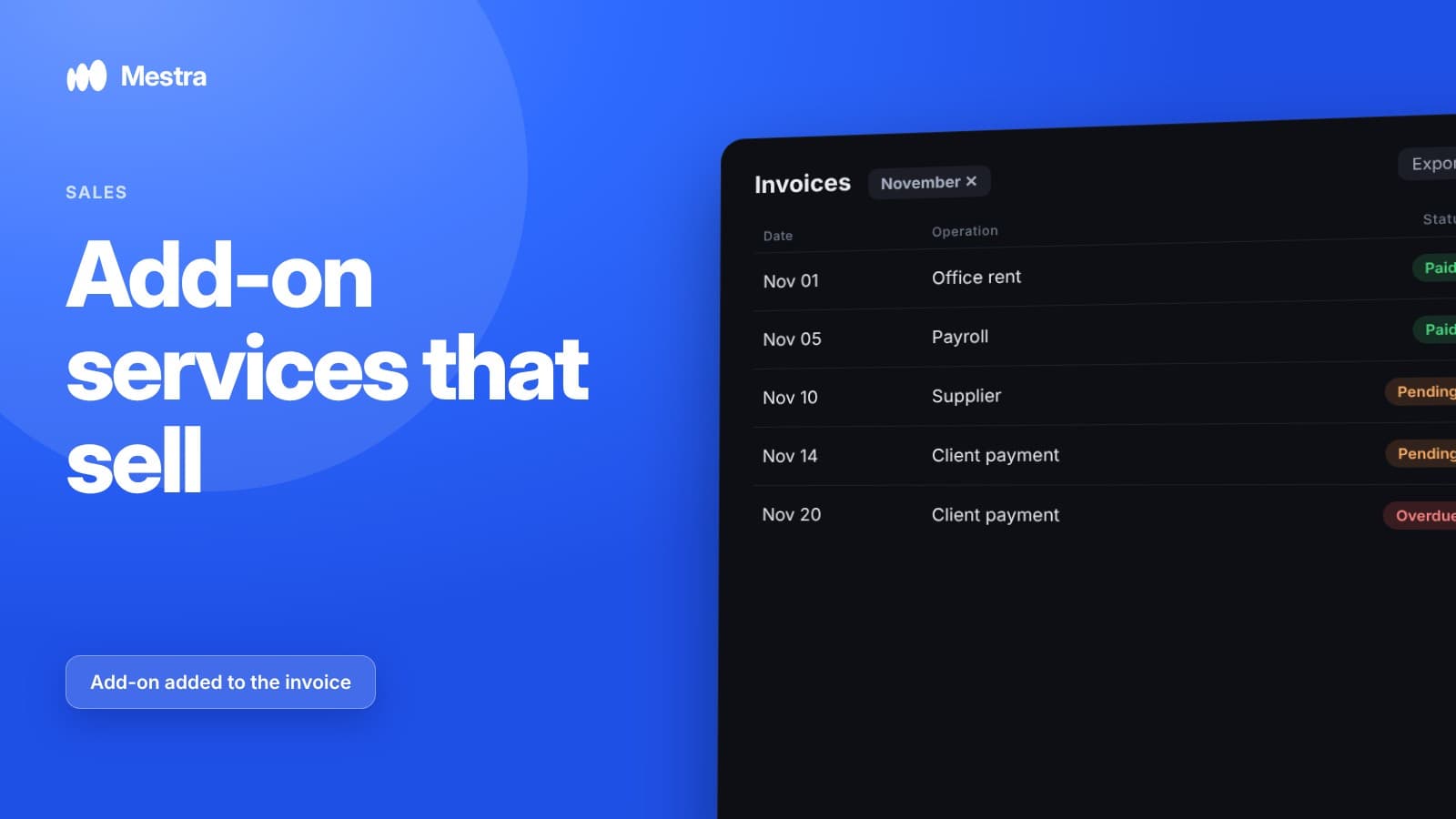
| Through add-on services | Base price stays the same, paid options are separate | There are services that used to be given for free |
How to tell clients about a price increase
Timing
- regular and key clients — 2–4 weeks ahead, in person;
- other clients — 1–2 weeks ahead, by mailing;
- new clients — new prices right away.
What to say
- The reason. Honest and brief: rising costs, better service, new features.
- Date and amount. Be specific: "From December 1, the service fee will be 12,500 ₽ instead of 11,000 ₽."
- What the client gets. What stays unchanged and what has improved.
- An option. For example, locking in the old price if they pay before a certain date.
Sample message for a messenger
Hello, Marina! We want to give you advance notice: from December 1, the monthly service fee will be 12,500 ₽ instead of 11,000 ₽. We haven't changed prices for the last year and a half, even though the cost of specialists and materials has gone up noticeably. Everything included in the service now stays — and from December we are adding priority same-day visits. If you pay for the next three months before November 30, we'll keep the current price. If you have any questions, write to us and we'll talk it through.
How to answer objections
| Objection | How to answer |
|---|---|
| "That's expensive" | Remind them what the service includes and show the result the client has already received |
| "Competitors are cheaper" | Compare not the price but what is included: timing, warranty, quality |
| "We've been with you for a long time, why us too?" | Thank them for their trust, offer to lock the price for a period or a bonus |
| "Then we'll leave" | Ask what exactly bothers them; offer a simpler package if you have one |
| "Why so much?" | Explain the cost structure and compare with what the same thing costs on the market |
It is important for reps to know the boundary in advance: what they can agree to themselves and what the manager decides. If the boundary isn't defined, a price increase turns into a series of individual discounts.
Raising prices through value
It is often easier to raise a price if the client gets something new at the same time:
- Selection matched to the request. The client gets several suitable options instead of one.
- Speed. A reply within 15 minutes in any messenger.
- Convenience. The invoice arrives right in the chat, and payment takes a couple of clicks.
- Add-on services. Support, document checks, warranty service.
If such improvements already exist, mention them in the message about new prices. How to increase the average check through additional offers is covered in the article on upselling.
After the increase: what to track
| Indicator | Period | What a rise or fall means |
|---|---|---|
| Churn of regular clients | 1–3 months | The real reaction to the increase |
| Conversion of new leads | 1 month | Whether the new prices became a barrier |
| Average check | 1–3 months | The effect of the increase |
| Number of discounts | 1 month | Whether the increase turned into haggling |
| "Too expensive" refusal reasons | 1–3 months | Where the price became a problem |
If churn is higher than calculated, look at which clients left: the problem may be in a specific segment or in how reps announced the new prices.
Raising prices for B2B clients
With business clients things are a little different: prices are often fixed in the contract, and the decision about the new budget is made by someone other than the person your rep talks to.
- Check the contract. If the price is fixed for a year, an increase is possible only with a new period or through an addendum.
- Take the client's budget cycle into account. Many companies approve next year's budget in the autumn — it is better to announce new prices before that.
- Prepare a justification for the client's management. Your contact has to explain the increase to their boss — give them a short document with the reasons and a comparison with the market.
- Offer options. Keep the price in exchange for a larger volume or a longer contract term, or choose a package with different contents.
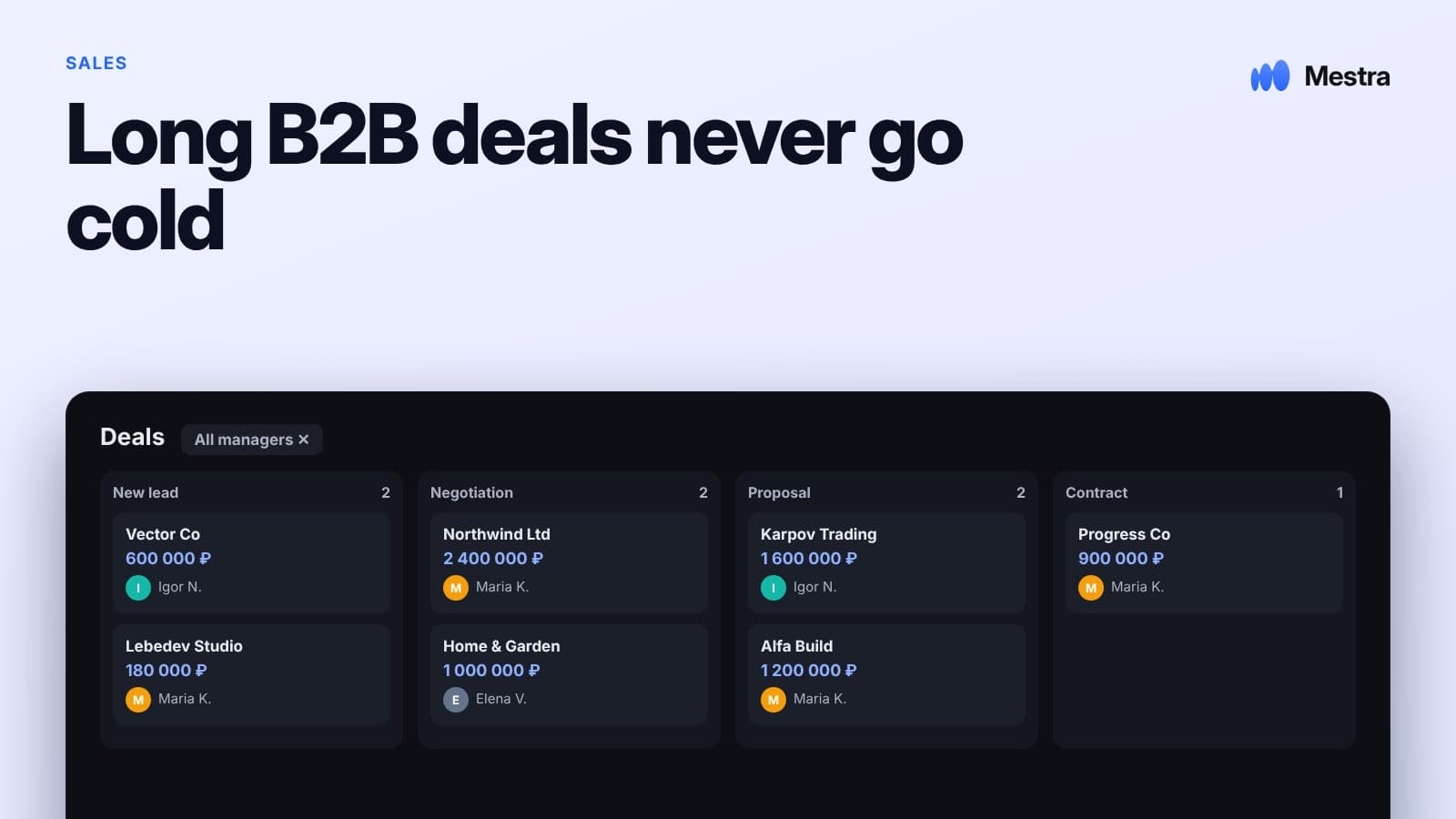
More on working with long deals is in the article on long B2B deals.
Why you can't put off raising prices forever
Every year without a raise while costs rise is an effective price cut. Example: if costs grow 8% a year and the price stays put, then in three years a 30% margin turns into roughly 12%. To get it back you would have to raise prices by 25% or more at once, and that would be much more painful for clients. On how to work on costs at the same time, see the article on how to cut costs.
Common mistakes
- Raising quietly. The client finds out from the invoice and feels cheated.
- Apologizing for the increase. Uncertainty rubs off on the client and invites haggling.
- Too rarely and too much at once. A 30% increase every three years is received worse than 8–10% every year.
- Not preparing reps. Each explains it their own way and gives discounts.
- Not tracking churn. The company doesn't know whether the increase worked.

Worked example: how many clients you can lose
Acceptable client loss is calculated with the formula: price increase ÷ (price increase + margin). Both price and margin are in percent.
A hypothetical example: a studio with 100 clients, an average check of 5,000 ₽ and a margin of 40%. Prices go up by 8%.
- Acceptable loss: 8 ÷ (8 + 40) = 16.7% of clients.
- Before the increase: 100 clients × 5,000 ₽ × 40% = 200,000 ₽ of margin.
- After, if 10 clients leave: 90 × 5,400 ₽ × (margin has grown: (5,400 − 3,000) ÷ 5,400 = 44.4%) = 216,000 ₽.
Even with ten clients lost, profit went up. The break-even point is about 17 departed clients, and, as a rule, real churn after a careful increase is noticeably lower.
| Price increase | Margin 20% | Margin 40% | Margin 60% |
|---|---|---|---|
| +5% | 20% | 11% | 8% |
| +10% | 33% | 20% | 14% |
| +15% | 43% | 27% | 20% |
The table shows the maximum share of clients you can lose without reducing profit. The lower the margin, the more a price increase gains you.
This effect has long been described in consulting literature: according to calculations by Michael Marn and Robert Rosiello (McKinsey, Harvard Business Review, 1992), a 1% price increase with unchanged volumes produced on average about an 8% rise in operating profit. The figure will differ for your industry, but the principle is the same.
30-day plan
| Week | What to do |
|---|---|
| 1 | Calculate margin by product and acceptable client loss |
| 2 | Split clients into segments, decide who gets the raise right away and who later |
| 3 | Prepare the letter, replies to objections and a list of exceptions |
| 4 | Send notifications 2–4 weeks ahead, track refusals and their reasons |
How it works in Mestra
In Mestra, a price increase is easier to carry out and to monitor:
- Products and services with prices. A catalog with prices in one place; new prices flow straight into invoices and selections.
- Selection matched to the client's request. AI picks suitable products, services or properties from the catalog — the rep offers options, not a single item at the new price.
- Messenger messages. You can warn regular clients right from their chats in the shared window, with the conversation history at hand.
- Invoice from the chat. The client gets an invoice at the new prices within a couple of minutes; AI puts it together from the name of the product or service.
- Refusal reasons. If a client leaves, the reason is recorded; the share of "too expensive" is visible in analytics.
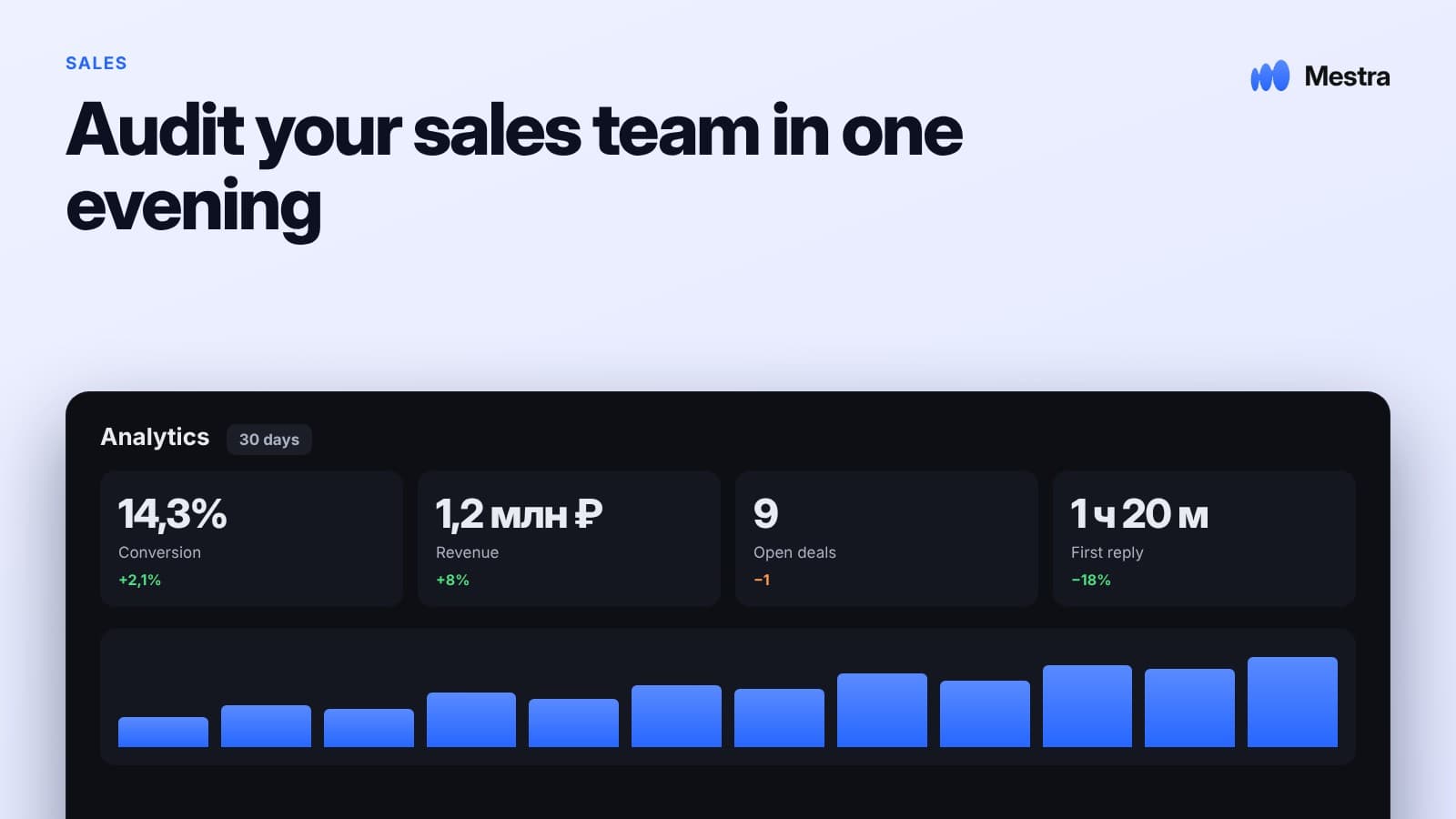
- Analytics. Average check, conversion and churn before and after the increase are in the reports; income and expenses are in the profit and loss statement.
Frequently asked questions
How often can I raise prices?
Usually once a year, in small steps. A regular 5–10% increase is received more calmly than a rare, sharp one.
How do I tell clients about a price increase?
In advance, in person for key clients, with a specific date, amount and reason. It helps if the client gets something useful along with the new price, or a chance to lock in the old one.
How many clients will leave after a price increase?
Usually fewer than expected. You can calculate acceptable churn with the formula: price increase / (current margin + price increase).
Can I raise prices only for new clients?
Yes, it is a soft strategy: regular clients keep the old price for a while, new ones pay the new price right away.
What should I do if a client insists on keeping the old price?
Find out what matters to them, and offer a simpler package, a price lock with prepayment or a bonus. Decisions about exceptions should be made by the manager, not by each rep individually.
Summary
You can raise prices without a mass loss of clients: calculate acceptable churn, choose a strategy, warn regular clients early and honestly, prepare reps and track the reaction. A raise is easier to accept when value grows along with the price.
In Mestra, the catalog with prices, selections matched to a request, invoices from the chat, refusal reasons and analytics are all in one system — so new prices are easy to roll out and monitor. Try Mestra free for 15 days at mestra.chat.