Warehouse Stocktaking: Procedure, Documents and Common Mistakes
Warehouse and goods6 min read
How to run a stocktake under Russian standard FSBU 28/2023: when it's mandatory, who sits on the commission, count sheets and comparison reports, shortages and surpluses.

A stocktake checks whether you can trust your records. A commission counts the goods, writes the result in a count sheet, compares it with the system's data, and posts any shortages and surpluses to the books while finding out where they came from.
Example: a home textiles warehouse
Myagky Dom has a warehouse outside Moscow with 800 items of throws, cushions and towels. In summer the storekeeper changed; in autumn the marketplace cancelled several orders as "out of stock" even though the records showed the goods. The director decides on a full count. Let's see how to do it by the rules.
When a count is mandatory
Organisations follow FSBU 28/2023, approved by Ministry of Finance Order No. 4n. The standard requires a count in these cases:
| Trigger | What is counted |
|---|---|
| Preparing annual financial statements | All assets and liabilities |
| A new storekeeper or other financially responsible person | The items they were responsible for |
| Theft, abuse, spoilage | What was affected |
| Fire, accident, natural disaster | The affected property |
| Reorganisation or liquidation | Everything |
Any other counts — how many and when — the company sets itself in its accounting policy. A sole trader who doesn't keep accounting records doesn't apply the standard, but counting stock still pays off: otherwise paper profit won't match the money in the account.
Who counts
Myagky Dom's director issues an order appointing the commission. The storekeeper is present during the count but cannot sit on the commission — the standard says so. Before it starts, they sign a statement that all receipt and issue documents have been handed in and there are no unrecorded transactions.
How to run it: 7 steps
- An order — the commission's members, scope of the check, dates.
- A pause in stock movement. During the count the warehouse neither receives nor ships, or all movement is recorded on a separate list.
- The storekeeper's statement about documents handed in.
- Count by storage location — rack by rack, item by item.
- Count sheet — actual quantities are recorded and signed by the commission and the storekeeper.
- Comparison with the records — discrepancies go into the comparison report.
- Decision — causes, accounting entries, stock adjustment.
The INV-3 and INV-19 forms are still convenient but not mandatory: a company may approve its own forms as long as they contain the required details of a primary document.
What to do with discrepancies
| What you found | How to record it | What to find out |
|---|---|---|
| More stock than in the records | Recognise at market value as other income | Was a delivery left unposted, is there mis-grading? |
| Shortage within natural loss limits | Write off as an expense | Are the limits approved? |
| Shortage above the limits, culprit known | Recover from them | Written explanation, report |
| Shortage above the limits, no culprit | Write off as other expenses | Where is the weak spot in the process? |
Mis-grading is a separate story: more of one SKU, less of a similar one. That's exactly what happened at Myagky Dom: beige and cream throws were mixed up at receiving.
One-minute calculation: what discrepancies cost
If a warehouse has 800 items with an average cost of 600 ₽, and 2% of them differ from the records by an average of three units, that's 16 × 3 × 600 = 28,800 ₽ "up in the air". On top of that, the marketplace sees stock that isn't there and cancels orders — which means penalties and the listing dropping in search.
How to make the next count faster
- Location-based storage — every item has its own place, and it's recorded in the system.
- A barcode scanner instead of counting by name.
- Cycle counting — part of the range is checked every week, starting with expensive and fast-moving items.
- A movement log — receipts, issues and transfers are recorded immediately.
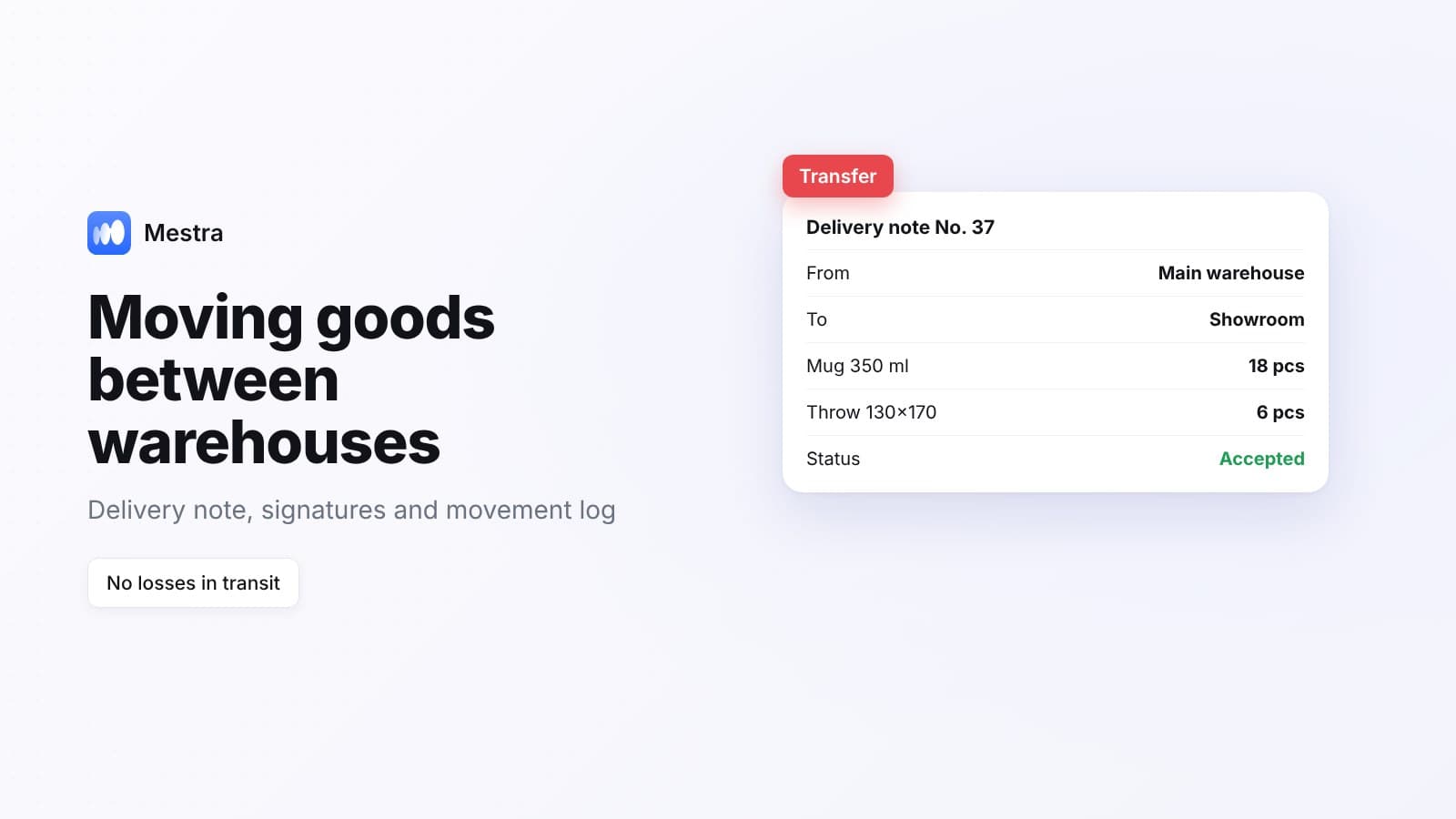
- Transfers only with a document. How this works is covered in moving goods between warehouses.
How it works in Mestra
In Mestra, stock is kept for each warehouse and storage location, and every movement — receipt, write-off, transfer — goes into a log with the date and the employee. When a discrepancy turns up, you can see at which stage it appeared.

- Multiple warehouses, including franchise locations.
- Movement history for every item.
- "Move stock" — transfers between warehouses without spreadsheets.
- Finance — write-offs and purchases appear in the profit and loss report.
FAQ
How often should stock be counted?
A full count at least once a year before the annual statements if you're an organisation. Partial counts of fast-moving and expensive items weekly or monthly, depending on turnover.
Does a sole trader have to do stocktaking?
A sole trader without accounting records doesn't apply FSBU 28/2023. But for management accounting and working with marketplaces, counting is still necessary.
Can I count without closing the warehouse?
Yes, if movement during the count is recorded separately or you count zone by zone. A small warehouse is easier to count outside working hours.
What if the storekeeper disagrees with a shortage?
They can set out their position in writing in the count sheet or report. Recovering losses from an employee is governed by the Labour Code and the liability agreement.
Bottom line
A count under FSBU 28/2023 means an order, a commission without the financially responsible person, a count sheet, comparison with the records and a decision on every discrepancy. The tidier your movement log during the year, the calmer the stocktake. How to link the warehouse with sales is covered in order tracking.
Mestra — 15 days free, no bank card required: set up your warehouses, import your stock and compare it with what's actually there.
Sources: FSBU 28/2023 "Inventory" (Order of the Ministry of Finance of Russia No. 4n of 13.01.2023), Federal Law No. 402-FZ "On Accounting".