Cold Calling: How to Call, What to Say and What the Law Prohibits
Sales6 min read
How to make cold calls in 2026: building the list, a call script, handling objections, metrics and the legal limits in Russia: prior consent and call labelling.

A cold call is a call to a potential client who wasn't expecting contact. To work, it needs an accurate list, a reason that matters to that particular client, a short script and one clear goal — agreeing on the next step.
What the law says
| Rule | What it means for business |
|---|---|
| Part 1 of Article 18 of the Law on Advertising | Telephone advertising is allowed only with the subscriber's prior consent. The caller must prove consent |
| Call labelling from September 2025 | Mass calls by organisations and sole traders must go through a contract with an operator and be labelled |
| Opting out of mass calls | A subscriber can opt out with their operator or via a self-ban on Gosuslugi (the state services portal) |
| Personal Data Law | Private individuals' numbers bought from dubious databases risk breaching Federal Law 152-FZ |
An individual business call to a specific company with an offer tailored to its needs and a mass call campaign using a purchased list are different situations. If you plan high-volume calling, check the scenario with a lawyer.
When cold calls work
- B2B sales with a high average ticket: equipment, services for companies, supplies.
- A short list of companies that could definitely be clients.
- There's a reason: a new branch, a tender, expansion, the season.
- The caller understands the client's tasks rather than reading a script.
Preparation: 4 steps before the call
- Describe your ideal client. Industry, size, region, signs of need.
- Build the list. Companies' public contacts, websites, industry directories. Check the companies before calling — how to do it is in how to check a counterparty.
- Find a reason. What has changed at the company and why your call is relevant now.
- Set the goal. Just one: a meeting, a demo, an estimate, a trial.
Cold call script
1. Greeting and introduction (10 seconds). "Good afternoon, is that Andrey? My name is Maria from Svet-Proekt. We design lighting for warehouses."
2. Reason for calling (15 seconds). "I saw you're opening a second warehouse in Podolsk. That's usually when lighting gets chosen, and we help cut electricity costs."
3. A question, not a pitch. "Have you already chosen a lighting contractor, or are you still looking?"
4. Propose the next step. "I suggest a 20-minute meeting: I'll show you an estimate for a warehouse your size. Would Thursday or Friday suit you better?"
5. Confirm. "I'll send an invitation to your email and my number to your messenger. See you Thursday at 11:00."
Handling objections
| Objection | How to respond |
|---|---|
| "We don't need anything" | "I understand. May I ask how you currently handle…? If you're happy with it, I won't take up your time" |
| "Send a proposal by email" | "Of course. To make it useful, let me check two things: …" |
| "Too expensive" | "Shall we compare the numbers? In 20 minutes I'll show you the payback calculation" |
| "No time" | "When would be better to call back — tomorrow morning or Wednesday?" |
| "We already have a supplier" | "That's normal. Many of our clients compared terms — let me show you where the difference is" |
More techniques in sales techniques.
Cold calling metrics
| Metric | How to calculate |
|---|---|
| Connection rate | Conversations ÷ dials |
| Reaching the decision-maker | Conversations with the decision-maker ÷ all conversations |
| Conversion to meeting | Meetings booked ÷ conversations with the decision-maker |
| Conversion to deal | Deals ÷ meetings |
One-minute calculation
A manager makes 60 dials a day. A 40% connection rate gives 24 conversations. Half are with the decision-maker — 12. Meetings are booked 15% of the time — about 2 meetings a day, 40 a month. If 20% of meetings become deals at an average ticket of 150,000 ₽, that's 8 deals and 1.2M ₽ of revenue a month from one manager.
Common mistakes
- Reading a script without pauses or questions.
- Trying to sell on the first call.
- Calling with no reason and no knowledge of the client.
- Not recording the outcome — a week later nobody remembers what was agreed.
- Not calling back: most deals close after several touches.
How it works in Mestra
In Mestra every contact is a client card with its communication history, tasks and files. After a call, the manager creates a "Call back" or "Meeting" task with a date and an owner, and the meeting goes into the calendar with a reminder and a Google Meet or Yandex Telemost link. The Pro plan includes integration with UIS and Mango IP telephony.

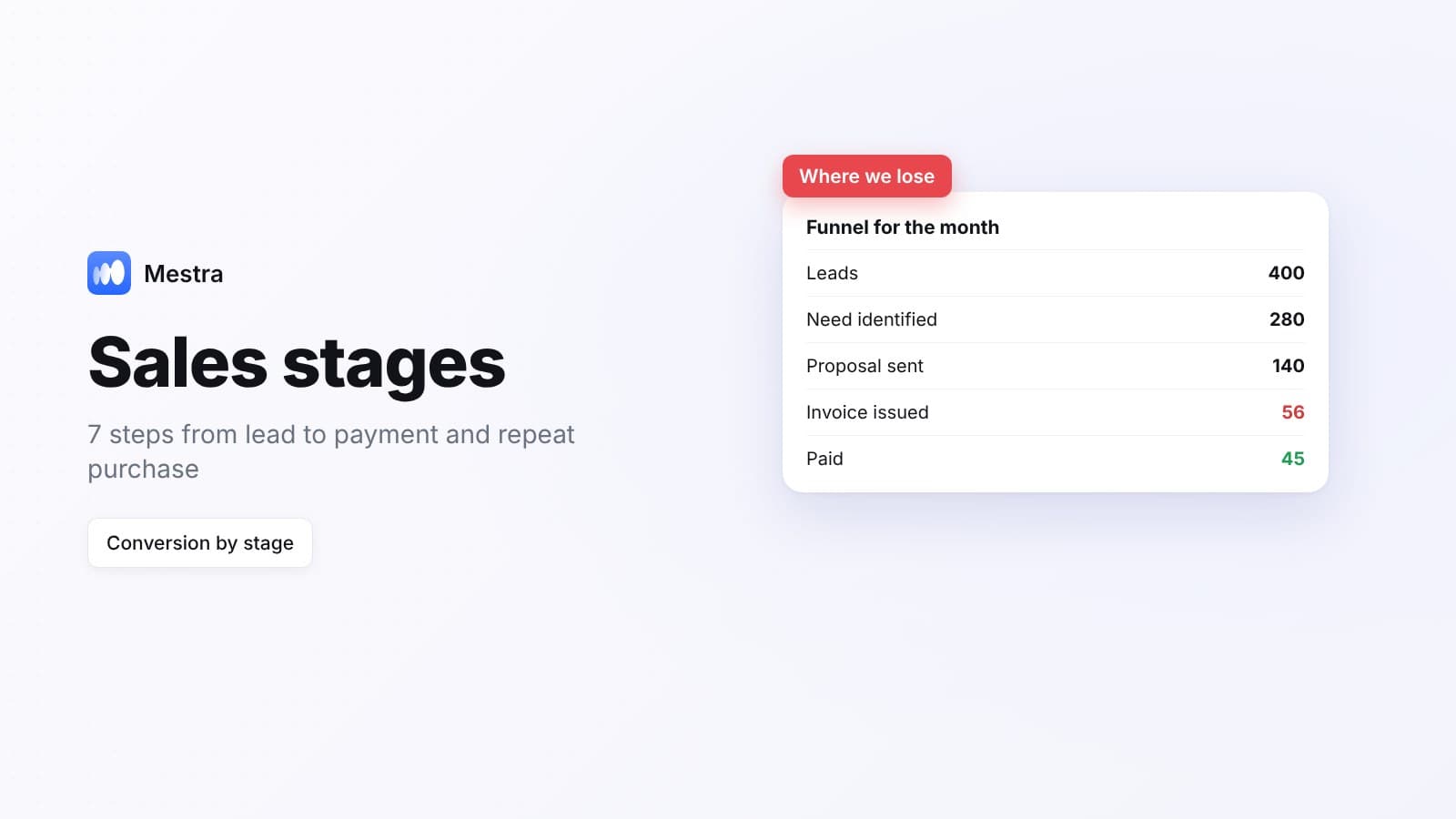
- Deal stages — from the first call to payment.
- Loss reasons — recorded when a deal is closed.
- Analytics — conversion by employee and by stage.
Related reading: IP telephony for business.
FAQ
Are cold calls legal in 2026?
You can call, but in Russia telephone advertising without the subscriber's prior consent is banned by the Law on Advertising, and mass calls from companies must be labelled. In B2B, individual calls to companies with a specific business offer are safer.
How many calls a day should a manager make?
It depends on the deal cycle. In high-ticket B2B, preparation quality matters more: 40–60 dials a day from a well-researched list usually beat 150 without preparation.
How do I get past the receptionist?
Don't hide your purpose, but talk about the company's task: "I'm calling about lighting for your new warehouse — who handles that?"
What if the client asks me not to call?
Apologise, remove the number from your list and don't call again. Repeat calls after a refusal lead straight to a complaint.
Bottom line
Cold calling in 2026 is targeted work: a narrow list, a reason, a question instead of a pitch and one goal — the next step. Follow the advertising law and labelling rules, record the outcome of every conversation and track the funnel. How to build the path from call to payment is covered in sales stages.
Mestra — 15 days free, no bank card required: build your list, set call-back tasks and track conversion by stage.
Sources: Federal Law No. 38-FZ "On Advertising" (Art. 18), Federal Law No. 126-FZ "On Communications" (Art. 44), Federal Law No. 152-FZ "On Personal Data". This article is not legal advice.