AI Adoption in Business: Tasks, a 30-Day Plan and a Payback Calculation
Artificial intelligence5 min read
How to bring artificial intelligence into a business: which tasks to give AI, a 30-day plan, personal data, a payback calculation and typical mistakes.

Bringing AI into a business means handing artificial intelligence specific repetitive tasks: answering typical questions, preparing texts, processing leads and analysing data. The approach that works is "one task — pilot — metric — scale up", not buying a tool and hoping it finds its own use.
Which tasks to give AI
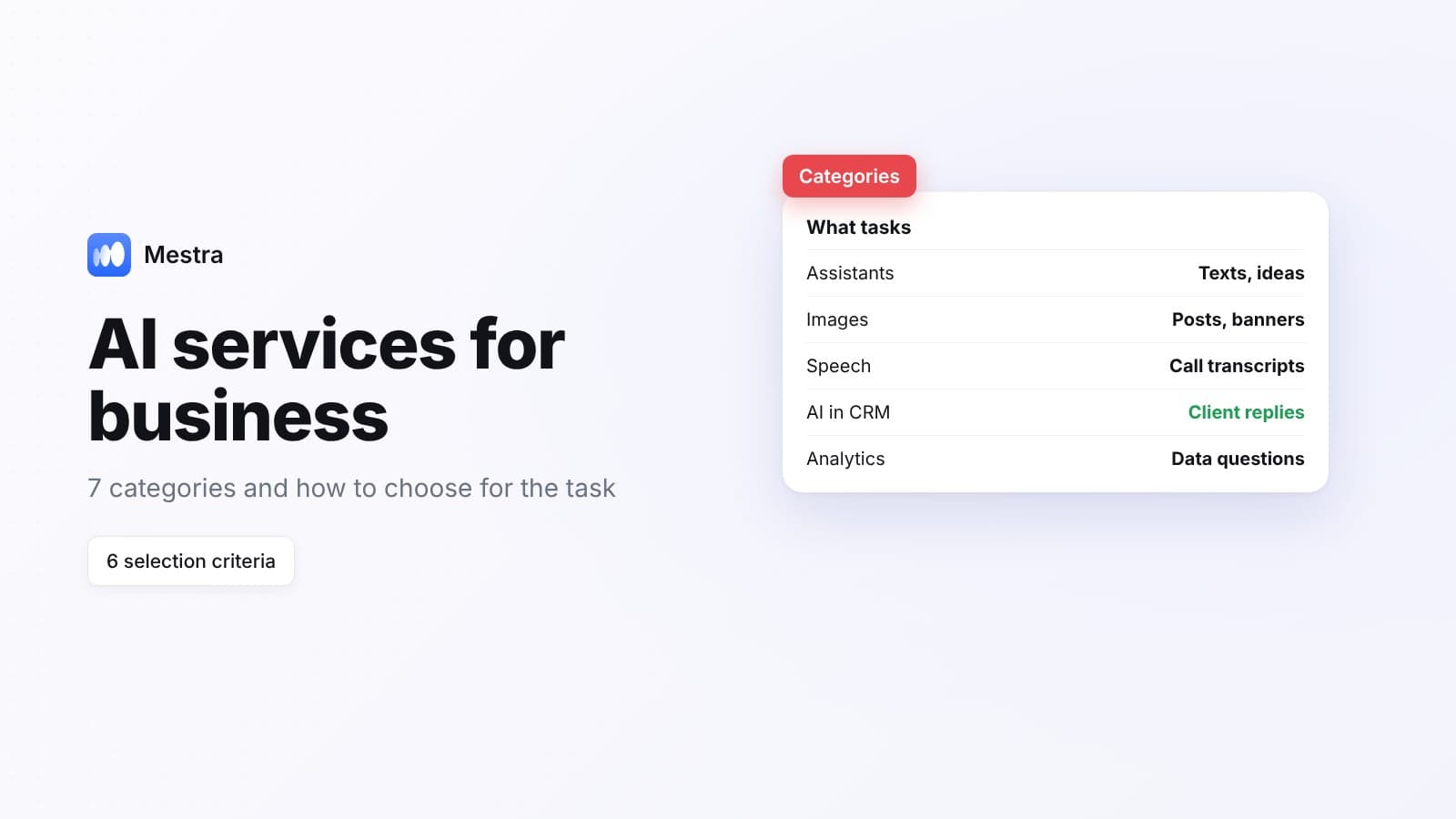
| Task | What AI does | Effect |
|---|---|---|
| Replying to clients | Answers typical questions about prices, timing, availability | Replies in seconds, including at night |
| Lead qualification | Clarifies the task, budget, timing; fills in the card | The manager gets ready context |
| Text drafts | Proposals, emails, product descriptions, posts | Hours saved per week |
| Hints for managers | Suggests a reply and the next step | Newcomers perform like experienced staff |
| Reports and summaries | Answers questions about data | The manager gets numbers without exports |
| Quality control | Reviews managers' replies, spots unhappy clients | Fewer losses |
| Documents | Extracts data from contracts and invoices | Less manual entry |
What not to hand over to AI entirely
- Decisions with legal and financial consequences without human review.
- Complex complaints and conflicts.
- Negotiating prices and individual terms.
- Medical and legal advice to clients.
A 30-day rollout plan
Week 1. Choose a process. Find a task with lots of repetition and a measurable result. Measure the current state: response time, number of requests, staff hours.
Week 2. Prepare the knowledge. Gather a base: prices, terms, answers to frequent questions, service descriptions. The quality of AI replies depends directly on this base.
Week 3. Pilot in suggestion mode. AI suggests replies, employees check and edit them. Note where it makes mistakes and add to the base.
Week 4. Partial automation. AI closes typical questions on its own and hands the rest to a person. Compare the metrics with week one.
One-minute calculation: payback
A company gets 1,500 requests a month, 60% of them typical questions. An employee spends 4 minutes on average on such a reply: 900 × 4 = 3,600 minutes, or 60 hours a month. At 500 ₽ an hour, that's 30,000 ₽. If AI handles two thirds of the typical questions, the saving is about 20,000 ₽ a month, plus out-of-hours replies that used to wait until morning.
Personal data and security
- Check where clients' data is processed and whether you have grounds to transfer it.
- Update your personal data processing policy if you connect a new service.
- Don't upload contracts, passport data or trade secrets to public chatbots.
- Limit AI's access to only the data needed for the task.
Common mistakes
- Rolling out "AI in general" with no specific task or metric.
- Not preparing a knowledge base — AI answers in generalities or makes mistakes.
- Switching on full automation straight away, skipping the suggestion stage.
- Not appointing someone to keep an eye on quality.
- Expecting AI to fix a process that doesn't exist: if leads get lost, first bring them into one window — more in omnichannel.
How it works in Mestra
The Mestra AI assistant is available from the Standard plan and works like a sales and support manager: it replies to clients in messengers, knows your products and services, creates clients and tasks, fills in the card from the chat and hands the conversation to a person when needed. Reply modes are "Auto", "Suggestions" and "Off", and the knowledge base can be extended with PDF files and your website.

- Business information from the settings is used by the AI in its replies.
- Reviewing managers' reply quality and an alert about an unhappy client.
- Questions about reports — the owner can message the Mestra bot in Telegram by text or voice.
FAQ
Where should a small company start with AI?
With the one process that eats the most time: usually answering typical client questions or preparing texts.
Will AI replace employees?
It takes over repetitive work. Employees get more time for complex tasks, sales and service.
How much does AI adoption cost?
Ready-made services cost from a few hundred to a few thousand rubles a month per user. The main cost is time spent preparing the knowledge base and running the pilot.
How do I know AI is doing a good job?
By the metrics: response time, share of requests closed without a human, client ratings, the number of mistakes that had to be corrected.
Bottom line
AI pays off where there's a lot of repetitive work with text and data. Choose one process, prepare a knowledge base, run a pilot in suggestion mode and move to automation based on the metrics. An overview of tools is in AI services for business.
Mestra — 15 days free, no bank card required: switch on the AI assistant in suggestion mode and see how many replies it prepares in a week.
Sources: Federal Law No. 152-FZ "On Personal Data"; figures in this article are illustrative.