Customer Service: Standards, Team and the Metrics That Keep Clients
Clients and service4 min read
How to build customer service: communication standards, response speed, handling complaints, a client database, NPS, SLA and repeat-purchase metrics. A step-by-step plan.

Customer service is a system that delivers an equally good experience to every client: fast replies, kept promises, solved problems and attention after the purchase. It's built through standards, request routing, a client database and metrics.
What service is made of
| Element | What it means in practice |
|---|---|
| Availability | The client can write in a convenient channel and get a reply |
| Speed | Minutes in messengers, hours by email |
| Competence | The employee solves the issue rather than passing it on |
| Predictability | Deadlines and prices are kept |
| Personalisation | The employee knows the client's history |
| Handling problems | A complaint is resolved quickly, with compensation if needed |
| After-sale care | Instructions, reminders, asking about the result |
Service standards: what to describe
- Time targets. First reply, resolution, callback. More in SLA: what it is.
- Tone. Formal or informal address, how to greet, which words not to use.
- Standard replies. Delivery times, payment, returns, warranty.
- Complaint procedure. Who responds, within what time, which compensations are allowed.
- Handover. How an employee passes a client to a colleague so the client doesn't repeat the question.
- After the purchase. When to ask for a review, when to remind about a repeat purchase.
Handling complaints: 5 steps
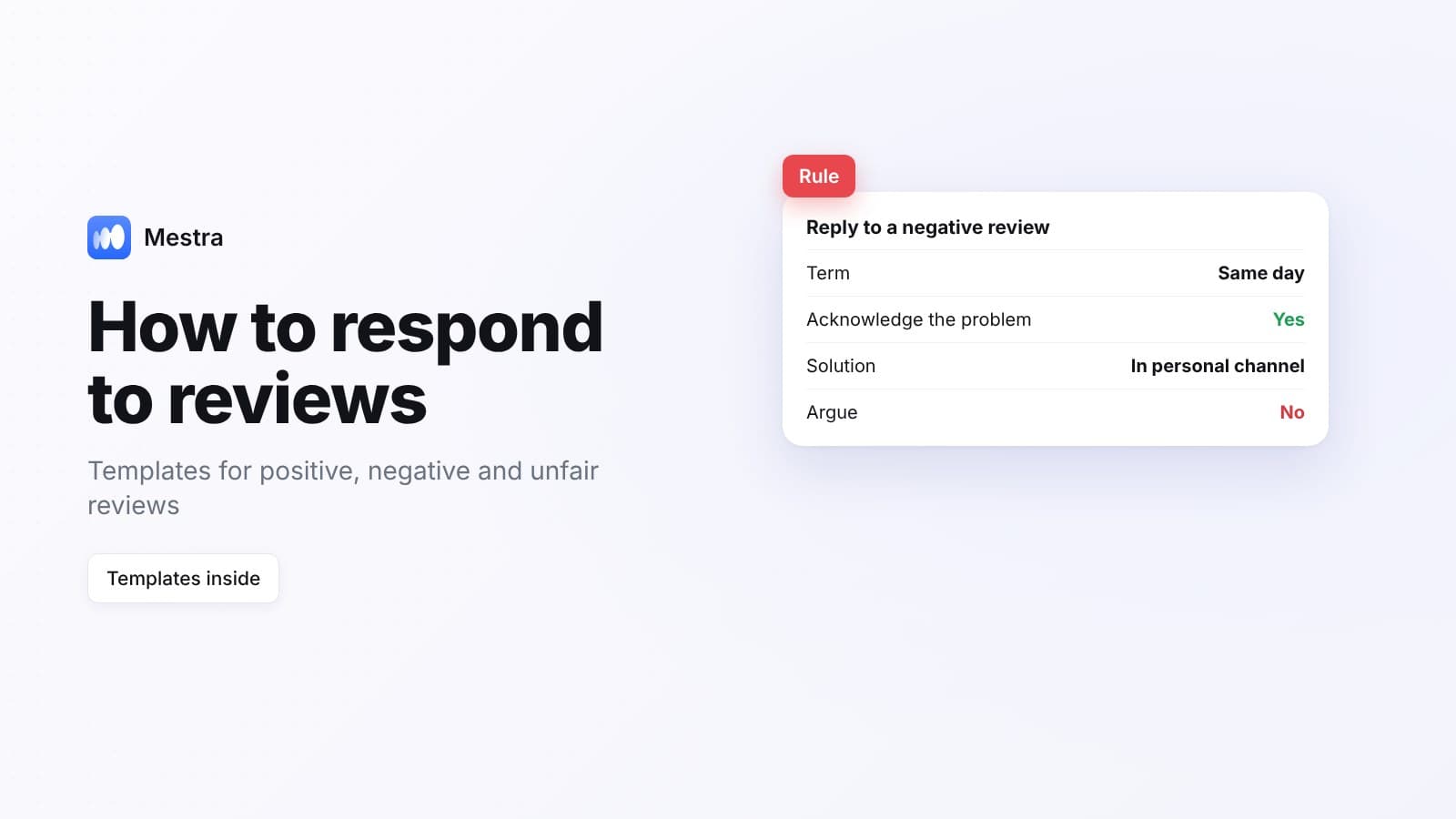
- Listen and don't argue.
- Acknowledge the problem and apologise for the inconvenience.
- Clarify the details and deadlines that matter to the client.
- Offer a solution — replacement, refund, discount, urgent fulfilment.
- Check the result a day or two later and record the reason for the complaint.
A client whose problem was solved quickly and humanely often becomes more loyal than one who never had a problem.
Service metrics
| Metric | What it shows |
|---|---|
| First response time | Speed of reaction |
| Share resolved on first contact | Employee competence |
| NPS | Willingness to recommend. More in NPS: what it is |
| Share of repeat purchases | Retention |
| Number of complaints and their reasons | Where the process breaks |
| Ratings and reviews on platforms | How other clients see your service |
One-minute calculation: the cost of losing a client
A company has 1,000 active clients, each bringing 24,000 ₽ a year on average. If poor service drives away 10% of clients a year, that's 2.4M ₽ of revenue. To replace them at an acquisition cost of 3,000 ₽ per client, you have to spend another 300,000 ₽ — not counting that new clients buy less than regulars.
How to improve service in a month
- Week 1. Bring all request channels into one window and measure response time.
- Week 2. Write standards and standard replies for the 10 most frequent questions.
- Week 3. Assign owners for channels and a handover procedure.
- Week 4. Launch an NPS survey and a weekly complaint review.
How it works in Mestra
Mestra brings requests from messengers and social media into one window, and every client has a card with the history of chats, orders and payments. The analytics dashboard shows "First reply and SLA", response time by employee, a chat activity heatmap and loss reasons.

- Client reviews in the employee profile.
- Tasks and mentions — bring a colleague into a difficult question.
- Business settings — company information the AI assistant uses.
FAQ
How is customer service different from support?
Support is part of service: answering questions and solving problems. Service is broader: it includes the sale, delivery, after-sale communication and everything that shapes the client's impression.
Where do I start improving service?
With measurement: how many requests, in which channels, how fast you reply. Then standards and owners.
How do I motivate employees to give good service?
Include response time, share of resolved requests and client reviews in their evaluation, not just sales volume.
Do I need a separate service department?
Not necessarily. At the start, salespeople and administrators handle service. A separate team is needed when order-related requests start to outnumber new leads.
Bottom line
Customer service is standards, speed and a client database, not polite words. Describe your targets, bring all requests into one window, review complaints and track the metrics. That's how service becomes the reason clients come back. How to handle public ratings is covered in how to respond to reviews.
Mestra — 15 days free, no bank card required: bring requests into one window and measure your team's response time.
Sources: customer service management practice; figures in this article are illustrative.